EuroCham Chairman has no doubt Viet Nam will materialize double-digit growth goal
VGP - By embracing bold reforms, innovation, and private-sector dynamism, Viet Nam is laying the groundwork for a new era of rapid and sustainable development, according to EuroCham Chairman Bruno Jaspaert.
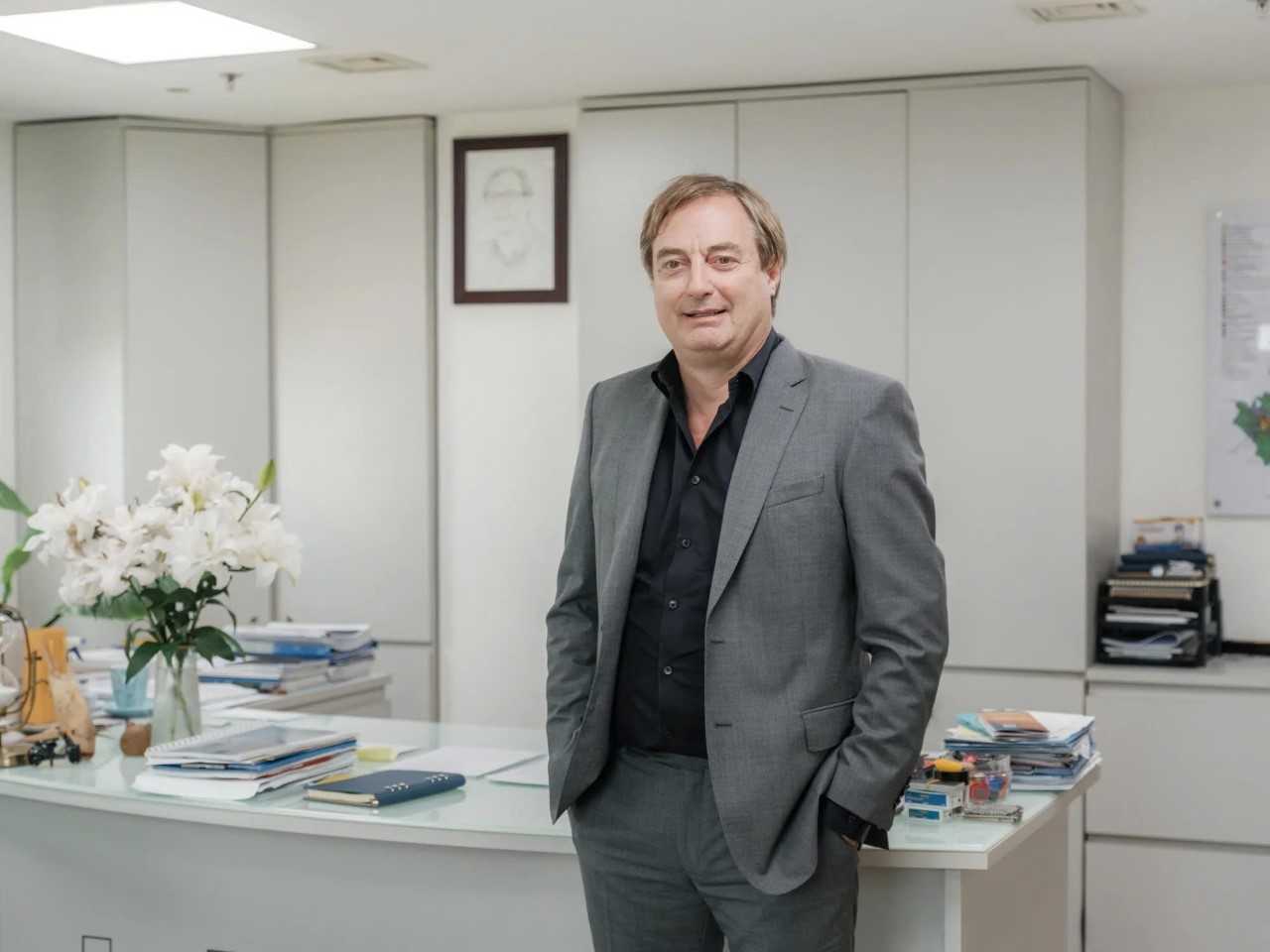
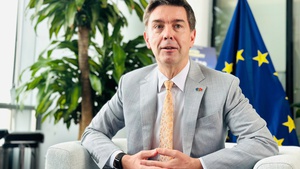
EuroCham Chairman Bruno Jaspaert
Editorial note: This is the second article of a series of three articles aimed at exploring how Viet Nam has prepared and what are the key factors for Viet Nam to achieve the double-digit growth goal.
Bruno Jaspaert made the above statement during an inverview with VGP about Viet Nam's ambitious target of achieving double-digit economic growth in the 2026-2030 period.
The target reflects a strong political determination to create a breakthrough in development and accelerate the country's journey toward becoming a high-income nation.
A 10 percent GDP growth target is an exceptional statement of political intent. But numbers on a balance sheet do not move on intentions alone. To achieve this double-digit momentum in a fractured global landscape, Viet Nam must transition rapidly from an investment model built on low costs to one built on total ecosystem efficiency.
The famous 10 percent growth target has been a major talking point at countless seminars recently.
Bruno Jaspaert said he has personally engaged in several debates with other investors and economists on this very topic. Personally, he said he has absolutely no doubts about it. "Soon enough, the coveted double-digit figure will materialise. I have learned that once Viet Nam sets its sights on a goal, no matter how ambitious it is, this country will move mountains to make it work," Bruno Jaspaert said.
Look at the monumental infrastructure investments cutting through cities and economic zones right now. Viet Nam is actively gearing itself up for large-scale projects that will entirely redefine its economic trajectory over the next five to seven years. If we look back at how China built itself up, they deployed an infrastructure driven FDI strategy: constructing massive roads, utilities, and connectivity networks years before the actual business communities arrived. Viet Nam is doing something far more complex: building infrastructure concurrently while seeking this growth in GDP and FDI. To do so it is pushing itself to pull off a once-in-a-lifetime national reinvention.
The prime golden era of this country is imminent, he said, adding that Eurocham is actively paving the road toward it today. This "era of rising" offers tremendous opportunities for companies to jump into the open arms of a government calling for sustainable, green capital. We cannot forget that Viet Nam does not just have an ambitious 10 percent growth target, it also has an equally if not more ambitious Net Zero target by 2050.
Looking back at global history, 10 percent growth is rare but not impossible. South Korea registered economic growth bursts of 12.5 percent between 1986 and 1988, while Singapore hit peaks of up to 13.9 percent in its booming decades from 1970s to1990s.
Both compressed centuries of development into decades by deploying intensive state-directed, export-oriented policies. Look what happened in post-war Europe: the wider war-torn Benelux region (including his home country Belgium) achieved an economic miracle in the mid-twentieth century by rapidly integrating their industrial infrastructure, developing coal mines, build nuclear plants and integrated steel mills. Yet, even during that golden era of reconstruction, our growth rates hovered just below that elusive double-digit threshold. This historical context shows just how monumental Viet Nam's 10 percent ambition truly is. But those were the days of the old world's order. Today, the world is changing fast, too fast, and we should accept that the old playbooks are obsolete.
What makes Viet Nam completely unique is its drive for speed. Only forty years ago, the country launched Doi Moi, opening itself to globalisation. Today, it is already charting up within the global value chain at an unprecedented pace. Viet Nam cannot simply copy the historical trajectories of its neighbours because it has a lot less time to achieve its conversion into a developed country. The next 7 to 10 years, it has managed itself into a truly unique position: it has the people, land and resources to become a FDI juggernaut.
The European business community is fully prepared to accompany Viet Nam on this exciting journey ahead. In fact, an overwhelming 93 percent of surveyed EuroCham members would actively recommend Viet Nam as an investment destination. That is as high as institutional confidence can get. It proves that the investors already active in this country fully trust, support, and are ready to further invest or expand in the Government's bold vision for economic growth.
Photo: VGP
Viet Nam's advantages to achieve breakthrough growth
Viet Nam has some intrinsic qualities that make it stand out globally, but the absolute most commendable is its resilience. The current geopolitical instability has resulted in the strange phenomenon that the (investment) decisions of companies are increasingly driven by risk. Or risk mitigation strategies. Quite frankly, the Vietnamese people manage risk like no one else on earth. Viet Nam is brilliant at moving at breakneck pace while still managing its diplomatic relations despite the global changes. Historically, this was framed around the concept of "bamboo diplomacy": flexible, strong, and deeply rooted. Today, while the vocabulary may evolve, the capability remains unmatched. This country adapts so quickly that by the time the outside world notices a regulatory shift, it has already been implemented on the ground.
Does that mean this country is running a completely flawless course? No, it does not. Does it mean the state is looking after its business ecosystem with increasing focus? I believe so, absolutely. Let us look at the raw data, because numbers do not lie. If you compare Q1 of last year, before the current wave of global tariffs and volatile oil prices took hold, GDP growth rate was 7.07 percent versus 7.83 percent in Q1 of 2026, Viet Nam's trade balance and industrial output numbers are actually outperforming previous records. Of course, a significant global macroeconomic crunch may still test international markets, but I remain a firm believer that the 10 percent breakthrough projected by the government is within reach.
This economic resilience is not accidental; it is driven by a unique willingness to align high-level political intent with grounded, functional policy execution. That exact agility formed the core of EuroCham's flagship Whitebook Dialogue Week in Ha Noi. Coming from Europe, Bruno Jaspaert told VGP that he can say candidly that coordinating a series of high-level, productive meetings with multiple ministries across a single week is a logistical feat. The openness and collaborative spirit shown by the Vietnamese Government to sit down with us, listen to our business realities, and hammer out practical alignments was remarkable. This level of active listening sends a powerful signal to global boardrooms that Viet Nam is actively co-authoring its next economic chapter with the private sector, transforming ambitions into concrete, long-term market velocity.
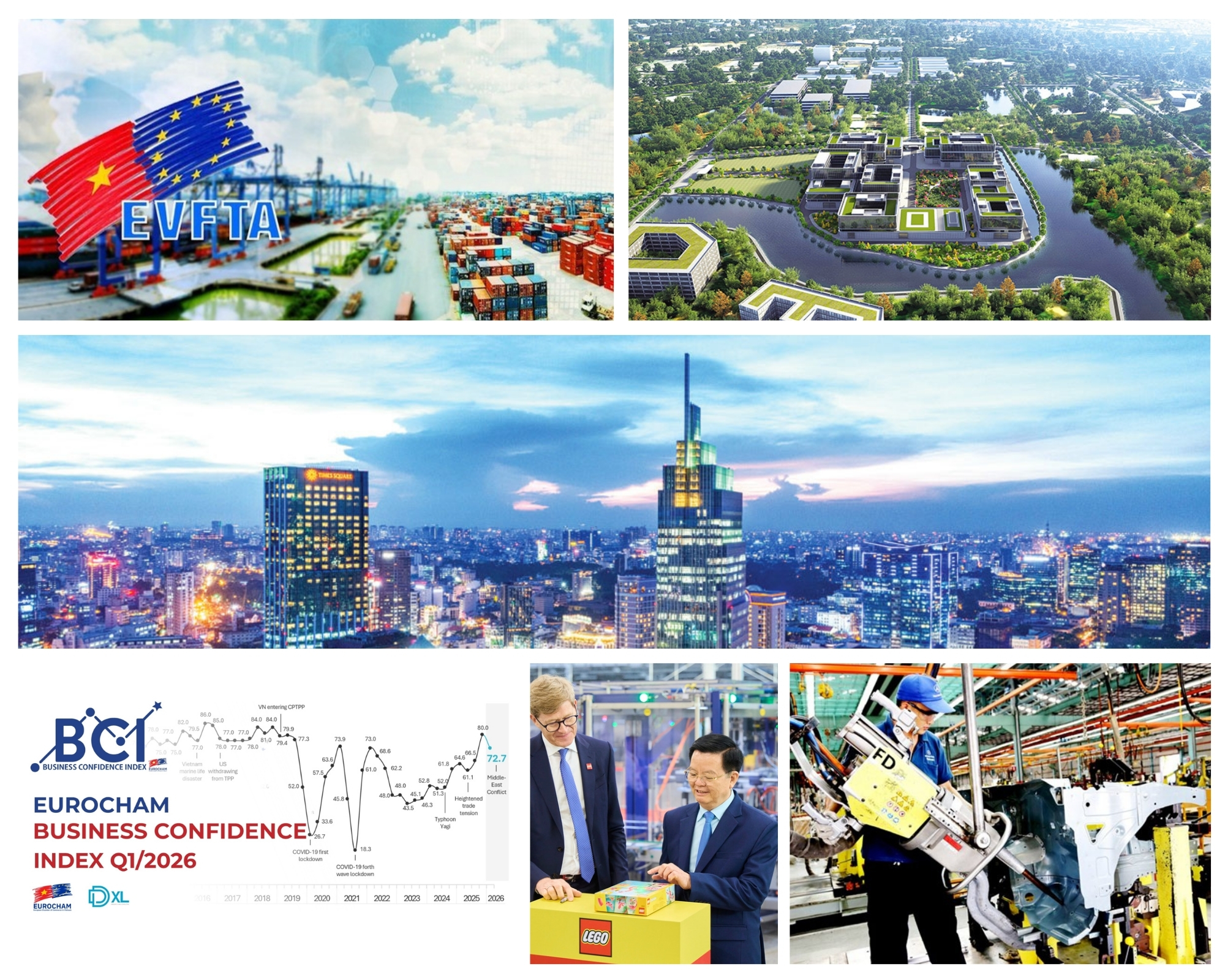
Photo: VGP
Expectations from Viet Nam's new growth model
At EuroCham, Bruno Jaspaert said business leaders see the increasing importance of Viet Nam in conversations across continents. They have been welcoming a steady stream of high-level visits from Europe, signalling this country's vital role in the new global economic landscape. In just the first few months of 2026, we have already welcomed three high-level delegations from Brussels.
It started in January when European Council President Costa came to anchor a new Comprehensive Strategic Partnership, a historic first for the EU in ASEAN.
In March, Commissioner Síkela was here to turn that diplomatic momentum into actual commercial volume, bringing multi-million-euro investments to the EU-Viet Nam Global Gateway Business & Investment Forum. And just this past May, Commissioner Zaharieva came to sign a Letter of Intent that opens up collaboration in science, tech, and innovation.
It is particularly worth noting that Viet Nam is the only nation receiving this level of concentrated focus from Europe. This sequence shifts the relationship beyond diplomatic upgrades into deep, technical ministerial alignments designed to enhance partnerships in key areas of growth. For European businesses, it confirms what we see on the ground: Viet Nam has truly become a vital link in the global supply chain and a safe habour in a stormy global economy.
Although our historical investment volume remains modest compared to the overall scale of Viet Nam's massive FDI growth, it is gradually increasing and European companies enter this market with a distinct, long-term vision. Eurocham is not here for transient, transactional manufacturing. Our businesses build integrated value chains, linking production with efficient logistics, stable energy systems, and advanced digital infrastructure. For a European multinational, setting up a factory footprint is merely step one; the true metric of success is establishing a surrounding ecosystem that can operate efficiently and sustainably over a fifteen- to twenty-year payback horizon.
As a foreigner who proudly calls this country my second home, Bruno Jaspaert said his belief in the era of rising is built on daily operational reality, as evidenced in expanding industrial zones, in ports running at higher efficiency, and in investment committees approving capital expenditure with long-term horizons because they trust the future of this nation. He said his sincere recommendation to Viet Nam is to resist chasing easy, short-term wins and continue building this deep, long-term capacity with the goal to develop sustainable growth. Economic giants are not built overnight, and a consistent effort to make this country optimised for its investors is exactly what European capital is looking for.
"If you wants a concrete proof-of-concept for this 10 percent growth target, you only need to look at Hai Phong, my home base for nearly a decade. Year after year, I have watched Hai Phong consistently outperforms that double-digit GDP threshold. They achieved this by maintaining a laser-sharp focus on intermodal connected-port logistics, industrial zone connectivity, and pioneering the pilot Free Trade Zone (FTZ). Viet Nam is absolutely capable of hitting these numbers nationally because the blueprint has proven to work on the ground," Bruno Jaspaert said.
Major recommendations
To be successful in advanced manufacturing, Viet Nam needs a flawless combination of land, utilities, water, stable energy, and human capital. And you need these to be synchronised. While the Government has done an excellent job ensuring the necessary infrastructure (and contrary to five years ago, there is plenty of industrial land available), the area where Viet Nam will struggle most over the next five years is its people.
While Viet Nam has an incredibly industrious workforce of over 60 million, our latest Business Confidence Index (BCI) report shows that concerns over talent shortages have surged from 23 percent to 33 percent. Looking at the available labour pool, shifting workers out of agriculture or remote mountainous regions will no longer be enough to shift the needle for a modern economy. Salaries are currently rapidly rising as the war for talent has arrived also in Viet Nam.
Viet Nam should invest in its human infrastructure and roll out high standard education and specialised training to keep up with its South East Asian neighbours. No one can build a high-tech economy on a skill-gap foundation.
To truly rise, Viet Nam's workforce evolution must match its industrial ambition. Bruno Jaspaert said he highly recommend that Viet Nam treats domestic talent development as an urgent national priority, and I have seen many European companies that are already investing in localised corporate academies to bridge this gap.
On the administrative front, Eurocham is very encouraged by the authorities' current shift toward "systemic efficiency." The Government's recent reform push to abolish 184 administrative procedures and 890 legacy business conditions is a massive milestone. It represents an opportunity to finally achieve economic liberation from the administrative hurdles that had long slowed companies on the ground.
"To put this in perspective, let us look at the real economic cost of bureaucracy with a brief math exercise. We have more than 60 million people currently in the labour force. Let us assume that just 10 percent of this workforce has to deal with administrative procedures on various topics, that is about 6 million people. If procedural redundancies cost each person just one extra hour every week, that equates to approximately 50 hours a year per worker. Scaled across that pool, redundancies cost society more than 300 million hours annually. Even calculated at basic minimum wage levels, that lost productivity translates to a staggering economic loss of VND7.5 trillion (approximately €250 million) every single year. For sure the real cost for private companies is higher than what this calculation brings forward." Bruno Jaspaert said.
Therefore, the Government's targeted effort to streamline these procedures acts as a massive "liquidity injection" into the economy. For European companies, faster Time-to-Market allows us to immediately reinvest saved "administrative capital" into high-tech equipment, green infrastructure, and local R&D, rather than siphoning it away into compliance officers and legal fees.
Viet Nam's "era of rising"
As the Government has rightly pointed out, the next phase of growth can only be unlocked by institutional reforms, the promotion of innovation, and the enhancement of the private sector's role.
Viet Nam is pushing hard on all three fronts. However, solving cross-cutting administrative challenges requires an orchestrated, multi-stakeholders' effort. This requires a profound shift in mindset toward collective accountability.
Innovation and scientific breakthroughs are the next secret weapons. Bruno Jaspaert said he seeing an increasing number of brilliant young Vietnamese citizens who were educated abroad returning home, bringing the crème de la crème of international expertise to contribute to this new phase of growth. And they have brought with the first startup clusters we see emerge today. Even within the public sector, we are seeing a rising generation of internationally educated, forward-thinking public servants driving modernisation at both the leadership and execution levels. To back this up, the European business community is investing heavily in major Research & Development (R&D) projects here. Several European companies have built their largest regional R&D centres or manufacturing bases in Viet Nam because they recognise that the exceptional quality of your engineers, combined with attractive innovation tax schemes, creates an unbeatable global competitive edge.
In his own business, Bruno Jaspaert said pouring capital into green infrastructure and climate resilience was a heavy, expensive upfront investment but it was a non-negotiable cost to future-proof our operations. And it paid off as this shift did not impact our margins as it allowed us to become a leading eco industrial park pioneer warranting a premium price. The Vietnamese Government is executing the exact same strategy on a national level. The massive infrastructure pipeline currently underway is capital-intensive today, but it is an absolute necessity to prevent economic stagnation and will directly add vital percentage points to long-term GDP. Furthermore, Viet Nam has a unique fiscal weapon that many European nations can only dream of: a remarkably low national debt-to-GDP ratio. This gives the state the financial leverage to open the vaults and fund large-scale green energy grids and transport corridors.
The new leadership of Viet Nam has stabilised the political landscape of this country. Due to its reforms, the authorities have been pushing out new regulations at breakneck speed, impacting so many parts of society and the economy. The legal framework is step by step overhauled and reviewed, and we expect that this will lead to higher transparency and a more uniform interpretation of the laws and regulations at hand.
Of course, this speed of Viet Nam comes at a price, reflected in the scramble to train talent on time, an overheated real estate market, and mounting pressure on the environment. Still, if forced to choose between an economy changing too fast or one changing too slow, I will choose too fast every single time. Viet Nam's economy is still young. If we think of it in terms of a human lifespan, this economy is in its prime, vibrant youth: a period where it possesses the energy to try out, (re)iterate, and if needed, review its idea of what it wants to be.
In Europe we believe it is never too late to reinvent yourself, but with its matured economies, European nations are often terrified of radical change out of fear of losing what we have built up and cultivated over centuries. Viet Nam, by contrast, has the courage and determination to bet all in on the new global game. Despite the risks involved, the Government is entirely right to embrace these bold, rigid structural reforms.
Ultimately, the European business community finds great reassurance in the Prime Minister's strategic priorities focused on a "people-serving government" and "systemic efficiency." These values align perfectly with our own corporate goals.
From EuroCham, we would like to express our profound thanks to the Vietnamese Government, the ministries, the State Bank, and the National Assembly for their open minds and collaborative spirit throughout our first Whitebook Dialogue Week.
As investors, we are not here to hand over a checklist of complaints and walk away. We are fully committed to ensuring that Viet Nam's "era of rising" is backed by the solid financial, physical, and legal infrastructure required to make it entirely sustainable, inclusive, and unstoppable./.