
From upper-middle-income to high-income status: Viet Nam breaks new development milestone
VGP - Viet Nam has overcome a challenging journey to join the ranks of upper-middle-income economies and is now moving toward its goal of becoming a high-income country by 2045. While the road ahead may be even more demanding, the country has gained valuable experience to support its next stage of development.
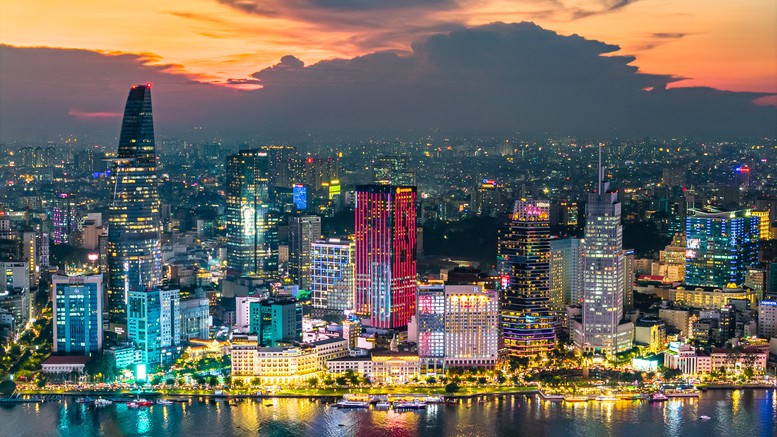
Viet Nam join the ranks of upper-middle-income economies
Advancing faster than several regional peers
According to data released by the World Bank in July 2026, Viet Nam's gross national income (GNI) per capita reached US$4,970 in 2025, up 10.7 percent from the previous year.
With the World Bank's upper-middle-income threshold set at US$4,636, Viet Nam has officially entered the upper-middle-income group.
According to Prof. Dr. Ngo Thang Loi from the National Economics University, the achievement marks the successful completion of the country's first major development milestone after a 17-year journey, from 2009 to 2026, on its path toward becoming a prosperous and developed nation.
Compared with the "economic miracle" economies of the last century, Viet Nam's transition took longer than the Republic of Korea (just over 10 years, from 1968 to 1979), Singapore (13 years, from 1965 to 1978), Taiwan (10 years, from 1968 to 1978), Hong Kong (8 years, from 1968 to 1976), and mainland China (11 years, from 1999 to 2010).
Within ASEAN, however, Viet Nam's pace was comparable to Malaysia's 16-year transition (1979–1995) and faster than Thailand's 23-year journey (1988–2011). Indonesia and the Philippines each took around 30 years, while many countries in Africa and South America have remained in the lower-middle-income group for three to four decades, appearing trapped in the so-called "lower-middle-income trap."
"The 17-year journey coincided with a period of profound global economic turbulence, including the COVID-19 pandemic and disruptions to international supply chains. Maintaining sustained growth throughout this period to advance in income classification reflects Viet Nam's remarkable resilience and is fully consistent with the World Bank's assessment," Ngo said.

Prof. Dr. Ngo Thang Loi from the National Economics University
Four key drivers behind Viet Nam's transition to upper-middle-income status
Ngo identified four key drivers behind Viet Nam's transition to upper-middle-income status.
First, strong export growth and deeper global integration.
According to the National Statistics Office, Viet Nam's total trade expanded by an average of around 10 percent annually during 2021–2025, accelerating to more than 15 percent over the past two years.
In 2025, total import-export turnover reached US$920 billion, placing Viet Nam among the world's 15 largest trading economies. The ratio of trade to GDP climbed to 181 percent, among the highest globally, compared to the global average of around 50–60 percent over the past two decades. This underscores Viet Nam's deep integration into the global economy and its position as one of the world's most open economies.
Second, substantial progress in attracting foreign direct investment (FDI), both in quantity and quality.
Annual FDI inflows have grown by around 7 percent over a prolonged period, with growth reaching nearly 9 percent annually during 2021–2025.
The FDI sector now contributes around 20–22 percent of GDP, accounts for 75 percent of total exports, generates 50 percent of industrial output, represents 25–28 percent of total social investment, and provides employment for more than five million direct workers, in addition to millions of indirect jobs.
At the same time, Viet Nam has increasingly attracted higher-quality investment in high-tech manufacturing, electronics, semiconductor production and other advanced industries from leading global corporations.
Third, the initial success of the National Digital Transformation Strategy, with the digital economy emerging as an important growth engine.
In 2025, the digital economy's value added was estimated at 14.02 percent of GDP, equivalent to approximately US$72.1 billion, representing a 1.64-fold increase compared to 2020.
The digital economy expanded by 11.8 percent in 2025—outpacing overall GDP growth—and contributed 11.8 percent to national economic growth. It has developed both in scale and sophistication, with core digital industries—including ICT and telecommunications, internet platforms, and sector-specific digital industries—accounting for more than 60 percent of the digital economy. Digitalization has also expanded across commerce, finance, public administration and energy infrastructure.
Fourth, macroeconomic stability and decisive institutional reforms, particularly administrative reform.
Efforts to streamline administrative procedures and accelerate national digital transformation have improved the business environment and enhanced transparency for investment flows.
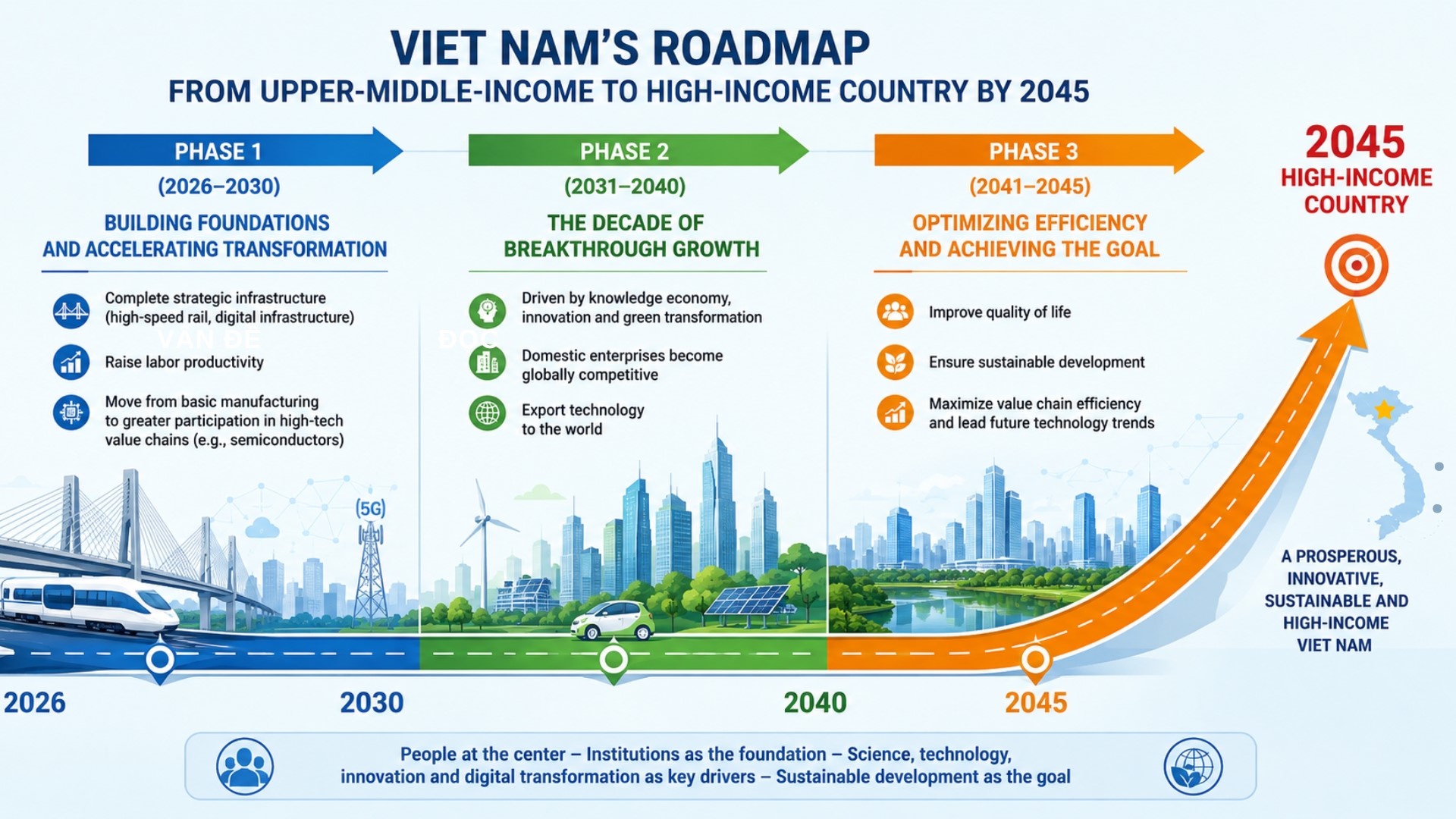
Viet Nam's roadmap toward high-income status - Photo with AI support
Roadmap toward high-income status
The Party and State have set the vision of transforming Viet Nam into a developed, high-income country by 2045, while targeting average annual GDP growth of at least 10 percent during 2026–2030.
Achieving this objective will require a fundamental shift in the growth model, with development increasingly driven by science and technology, innovation, digital transformation, productivity improvements and stronger national competitiveness.
Viet Nam will need to nearly triple its current GNI per capita, exceeding the World Bank's minimum high-income threshold of US$14,376 per person per year.
Ngo agreed with the World Bank's assessment and research by the National Economics University that the country's roadmap could be divided into three phases.
Phase 1 (2026–2030): Building foundations and accelerating transformation
Key priorities include completing strategic infrastructure—particularly high-speed rail and digital infrastructure—raising labor productivity, and moving beyond basic manufacturing toward greater participation in high-tech value chains, especially semiconductors.
Phase 2 (2031–2040): The decade of breakthrough growth
This will be the decisive period for overcoming the upper-middle-income trap.
Growth must be driven primarily by the knowledge economy, innovation and green transformation. Domestic enterprises will need to become globally competitive and capable of exporting technology to international markets.
Phase 3 (2041–2045): Optimizing efficiency and achieving the goal
The final stage will focus on improving people's quality of life, ensuring sustainable development, maximizing value chain efficiency and leading emerging technology trends.
Transitioning to a new growth model
To achieve these milestones on schedule, Ngo emphasized that Viet Nam must fully embrace the Party and State's strategic orientation by shifting decisively toward a growth model based on quality, science and technology, innovation and digital transformation, thereby increasing knowledge content and productivity across the economy.
Ngo proposed four breakthrough policy priorities:
First, commercializing technology and stimulating innovation through bringing research to market, expanding national technology exchanges to connect scientists with businesses, and prioritizing public procurement of qualified "Make in Viet Nam" technology products and digital solutions.
Second, rapidly establishing a competitive position in future technologies by developing a comprehensive semiconductor ecosystem in Ha Noi, Ho Chi Minh City and Da Nang; promoting widespread AI adoption in logistics, finance and high-tech agriculture; and integrating digital transformation with green transition to meet increasingly stringent export standards.
Third, upgrading the quality of the digital workforce by reskilling workers in labor-intensive industries, accelerating the training of 50,000 semiconductor engineers and high-quality AI specialists by 2030, and introducing attractive policies to encourage overseas Vietnamese scientists and technology experts to contribute to national development.
Fourth, unlocking venture capital by encouraging major corporations to establish venture funds for startups and simplifying administrative procedures to facilitate investment and capital flows from international venture capital funds.
From a sectoral perspective, Ngo suggested that Viet Nam should prioritize financial resources, land and human capital for industries capable of generating high added value, including semiconductors and precision electronics, artificial intelligence, the digital economy and big data, renewable energy and the green economy, as well as high-tech agriculture and deep processing integrated with circular economy models.
"Most importantly, institutional reform must become the breakthrough of all breakthroughs. If the Vietnamese economy is compared to a train, then science and technology are its engine, while institutions are the railway tracks. Only with modern and efficient institutions can the train accelerate safely toward the 2045 goal," Ngo concluded./.