
Viet Nam's path to double-digit growth requires bold reforms and new growth drivers
VGP - As Viet Nam targets double-digit economic growth, SingCham President Tan Quee Peng suggested the country focus on comprehensive institutional reforms, stronger innovation, an empowered private sector, and a strategic shift toward high-quality investment.

SingCham President Tan Quee Peng
Editorial note: This is the last article of a series of four articles aimed at exploring how Viet Nam has prepared and what are the key factors for Viet Nam to achieve the double-digit growth goal.
Tan Quee Peng made the suggestion during an interview with the VGP about Viet Nam's ambitious goal of double-digit economic growth in the 2026-2030 period.
First, robust institutional reforms are essential. Streamlining regulatory frameworks, ensuring transparency, and reducing bureaucratic barriers will create a more attractive environment for both domestic and foreign investors.
Second, fostering innovation through policies that encourage research and development, digital transformation, and technology adoption is crucial. By building a culture of innovation, Vietnam can boost productivity and remain competitive in global markets.
Third, the private sector must be empowered as a primary driver of growth. This involves improving access to financing, simplifying business registration processes, and supporting small and medium-sized enterprises (SMEs) through targeted incentives. The government's continued commitment to these reforms will lay the foundation for sustainable and inclusive economic expansion.
Finally, to pave the way for double-digit economic growth, Viet Nam needs to continue to boost FDI attraction, especially "new-generation FDI" in high-tech and green industries with high added value potential. Sectors such as semiconductors, AI, renewable energy, and supporting industries, with clear criteria for technology, ESG, and local linkages, are what Vietnam should steer towards as long-term plans for the future.
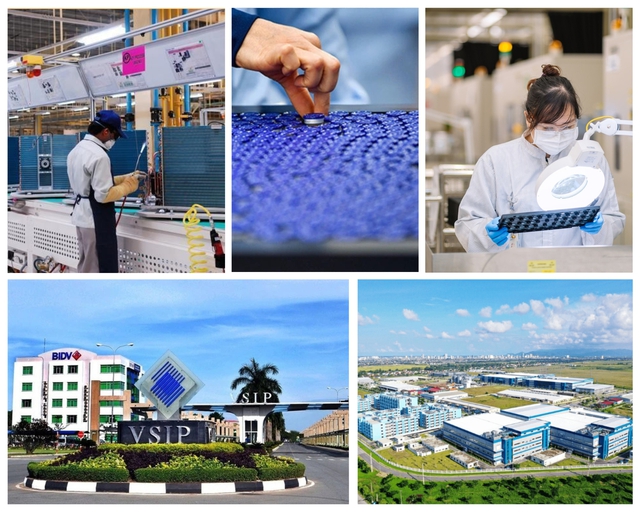
Viet Nam-Singapore Industrial Park - a successful economic cooperation model between Viet Nam and Singapore
Viet Nam's advantages to rise up
Viet Nam's first major advantage is its social and political stability. In a volatile international environment, stability is itself an economic asset. Investors value a country that offers policy continuity, internal security, and a clear long-term development direction. EuroCham's recent Business Confidence Index reporting similarly describes Viet Nam as a stable link in the global supply chain, even while businesses remain cautious about global shocks.
Second, Viet Nam has a visible and increasingly credible government commitment to regulatory reform. The 2025-2026 policy agenda places strong emphasis on improving the legal framework, removing bottlenecks, and restructuring the administrative system to support growth. EuroCham's Whitebooks for 2025 and 2026 both recognize this reform direction, while also urging stronger execution.
Third, Viet Nam benefits from ongoing infrastructure development at an unprecedented scale. The Government has been pushing to expand the expressway network, complete key airport and logistics projects, and prepare special mechanisms for strategic rail and energy projects. These investments can reduce logistics costs, connect production zones more efficiently, and improve the economics of large industrial and service projects.
Fourth, the recent institutional overhaul, including the administrative reorganization and move toward a more streamlined two-tier local governance model, could become a structural advantage if implemented well. According to analyses of the 2025 reform, the intended benefits include clearer authority allocation, faster administrative processing, stronger decentralization, and better conditions for regional planning. However, the transition period will need careful management so that short-term uncertainty does not offset long-term gains.
Biggest bottlenecks currently hindering businesses
The most immediate bottleneck remains administrative friction and regulatory inconsistency across sectors and provinces. Even where central policy is reform-minded, businesses still face fragmented interpretation, overlapping approvals, and uneven implementation at local level. Business communities have repeatedly highlighted administrative procedures, customs, work permits, and other procedural issues as practical barriers to investor confidence and operational efficiency.
A second bottleneck is market access, including lingering complexity around retail expansion and market-entry conditions in certain sectors. Although trade commitments have gradually reduced some restrictions, businesses still report uncertainty where legal commitments, sectoral rules, and practical licensing requirements do not align smoothly. For example, under Vietnam's commitments under recent international agreements (i.e., EVFTA, CPTPP, etc.), the Economic Needs Test (ENT) requirements in the retail sector, where the establishment of outlets (beyond the first one), where removed. However, while the direction of these trade agreements is toward greater trade liberalization, the domestic regulatory reality has not kept pace. Draft regulations that would internalize the commitments regarding removal of ENT requirements in the retail sector remain pending with no visible progress.
A third constraint is the practical difficulty of obtaining M&A and investment approvals, especially for regulated sectors or transactions requiring multiple clearances. Delays often do not come from lack of investor interest, but from sequential approvals, unclear agency competence, and a cautious administrative mindset during transition periods. That can raise transaction costs and reduce the attractiveness of acquisition-led expansion.
A fourth bottleneck is regulatory clarity in renewable energy and related infrastructure. Vietnam has strong demand for power and large investor interest in LNG, offshore wind, grid infrastructure, and other clean-energy projects. Yet investors still need clearer bankable rules on licensing, project implementation, transmission readiness, and long-term policy consistency. Without that clarity, capital may remain committed in principle but delayed in practice.

Key recommendations
To achieve the 10 percent growth target in the 2026-2030 period, Viet Nam should introduce additional policies that build on existing strengths and address persistent challenges.
Key recommendations include:
Accelerate Institutional Reforms: Streamline administrative processes, enhance transparency, and strengthen legal frameworks to attract investment.
Promote Innovation and Digital Transformation: Invest in education and training, support startups, and incentivize technology adoption across industries.
Enhance Infrastructure: Expand and modernize transportation, logistics, and energy systems to improve efficiency and support growth.
Support the Private Sector: Provide targeted incentives for SMEs, improve access to financing, and encourage entrepreneurship.
Foster Green Growth: Implement policies that promote sustainable development, environmental protection, and renewable energy.
Strengthen International Integration: Leverage free trade agreements, diversify export markets, and facilitate cross-border collaboration.
Promote the international financial center (IFC) model: A credible and strongly supported IFC framework could help solve funding issues and complement Viet Nam's objective of becoming a regional platform for higher-value investment./.