JICA vows to accelerate Viet Nam's bid on reforms and double-digit growth
VGP - President of Japan International Cooperation Agency (JICA) Tanaka Akihiko pledged to cement and deepen cooperation to help Viet Nam to accelerate reforms and achieve double-digit growth on the basis of JICA's four main pillars.
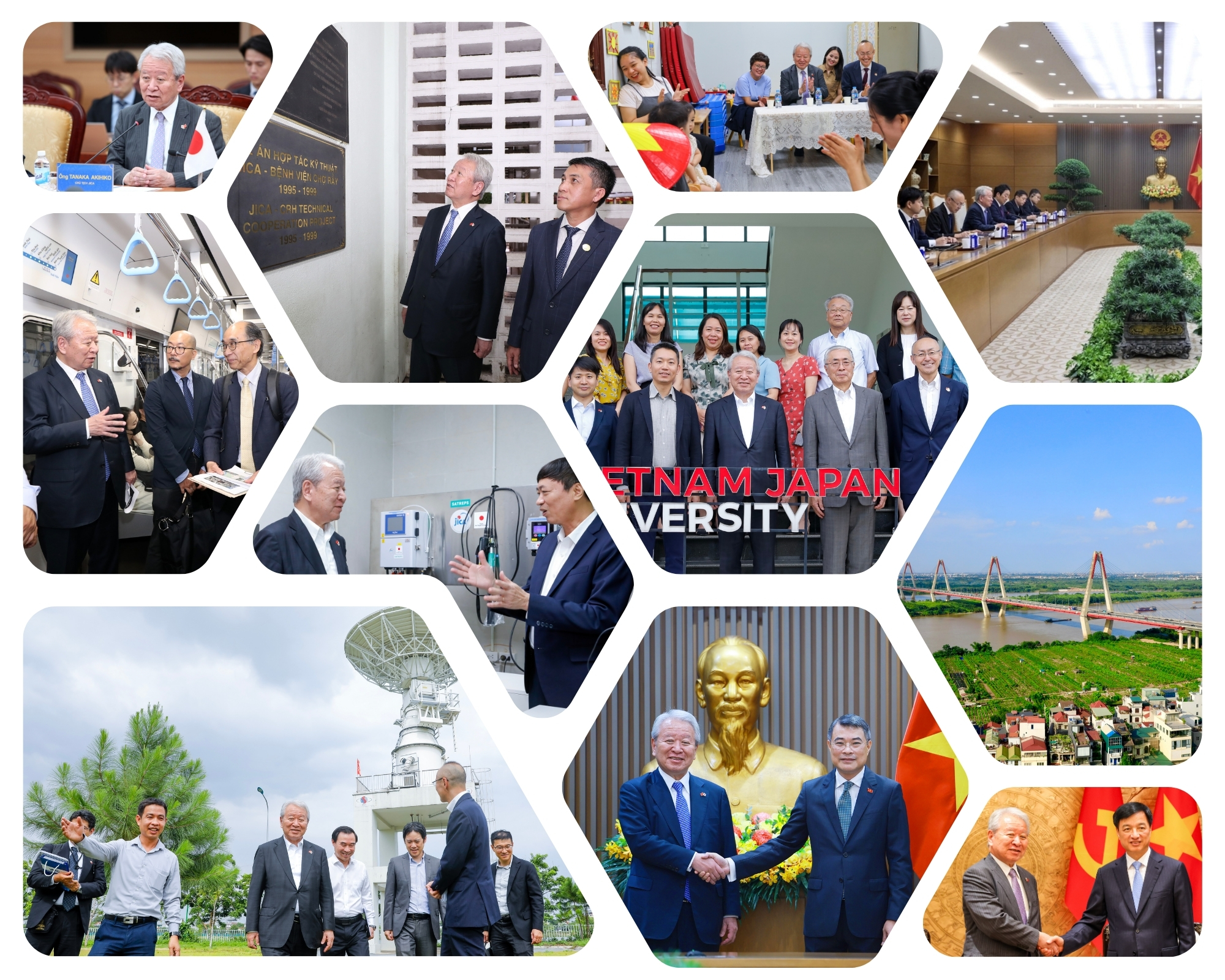
An overview of the working visit of JICA President Tanaka Akihiko to Viet Nam - Photo: JICA
Editorial note: Prime Minister Le Minh Hung has launched a campaign, calling on the whole nation to strive for achieving this year's growth goal of at least 10 percent.
On the occasion, we interview heads of several foreign business associations to seek their insights about how the Southeast Asian country has prepared and what are the key factors for Viet Nam to achieve the double-digit growth goal.
During a recent interview with VGP on the occasion of his visit to Viet Nam, Mr. Tanaka Akihiko, President of the Japan International Cooperation Agency (JICA) shared his vision on how JICA will assist Viet Nam in achieving the double-digit growth goal.
Viet Nam is aiming to maintain double-digit economic growth in the coming years in order to realize its aspiration of becoming a high-income country by 2045. In your opinion, what are the key factors that will enable Viet Nam to achieve this goal, and how will JICA support Viet Nam in this process?
JICA President Tanaka Akihiko: JICA is proud to have been one of Viet Nam's leading bilateral development partners. To date, JICA has dispatched to Viet Nam more than 30,000 Experts and mission members, as well as close to 800 JICA Volunteers, and has welcomed more than 17,000 participants from Viet Nam to training programs and study tours in Japan. JICA has also provided grant aid and loans amounting to more than US$600 million and US$18 billion, respectively. The year 2025 marked the 30th anniversary of the dispatch of JICA Volunteers to Viet Nam, and to commemorate this milestone, we produced a video together with our partners and friends in Viet Nam.
Going forward, Viet Nam's goal of achieving double-digit growth in the coming years is underpinned by its plan to establish a new economic growth model. Reforms to realize this model are being actively advanced under strong Party leadership, and JICA stands ready to support these efforts comprehensively and strategically through a support package, in line with the policy direction of the Government of Japan and in collaboration with a wide range of Vietnamese and Japanese stakeholders.
This support, which builds on JICA's long history of cooperation, can be structured around four main pillars that align with Viet Nam's priority areas, namely, (1) science and technology, innovation and DX (STI&DX) human resources, (2) growth of domestic enterprises and deeper integration into Global Value Chains (GVCs), (3) investment environment, and (4) strategic infrastructure. The details of these pillars are as follows:
(1) Science and Technology, Innovation and DX (STI&DX) Human Resources
JICA will actively support the development of high-quality human resources in science, technology, innovation, and digital transformation (STI&DX). This includes: policy advice; support for education and research; promotion of brain circulation between Viet Nam and Japan; strengthening industry–academia–government collaboration and inter-university partnerships; and the development of educational and research infrastructure.
These efforts build on JICA's existing cooperation with more than 20 universities, including Viet Nam-Japan University, Can Tho University, and Ha Noi University of Science and Technology, as well as partnerships with Hoa Lac Hi-Tech Park and the Viet Nam Space Center.
JICA places particular emphasis on strengthening core capabilities in emerging technologies such as semiconductors and AI/DX, while also supporting their application across priority sectors including green transformation, disaster risk management, agriculture, transport, and healthcare. At the same time, foundational elements such as Japanese language education and people-to-people exchange play an essential role in enabling deeper collaboration and knowledge transfer between Viet Nam and Japan.
For example, the newly established semiconductor program at Viet Nam-Japan University provides an important platform for further collaboration among academia, industry, and local governments, including by promoting stronger brain circulation between the two countries. In parallel, JICA is exploring the possibility of a new program loan to support Viet Nam's policy reforms in the AI/DX field under a comprehensive framework for collaboration with Japanese stakeholders.
(2) Growth of Domestic Enterprises and Deeper Integration into Global Value Chains (GVCs)
JICA will continue to foster partnerships with Japanese enterprises and promote economic security, while supporting the growth of domestic enterprises in manufacturing and other sectors through innovation, thereby facilitating their deeper integration into global value chains.
One notable example is Keieijuku, through which JICA, in partnership with the Viet Nam-Japan Institute for Human Resources Development, has supported the transfer of knowledge and experience in Japanese-style management to more than 1,100 executives and managers of Vietnamese enterprises.
In the area of economic security, preparations are underway to formulate new projects in the energy sector, as well as to consider possible avenues for supporting the enhancement of Viet Nam's oil reserve infrastructure.
(3) Investment Environment
JICA will leverage its experience in legal and judicial cooperation to support the effective development and enforcement of institutions and policies aimed at enhancing the investment environment for Japanese and other foreign enterprises.
With regard to governance, which underpins a transparent and efficient investment environment, JICA will support Vietnam's efforts to improve the operation of its newly introduced two-tier local governance system by sharing Japan's extensive experience with a comparable governance structure. Areas such as taxation and intellectual property are also critical. Building on its long-standing cooperation in these fields, JICA will further strengthen its engagement while also exploring the possibility of cooperation in areas of growing importance, such as copyright.
(4) Strategic Infrastructure
JICA will support the development of strategic infrastructure and equipment that reinforce the three pillars outlined above.
As the Vietnamese economy continues to grow rapidly, demand for high-quality infrastructure will inevitably increase. JICA will continue working closely with both Vietnamese and Japanese stakeholders to identify opportunities for financial and technical cooperation in infrastructure development aligned with Viet Nam's various master plans, including Hanoi's 100-year Master Plan. Particular emphasis will be placed on facilitating technology transfer from Japanese stakeholders to their Vietnamese counterparts.
Through these mutually reinforcing efforts, JICA will support Viet Nam not only in achieving higher growth but also in ensuring that such growth is sustainable, resilient, and inclusive over the long term. This will benefit not only the people of Viet Nam, but also Japan, the region, and the international community as a whole.
Tanaka Akihiko's Viet Nam visit and his impressions
How Viet Nam has changed since the success of the 14th National Party Congress?
JICA President Tanaka Akihiko: It is a great honor for me to return to Viet Nam. I have visited Viet Nam several times, including my most recent visit in March 2023, and I am truly pleased to be back at such an important moment following the successful National Party Congress.
On each visit, I have been deeply impressed by Viet Nam's dynamism and its steady progress in economic and social development. This time in particular, I strongly sense renewed direction and momentum as the country advances toward its long-term goal of becoming a high-income country by 2045.
I also recognize a clear commitment by the Vietnamese leadership to further advance reforms in areas such as science, technology, and innovation, lawmaking and enforcement, education and training, international integration, and private sector development. These priorities are closely aligned with the areas in which JICA has long partnered with Viet Nam. In my meetings with Vietnamese leaders, I reaffirmed JICA's firm commitment to supporting these reforms comprehensively and strategically, based on four main pillars – (1) science and technology, innovation and DX (STI&DX) human resources, (2) growth of domestic enterprises and deeper integration into Global Value Chains (GVCs), (3) investment environment, and (4) strategic infrastructure. I was greatly encouraged by their strong interest in further deepening our cooperation along these pillars to accelerate reforms and achieve double-digit growth.
In addition to meetings with leaders, I had the opportunity to observe new infrastructure facilities that were not yet in place during my previous visit. For example, I rode on the Ho Chi Minh City Metro Line 1 for the first time. To date, the Metro has recorded more than 30 million passenger trips and has made significant contributions to improving the lives of the Vietnamese people by ensuring safe mobility. Reflecting on this experience, I renewed my appreciation for the tireless efforts made by both Vietnamese and Japanese stakeholders over the years to bring the project to fruition.
During my visit, I was once again reminded of the essential role played by major infrastructure developed through Viet Nam-Japan cooperation, such as Noi Bai International Airport Terminal 2, Nhat Tan Bridge, and the road connecting them. This experience also reinforced my sense of the profound impact that infrastructure development can have in a rapidly growing country like Viet Nam, as well as of the importance of continuing and further strengthening our cooperation in this field. Through my discussions with Vietnamese leaders, I also sensed a strong desire to further promote technology transfer from Japanese stakeholders to their Vietnamese counterparts in infrastructure development, which I believe represents one of the key strengths of Japan's cooperation with Viet Nam.
In many scientific fields, we are going beyond one-way technology transfer and co-creating innovative solutions. My visits to the Vietnamese National Space Center and the laboratory at VNU University of Science both reaffirmed the potential impact of Japan and Vietnam co-creating solutions to shared challenges—solutions that can be utilized not only in Vietnam but also in Japan and other countries around the world, thereby contributing to a broader circulation of knowledge and innovation.
I also met with JICA Experts and Volunteers, as well as their counterparts working across various sectors in Viet Nam, and visited several of their project sites. At Viet Nam-Japan University, Vietnamese and Japanese counterparts explained their plans to enhance the quality of education, with the aim of developing highly skilled human resources who will serve as a vital bridge between Viet Nam and Japan.
A volunteer working in a kindergarten spoke about the joy she and her colleagues experience in watching Vietnamese children grow day by day. I also heard about the close collaboration between JICA Experts and Volunteers and their Vietnamese counterparts during my visit to Cho Ray Hospital, to which JICA has provided various forms of cooperation since the 1960s.
Through these experiences, I was pleased to reaffirm that, even amid rapid development, the warmth and hospitality of the Vietnamese people toward our Experts and Volunteers remain unchanged. At the heart of cooperation between countries are people-to-people ties. JICA Experts and Volunteers, together with their Vietnamese counterparts, stand at the forefront of these ties and provide a solid foundation for the Comprehensive and Strategic Partnership between our two countries./.