Viet Nam becomes increasingly influential on global stage: UK Ambassador
VGP - Over the past decade, Viet Nam has evolved from an emerging economy into a country with an increasingly significant voice in regional and international affairs, noted UK Ambassador to Viet Nam Iain Frew.
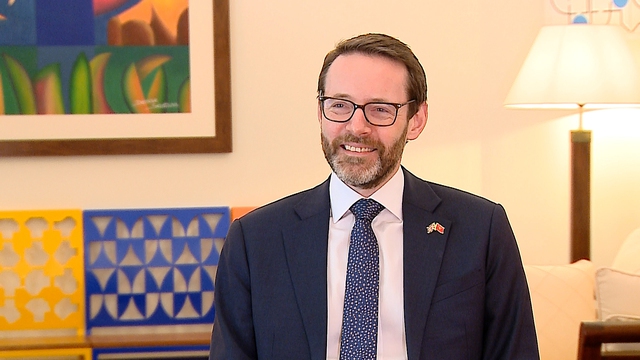
UK Ambassador to Viet Nam Iain Frew - Photo: VGP/Do Cuong
In a recent interview with VGP, the Ambassador hailed Viet Nam's strong economic growth and the rapid expansion and deepening of its diplomatic relationships.
Viet Nam's increasingly prominent role in ASEAN, together with its growing engagement with regional and global powers, including the United Kingdom, has given the country a stronger position in contributing to solutions to major international challenges, ranging from trade and security to climate change and environment.
The Ambassador highlighted Viet Nam's role as Chair of the CPTPP this year as a particularly important example. At a time when the global trading system faces considerable uncertainty, Viet Nam's efforts, alongside the UK and other partners, to champion free and open trade are contributing to greater stability and reinforcing the country's international integration.
This diplomatic trajectory is underpinned by an increasingly impressive economic performance. With growth exceeding 8 percent last year and ambitions for double-digit growth, Viet Nam is performing strongly by international standards.
In the Ambassador's assessment, the country's economic dynamism and increasingly proactive diplomacy are reinforcing each other and creating a trajectory that is likely to strengthen further in the years ahead.
Viet Nam - key player in ASEAN
From the UK's perspective, Viet Nam is not simply a bridge between ASEAN and major economic powers. It has become a key player within ASEAN itself and a pivotal partner for the UK in its engagement with the region.
As the UK's country coordinator for ASEAN, Viet Nam plays an important role in helping Britain strengthen its integration and connectivity with the regional bloc.
Ambassador Frew pointed to the decision by UK Foreign Secretary Ed Miliband to attend the ASEAN Ministerial Meeting shortly after taking office as a powerful demonstration of the importance Britain attaches to both ASEAN and Viet Nam. His first meeting there was with Viet Nam's Foreign Minister Le Hoai Trung, after which the two co-chaired the ASEAN-UK Post-Ministerial Conference.
Five years after becoming ASEAN's dialogue partner, the UK has made substantial progress in implementing its Plan of Action with ASEAN, covering economic and regulatory cooperation, people-to-people links, political engagement, regional security and stability.
The agreement of a new UK-ASEAN Plan of Action at the ASEAN Ministerial Meeting in July, the Ambassador noted, provides a new foundation for elevating these ties further.
Within ASEAN itself, he also praised Viet Nam's ASEAN Future Forum, an initiative that has grown steadily since its launch. The forum provides a platform for ASEAN to reflect on its future direction while bringing together external partners to discuss common challenges and develop practical approaches to cooperation.
Against the backdrop of an increasingly uncertain international environment, Frew said, ASEAN can play a crucial role in promoting stability, reform and the responsible adoption of emerging technologies such as artificial intelligence. Viet Nam's increasingly prominent leadership within ASEAN will therefore help shape the future direction of the region.
Strong foundations for Viet Nam's next stage of growth
Reflecting on his experience in Viet Nam, Ambassador Frew said one of the things that has impressed him most is the energy, creativity and resilience of the Vietnamese people.
He described Viet Nam as a highly entrepreneurial country, where people are willing to turn ideas into businesses quickly and adapt when something does not work. This dynamism, in his view, is one of the fundamental forces behind Viet Nam's rapid economic development and will remain a major advantage as the country enters its next phase of growth.
Another key strength is Viet Nam's openness to international trade. With trade equivalent to around 170 percent of GDP, Viet Nam is deeply integrated into the global economy. Its network of free trade agreements, including CPTPP and the UK-Viet Nam Free Trade Agreement, has helped attract investment, develop new industries and strengthen the country's connections with global markets.
The Ambassador stressed that Viet Nam and the UK share a strong interest in preserving the benefits of an open trading system while continuing to reform it and expand market access.
Equally important is Viet Nam's increasing investment in the future, particularly in education, skills, infrastructure and technology. These investments will be critical to the country's ambition of moving from an upper-middle-income economy to a high-income economy by 2045.
Viet Nam: from technology user to technology developer
Looking ahead, Ambassador Frew identified four broad areas that will be critical for Viet Nam to move further up global value chains, including skills and innovation; infrastructure and energy; advanced technology and manufacturing; and sustainability and resilience.
Science, technology and innovation, he said, will be fundamental. Referring to Viet Nam's Resolution 57 and its emphasis on science and technology, he noted that these areas, together with education and skills, are also at the heart of the Comprehensive Strategic Partnership between Viet Nam and the UK.
For Viet Nam to achieve its next stage of development, it will need to move beyond being primarily a recipient and user of technology and increasingly become a developer, co-developer and designer of new technological solutions. Areas such as AI, quantum computing and advanced manufacturing will require highly skilled people as well as stronger links between research institutions, universities and businesses.
Infrastructure and energy will be equally important. The UK is co-leading the International Partners Group supporting Viet Nam's Just Energy Transition Partnership, helping accelerate the transition towards renewable energy.
The Ambassador highlighted Viet Nam's enormous potential in wind and solar power, given its long coastline, abundant sunshine and favorable natural conditions.
At the same time, investments in high-speed rail, urban rail and modern transport infrastructure will be essential to unlocking new sources of growth. The UK is working with Ha Noi and Ho Chi Minh City on urban rail and transit-oriented development, seeking to maximize the economic potential around new transport nodes.
Sustainability and climate resilience are also becoming increasingly important. Viet Nam faces growing risks from storms, flooding, sea-level rise and other extreme weather events. The Ambassador shared that the UK has joined Viet Nam's Disaster Risk Reduction Partnership to strengthen preparedness and resilience.
Such investment is not merely an environmental priority but an economic necessity. Without effective adaptation, the impact of natural disasters could significantly undermine Viet Nam's future growth.
Unlocking next wave of UK-Viet Nam cooperation
The UK-Viet Nam economic relationship is already expanding rapidly. Bilateral trade exceeded £10.5 billion last year and has more than doubled during Ambassador Frew's tenure.
He said the next priority should be to fully unlock the opportunities created by existing trade agreements while expanding cooperation into strategic sectors.
Education remains a major area of opportunity. More than 12,000 Vietnamese students study in the UK each year, while British education providers are increasingly partnering with Vietnamese institutions to offer high-quality programs in Viet Nam. Such partnerships can help equip the next generation of Vietnamese workers with the skills required by a technology-driven economy.
The development of the International Financial Centre in Ho Chi Minh City and Da Nang represents another strategically important opportunity. The UK has supported Viet Nam in developing the institutional framework for the centre, including specialized legal mechanisms.
A well-designed international financial centre, Ambassador Frew said, could unlock substantial new flows of international capital into Viet Nam, including investment in green projects, financial technology and other high-growth sectors. Developing a sophisticated financial sector will be essential as Viet Nam advances towards high-income status.
Technology is another major frontier. The UK has particular expertise in semiconductor chip design, while Viet Nam is rapidly developing its semiconductor ecosystem and plans to train 50,000 new semiconductor engineers. There is significant potential for cooperation in semiconductors, AI, quantum computing, cybersecurity and fintech.
Healthcare and pharmaceuticals offer further opportunities. UK companies such as AstraZeneca and GSK are already operating in Viet Nam and are seeking to deepen partnerships with Vietnamese counterparts in medicines, healthcare innovation and supply chains.
For Ambassador Frew, Viet Nam's rising economic strength, deep international integration, growing technological capabilities and increasingly influential diplomatic role are creating a country that is not only benefiting from globalization but increasingly helping to shape it./.