Viet Nam well positioned to become strong maritime nation
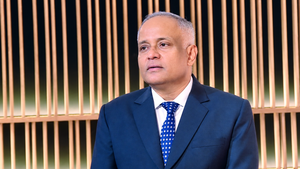
VGP - Viet Nam has strong potential to become a maritime nation, but realizing that potential requires translating policy commitments into action, strengthening ocean governance and unlocking the full potential of the marine economy, UNDP Resident Representative in Viet Nam Ramla Khalidi said.
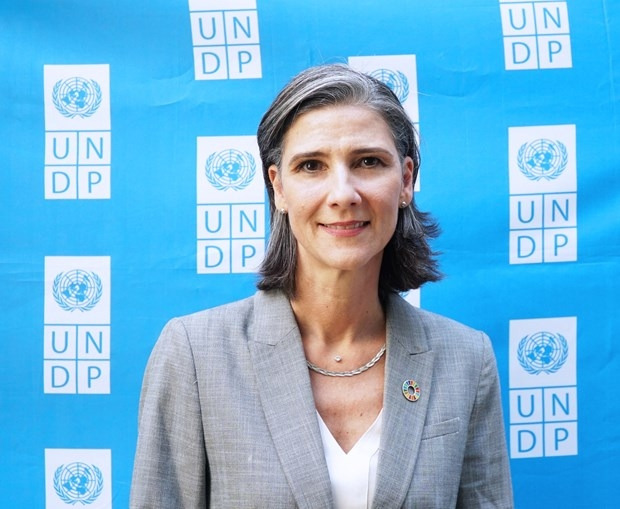
UNDP Resident Representative in Viet Nam Ramla Khalidi. (Photo: UNDP)
Speaking in an interview on the development of Viet Nam's marine economy, Ramla Khalidi highlighted the country's strategic advantages, policy priorities and international lessons for building a green and sustainable marine economy.
The sea is a strategic asset of Viet Nam
According to the UNDP Resident Representative, Viet Nam has distinctive advantages for developing its marine economy, reflected not only in its coastline but also in its position at the intersection of regional and global economic, energy and ecological flows.
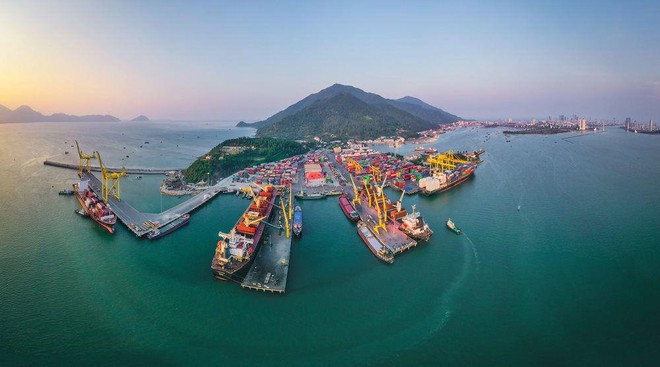
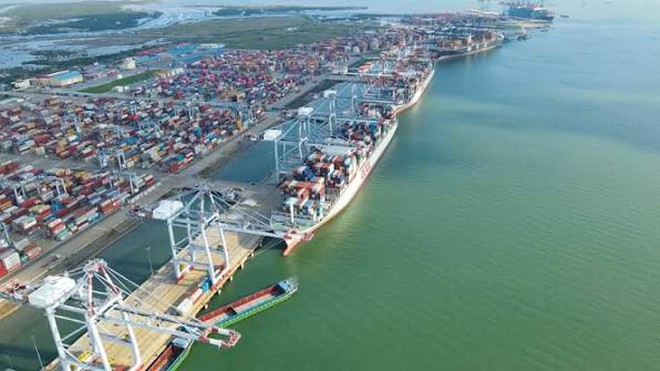
From UNDP's perspective, the sea is a strategic asset of Viet Nam. With a coastline of more than 3,260 km, extensive maritime areas and a location along major international shipping routes, Viet Nam is well positioned to promote trade, logistics and port services and strengthen connectivity with regional and global markets.
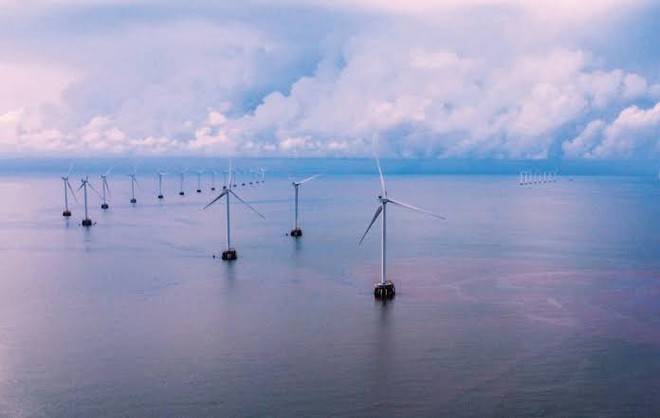
Another major advantage is the potential to develop green and low-carbon economic sectors. Viet Nam's offshore wind potential is among the highest in the region, estimated at more than 1,000 GW. Opportunities in green hydrogen, green shipping and climate-resilient infrastructure could create new growth drivers while supporting the country's commitment to achieve net-zero emissions by 2050.
With its geographical location, maritime space, energy resources and natural capital, Viet Nam has strong foundations to realize its goal of becoming a strong maritime nation.
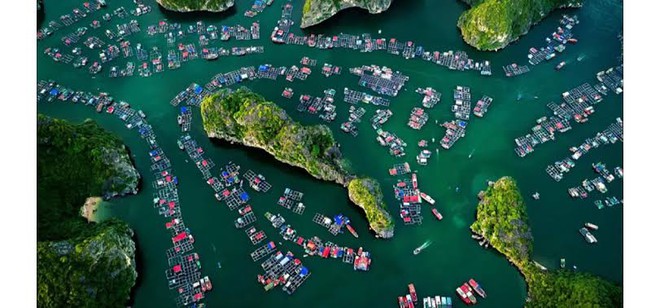
Viet Nam also possesses abundant marine natural capital, with more than 11,000 marine species and important ecosystems, including coral reefs, seagrass beds and mangrove forests.
Located at the heart of ASEAN, Viet Nam is part of a region that accounts for only about 3 percent of the world's land area but is home to more than 25 percent of the world's described plant and animal species.
These marine and coastal ecosystems directly support the livelihoods of more than 4 million workers in the fisheries sector and have significant carbon-storage capacity. They constitute important natural capital for promoting development while conserving biodiversity, strengthening the resilience of coastal communities and creating new opportunities through blue carbon and nature-based economic models.
By continuing to promote innovation, strengthen integrated ocean governance and effectively mobilize public and private investment in nature-based solutions, Viet Nam can realize its ambition of becoming a strong, prosperous and sustainable maritime nation in the 21st century, Ramla Khalidi said.
Four priorities for green marine economy
Assessing Viet Nam's progress, Ramla Khalidi said that nearly eight years after the issuance of Resolution No. 36-NQ/TW, the country has made important progress in laying the foundations for green and sustainable marine economic development.
Resolution No. 20-NQ/TW dated July 28, 2026, adopted by the 3rd Plenum of the 14th Party Central Committee, on building and developing Viet Nam into a strong maritime nation.
Resolution 20 targets to convert Viet Nam into a strong maritime nation; develop a modern, sustainable marine economy; strengthen ocean governance; protect marine ecosystems and biodiversity; develop marine science, technology and innovation, strengthen marine infrastructure; promote international cooperation; and link marine economic development with national defense and security.
In particular, Resolution No. 20-NQ/TW, adopted at the third Plenum of the 14th Party Central Committee on building and developing Viet Nam into a strong maritime nation, calls for a major shift in thinking in two areas.
First, Viet Nam needs to shift from exploiting the sea to modern ocean governance.
Second, it needs to move from fragmented, sector-based marine economic development toward unified and integrated governance of the national maritime space.
However, she noted that there remains a significant gap between the vast potential of the marine economy and the ability to turn that potential into economic, social and environmental value on a broader scale.
The UNDP Resident Representative identified four priorities for the coming period.
First, Viet Nam needs to strengthen coordination in maritime spatial governance and move from planning to effective implementation.
Second, it needs to accelerate marine nature conservation.
Third, it needs to strengthen marine data infrastructure and address bottlenecks in mechanisms for allocating marine areas.
Fourth, Viet Nam needs to continue developing green financing mechanisms for the marine economy.
Importantly, a green marine economy not only generates environmental benefits but also creates clear economic value.
UNDP's study Green Marine Economy Scenarios for Viet Nam shows that, under green marine development scenarios, GDP generated by marine economic sectors could reach US$70.1 billion by 2030, accounting for up to 35 percent of national GDP. This would be about 34 percent higher, equivalent to an additional US$23.5 billion, compared with business-as-usual development.
Therefore, the priority in the coming period is to translate the policy foundations already established into concrete action, enabling Viet Nam to create greater value from the sea while maintaining a healthy ocean and ensuring sustainable livelihoods for coastal communities.
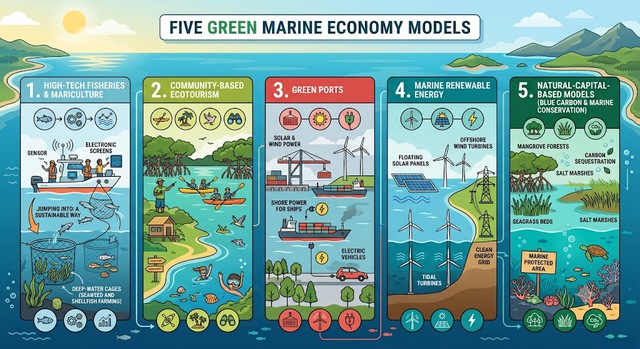
Photo with AI support
Five green marine economy models
Ramla Khalidi said that UNDP research has identified five groups of green marine economy models with potential for Viet Nam: high-tech fisheries and mariculture; community-based ecotourism; green ports; marine renewable energy; and natural-capital-based models such as blue carbon and marine conservation.
These models can help reconcile economic growth and livelihood creation with ecosystem protection and restoration while increasing the value of marine resources.
However, developing and scaling up these models requires Viet Nam to address several important gaps.
One key challenge is the lack of effective implementation mechanisms and sufficiently attractive economic and financial instruments to mobilize the private sector and local communities.
Other challenges include fragmented inter-sectoral coordination, limited capacity to design models at the local level, and data gaps in monitoring, reporting and verification (MRV) systems.
Each group of models also has different investment cycles, risk profiles, profitability and capital requirements.
Mariculture, community-based tourism, renewable energy and blue carbon therefore cannot be supported through the same financial mechanism. Policies and financial instruments need to be sufficiently flexible to match the characteristics and level of readiness of each model.
Viet Nam also needs to design flexible incentives and specialized green financial instruments tailored to the risk profile of each model, while strengthening inter-sectoral coordination, improving local governance capacity and completing the MRV data system.
More importantly, Viet Nam needs to create a transparent and stable policy environment to reduce risks and strengthen investor confidence, while ensuring that local communities can participate in and benefit from the transition.
Lessons from Norway
Ramla Khalidi highlighted Norway as a noteworthy international example of how to combine large-scale marine economic development with ecosystem protection, offering several policy lessons for Viet Nam.
One of Norway's key experiences is science-based integrated ocean governance.
Since the early 2000s, Norway has developed integrated management plans for strategic marine areas such as the Barents Sea, the Norwegian Sea and the North Sea, supported by inter-ministerial and inter-sectoral coordination mechanisms to allocate maritime space for oil and gas, offshore wind power, fisheries, shipping and conservation.
Norway has also shifted its marine economic value chains from resource-intensive activities toward technology and higher value-added activities.
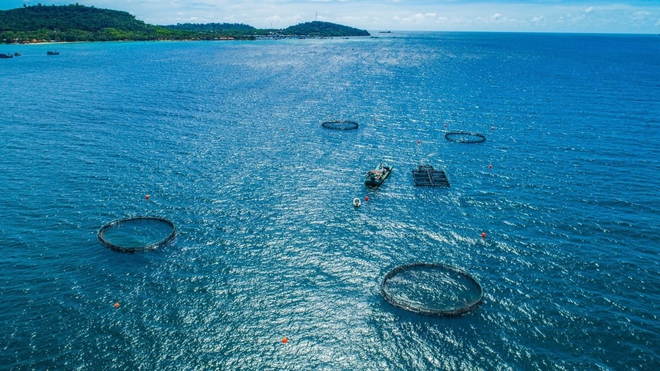
In fisheries, instead of continuing to expand wild harvesting, Norway has developed high-tech aquaculture, implemented strict disease management and increased value through quality, traceability and global branding. Norwegian salmon is a clear example.
In shipping and energy, Norway has pioneered vessel electrification, developed green ports and leveraged capabilities and infrastructure from the oil and gas sector to support offshore wind power.
Another important foundation is transparent and shared marine data. Digital ocean data platforms enable the Government to regularly update plans and provide reliable information for long-term investment decisions.
From Norway's experience, Viet Nam can draw several important lessons.
First, following the approval of the National Marine Spatial Plan, Viet Nam needs to focus on effective implementation and strengthen inter-sectoral coordination.
Completing the legal framework for green bonds, marine carbon credits and public-private partnership models could help expand domestic and international sources of capital for the green marine economy.
Second, Viet Nam needs to continue greening and upgrading the value chains of marine economic sectors, shifting from expanded exploitation toward technology application, higher quality, traceability and greater value addition.
Third, Viet Nam should continue developing green financial instruments to mobilize private resources.
Finally, it needs to strengthen data and measurement tools at the local level.
UNDP has begun researching a Provincial Marine Economy Index (VN-BEI), based on international measurement frameworks and practical experience from leading countries, to support the country's 21 coastal localities.
The index covers four pillars — economic, social, environmental and governance — to monitor the quality of growth, the level of greening and the ability to attract sustainable investment, thereby enhancing transparency and supporting evidence-based policymaking./.