
Int'l organizations maintain positive outlook for Viet Nam’s 2026 economic growth
VGP - Despite continued uncertainties in the global economy, Viet Nam’s socio-economic situation recorded positive results in the third quarter and the first nine months of 2026.
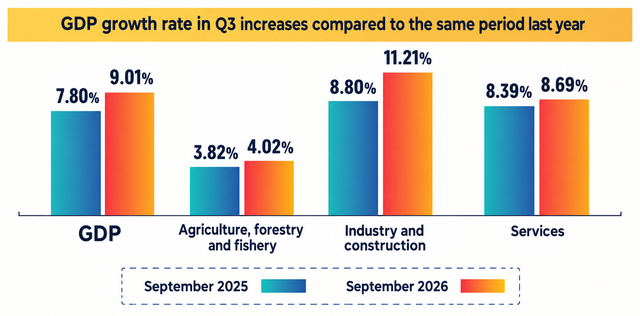
Viet Nam's GDP grew 9.95 percent year-on-year in the third quarter, bringing nine-month growth rate to 9.01 percent. The outcome is reinforcing positive assessments by international financial institutions of the Vietnamese economy's outlook, with many forecasts suggesting that the growth momentum could be sustained through the final months of the year.
According to the National Statistics Office under the Ministry of Finance, Viet Nam's GDP in the third quarter of 2026 was estimated to expand 9.95 percent year-on-year, compared to 8.15 percent in the first quarter and 8.81 percent in the second quarter.
In the first nine months of 2026, the nation's GDP was estimated to increase 9.01 percent year-on-year. The agriculture, forestry and fisheries sector grew 4.02 percent, contributing 5.35 percent to the overall increase in gross value added; the industry and construction sector expanded 11.21 percent, contributing 49.62 percent; while the services sector grew 8.69 percent, contributing 45.03 percent.
The strong growth performance has also provided a basis for international organizations to maintain positive assessments of Viet Nam's economic outlook for 2026.
According to the National Statistics Office, although the latest reports by the Organization for Economic Cooperation and Development (OECD) and the United Nations (UN) both raised their 2026 global growth forecasts by 0.1 percentage point from their previous projections, the revised forecasts remain significantly lower than the growth rate recorded in 2025. Growth forecasts for individual economies in the region vary. Viet Nam is projected to record the highest growth rate in Southeast Asia, ranging from 7.5-8.2 percent.
AMRO projects Viet Nam's GDP growth at 7.5 percent in 2026, while the IMF has raised its forecast for Viet Nam to 8.2 percent, up 0.7 percentage point from its previous projection.
In its September 2026 Asian Development Outlook, the ADB raised its forecast for Viet Nam's economic growth to 7.8 percent in 2026 and 7.6 percent in 2027.
Growth is being driven by multiple factors, with manufacturing and processing continuing to expand, domestic consumption strengthening, and foreign direct investment (FDI) inflows remaining stable. Improving domestic demand and accelerated investment disbursement are also helping reinforce the growth outlook in the period ahead.
In its latest report, Standard Chartered forecast Viet Nam's full-year GDP growth at 9.5 percent. Despite continued external uncertainties, growth-supportive policies are expected to further strengthen Viet Nam's growth prospects in the final months of the year.
Tim Leelahaphan, Senior Economist for Viet Nam and Thailand at Standard Chartered, said: "Viet Nam's economy continues to demonstrate strong resilience, underpinned by robust domestic demand, positive industrial production and trade activity. We expect the growth momentum to continue through the remaining months of the year."
According to Tim, although external uncertainties remain, growth-supportive policies and continued positive economic activity are expected to further bolster Viet Nam's growth outlook through the end of the year.
Earlier, in light of Viet Nam's positive economic performance, analysts at UOB said that stronger-than-expected economic results in the first half of 2026, continued strong momentum in artificial intelligence (AI) development, and easing energy prices had supported the outlook. UOB subsequently raised its 2026 GDP growth forecast for Viet Nam to 8.5 percent, from its previous estimate of 7 percent.
The forecasts came after Viet Nam maintained positive growth momentum in the first half of the year amid continued volatility in the global economic and trade environment.
Viet Nam's growth outlook is supported by industrial production, exports, domestic consumption and investment inflows. The production of technology-related products has also benefited from global demand associated with AI and ongoing supply-chain shifts.
However, international organizations continue to flag risks arising from trade uncertainty, geopolitical tensions, energy prices and demand in major export markets. Given its high degree of economic openness, Viet Nam remains significantly exposed to fluctuations in the global economy.
Following the 9.01 percent growth rate in the first nine months of 2026, the economy is now facing the task of sustaining high growth in the final quarter while containing inflationary pressures, exchange-rate risks and external uncertainties./.