
Gov't approves National AI Strategy
VGP - The Government has approved a National Strategy on Artificial Intelligence (AI) through 2030, with a vision to 2045.

From AI application to research and development
The Strategy calls for a shift from the traditional approach of AI research, development and application to AI research and development and nationwide AI transformation.
It advocates a major shift from integrating AI into existing products, services, processes and systems to making AI a core capability from the outset, from problem identification and design to organization and operation.
AI will become an important driver for redesigning governance, production, business and service delivery; increasing productivity; improving the effectiveness of national governance; enhancing business competitiveness and innovation; and creating new products, services and business models.
The Strategy identifies human resources, infrastructure and data as foundations, while considering institutions and AI governance as breakthroughs.
Human resources development is identified as a decisive foundation for AI research and development and nationwide AI transformation. The Strategy stresses the need to develop high-quality AI human resources, AI talent and elite AI professionals; providing AI training, retraining and skills development for the workforce; and promoting AI skills across society.
It also calls for a shift from training individual technology skills to developing the capacity to create practical products, services and value through AI, while attracting and effectively utilizing leading AI experts, Vietnamese experts overseas and foreign experts.
Vietnamese AI enterprises are expected to play a leading role in AI research, development, deployment and nationwide AI transformation. Enterprises are encouraged to shift from simply integrating AI into existing products, services and processes to designing products, services, business models and governance methods with AI built in from the outset.
The Strategy underscores the need to promote the development of AI-native enterprises and "Make in Viet Nam" AI products, platforms, services and solutions.
Developing at least 10 Vietnamese AI brands
The Strategy aims to make Viet Nam one of the leading centers in ASEAN and Asia for AI research, development, application and co-creation of value by 2030, while building strong national capacity in AI research, development, mastery, deployment and governance.
AI is expected to become a core capability deeply and comprehensively integrated into national governance, public service delivery, production, business, scientific research, innovation and social life.
This will contribute significantly to improving productivity, quality, efficiency and national competitiveness, while creating new products, services and growth models.
By 2030, Viet Nam strives to rank among the top three countries in Southeast Asia in AI research and development.
The Strategy sets the targets of integrating and supporting 100 percent of online public services with AI and using AI to support the processing of 100 percent of administrative procedure dossiers.
Viet Nam will develop at least five national shared AI platforms, establish at least 10 Vietnamese AI brands capable of competing in regional and international markets, and develop at least eight Vietnamese-language AI models.
Viet Nam aims to rank among Asia's top 10 in AI by 2045
By 2045, Viet Nam aims to rank among the top 10 countries in Asia in AI research, development and mastery, as well as in nationwide AI transformation.
AI will become an important strategic driver for increasing productivity, innovation capacity and national value creation, helping Viet Nam overcome the middle-income trap and become a developed, high-income country by 2045.
AI will become a major operational foundation of the State, economy and society. Viet Nam will complete a fundamental transformation in which institutions, governance models, business processes, products, services, production and business methods, and critical infrastructure systems are designed, developed and operated on AI platforms.
Viet Nam will establish an AI and AI-native enterprise ecosystem with regional and international competitiveness and become an important regional and global center for AI research, development, production, and the provision of AI products, services and solutions.
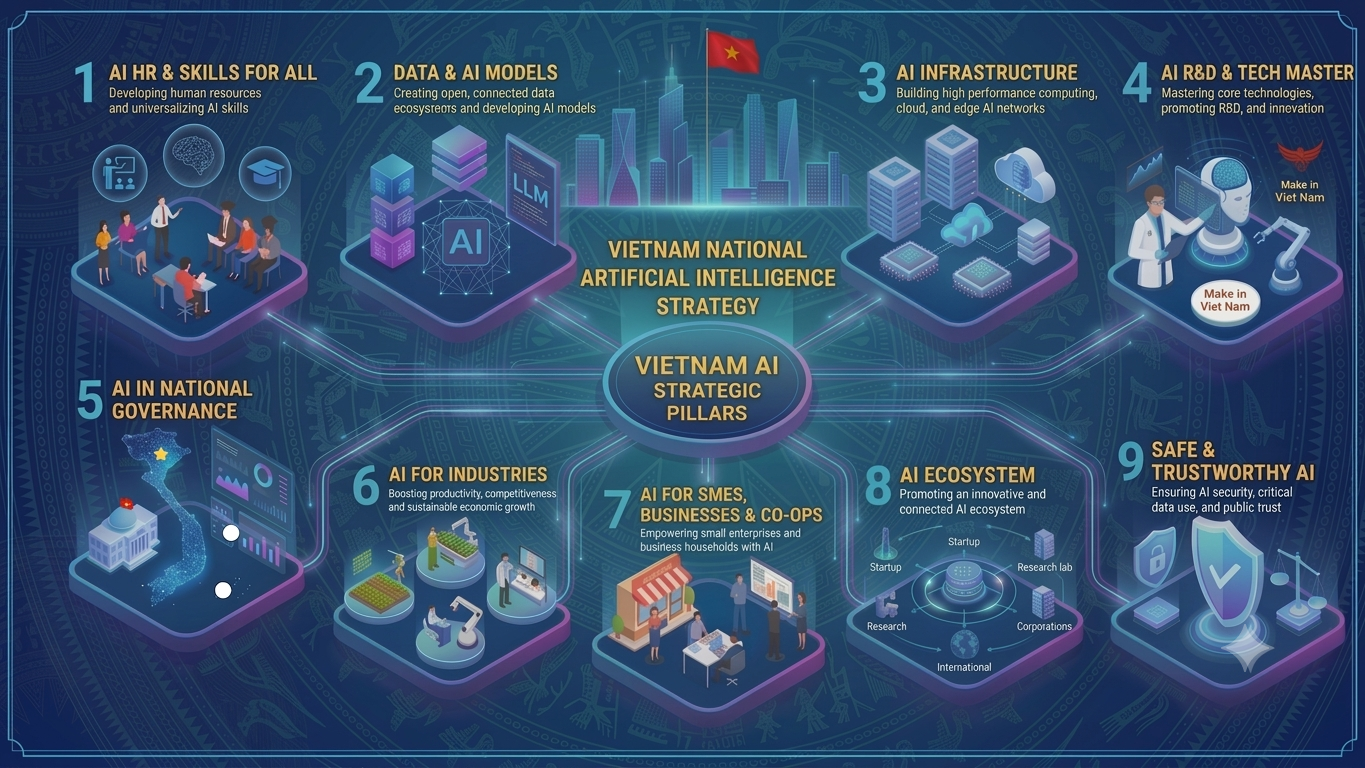
Infographic with AI support
Nine strategic pillars
The Decision identifies nine strategic pillars as follows:
AI human resources and AI skills for all: Develop high-quality AI human resources, promote AI skills across society, and ensure the workforce has the capacity to research, develop, deploy and use AI.
Data and AI models: Develop data, data infrastructure and AI models as foundations for AI research, development, training, testing, evaluation and deployment.
AI infrastructure: Develop computing infrastructure, cloud computing, edge AI and AI data centers to ensure computing capacity for State management, research, innovation and AI deployment.
AI research, development and technology mastery: Promote AI research, development and mastery of AI technologies, develop "Make in Viet Nam" AI products and services, and build core technological capabilities to address major national challenges.
AI in national governance: Develop, deploy and use AI in national governance to build a modern, proactive and adaptive governance system in the AI era; improve national governance effectiveness, public service quality, forecasting, direction and administration, and services for people and businesses.
AI for industries and sectors: Promote comprehensive AI transformation across industries and sectors, focusing on key areas with major impacts on productivity, growth, national competitiveness, social welfare and people's lives.
AI for small and medium-sized enterprises, household businesses and cooperatives: Support small and medium-sized enterprises, household businesses and cooperatives in accessing, deploying and maintaining the use of AI products, services and solutions, and measuring their practical effectiveness.
AI ecosystem: Develop a Vietnamese AI ecosystem capable of conducting research and development, commercializing and exporting AI products, services and solutions.
Safe and trustworthy AI governance: Ensure safe, trustworthy and responsible AI governance, and ensure that AI is developed, provided, deployed and used in accordance with the law.
Six breakthrough solutions
The Strategy identifies six breakthrough solutions for implementation.
First, improve institutions, policies and laws to create an open and favorable legal framework for the rapid development and effective application of AI across all areas of socio-economic life.
Second, strengthen national coordination and implementation responsibility. Heads of ministries, sectors and localities will directly lead and organize implementation and bear responsibility before the Government and the Prime Minister for the results of assigned AI transformation objectives, targets and tasks. They will also regularly inspect and evaluate implementation and address difficulties and obstacles.
Third, mobilize resources and ensure funding. The State will ensure funding for Strategy-related tasks and solutions through State orders, assignment of tasks and bidding. Public-private partnerships and international investment funds will be mobilized to provide additional resources for AI research, development and deployment. The Strategy also calls for research into interest-rate support mechanisms for AI research, development, application and management, as well as tax incentives for AI-related activities.
Fourth, strengthen international cooperation and develop standards and technical regulations. Viet Nam will develop bilateral and multilateral AI cooperation programs with developed countries and international organizations, while establishing exchange programs for AI postgraduate researchers, engineers and scientists between Viet Nam and leading AI research and development centers worldwide.
Fifth, raise public awareness and promote a culture of responsible AI use.
Sxith: strengthen measurement, monitoring and evaluation to develop, promulgate and periodically review and update indicators for assessing the level of AI transformation at the ministry, sector, local and national levels, in accordance with the Strategy, practical conditions and international practices./.