
World Bank raises Viet Nam’s GDP growth forecast to 7.4%
VGP - The World Bank forecasts that Viet Nam’s GDP will grow by 7.4 percent this year, the highest rate in the region, driven by a strong performance in manufacturing and exports of AI-related products.
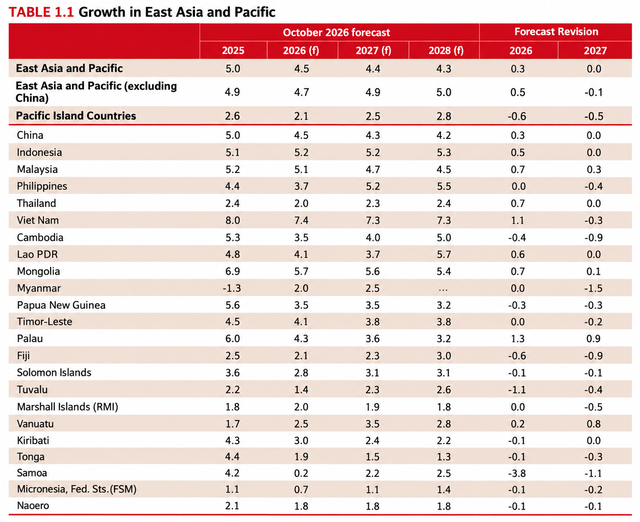
According to the East Asia and Pacific Economic Update released by the World Bank on October 6, several economies in the region are growing faster than expected, thanks to their manufacturing and exports of products that underpin AI-related activities worldwide.
Viet Nam is among the economies benefiting from the AI wave, with GDP growth forecast at 7.4 percent, the highest in the region. The forecast is 1.1 percentage points higher than the World Bank's projection in April, when many countries in the region were affected by an energy crisis linked to the conflict in the Middle East.
Viet Nam serves as a downstream assembly hub. Finished products such as computers, servers, and routers account for 60 percent of AI-related exports.
By April 2026, export growth remained robust across most EAP economies, despite rising energy and transportation costs. Increased demand for AI-related products accounted for more than half of total export growth in most countries and more than 70 percent in Malaysia, the Philippines, Thailand, and Viet Nam.
Viet Nam has the largest textile sector relative to GDP among major EAP economies, while also maintaining a strong electronics segment, according to the report.
Despite its strong growth performance, Viet Nam faces a number of macroeconomic pressures, the World Bank noted.
The country's export growth is heavily dependent on AI-related goods, exposing the economy to direct risks should global demand for AI investment weaken.
Speaking on the issue, World Bank Chief Economist for Asia Franziska Ohnsorge said whether Viet Nam's target of double-digit growth would mark the beginning of a new development phase or prove to be a short-term objective facing multiple challenges would depend largely on developments in the external environment.
She noted that Viet Nam is one of the world's most open economies and is highly dependent on its participation in value chains linked to the application and development of AI.
If the global growth trend driven by the AI wave continues, Viet Nam will be in a highly favorable position, she said. Conversely, the country could be vulnerable if signs of a slowdown emerge in global economic activity.
The World Bank also pointed to pressures arising from imports and foreign exchange reserves. Imports have been growing faster than exports as businesses have increased inventories of electronic components, while chip and fuel prices have risen.
The World Bank forecasts average consumer price inflation at 4.2 percent for the full year./.