Viet Nam aims for top 30 worldwide in EGDI by 2045
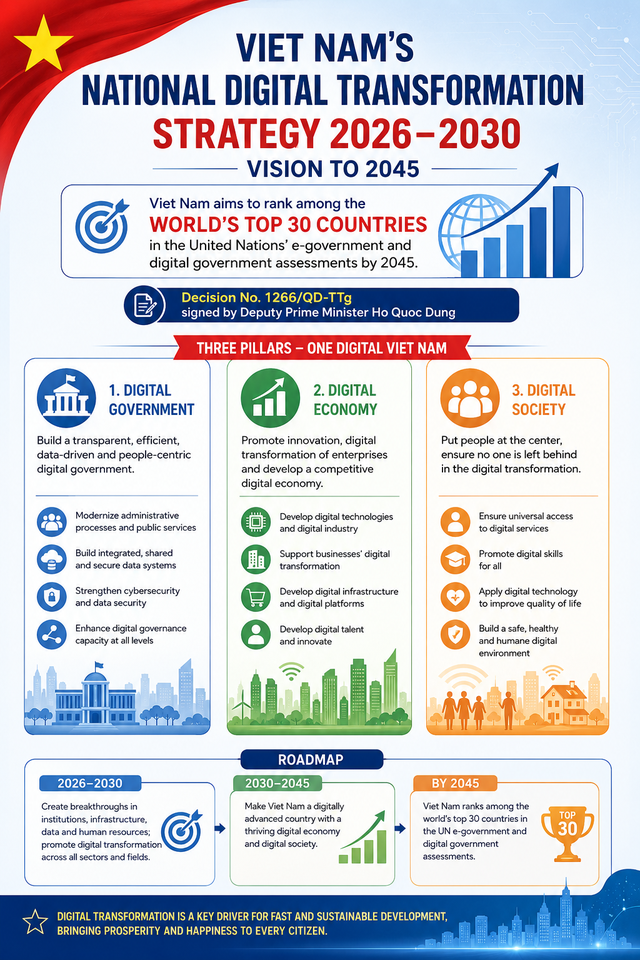
VGP – Viet Nam aims to rank among the world's top 30 countries in the United Nations E-Government Development Index (EGDI) by 2045, according to the National Digital Transformation Strategy for 2026–2030, with a vision to 2045.
The strategy, approved by the Government, places people and businesses at the center of the country's digital transformation, identifying them as both the driving force and the primary beneficiaries of the process.
It envisions Viet Nam becoming a developed digital nation where digital transformation is implemented comprehensively across all sectors and serves as the country's principal development model. The strategy also aims to build a modern governance system powered by data and artificial intelligence (AI), strengthen domestic capabilities in strategic digital technologies and firmly safeguard national digital sovereignty.
The strategy sets out objectives across three pillars: digital government, digital economy and digital society.
Digital government
By 2030, all administrative records and the results of administrative procedures are expected to be fully digitised.
The Government targets 99 percent public satisfaction with online public services, while all ministries, sectors and localities will use national shared digital platforms for governance, public administration and public service delivery.
All government information systems will be interconnected through national data-sharing services, with national, sectoral and provincial shared databases standardised and ready for AI applications.
Provincial smart operation centres will be upgraded with AI-powered capabilities for analysis, forecasting, early warning, monitoring and decision-making support.
Every public official and civil servant will have an electronic personnel record and receive digital skills training. Officials responsible for digital transformation and information technology will be provided with regular technology updates, while every public servant will have access to an AI assistant and training on AI-powered tools for public administration.
The strategy also targets compiling 70 percent of official statistical indicators from administrative data sources, reducing reliance on traditional surveys.
By 2030, Viet Nam aims to rank among the world's top 50 countries in the United Nations' e-government and digital government assessments, before advancing into the top 30 by 2045.
Digital economy
The strategy aims to increase the digital economy's contribution to at least 30 percent of GDP by 2030.
At least 500,000 small and medium-sized enterprises (SMEs) will receive support for digital transformation.
The country also plans to establish and operate at least five secure and legally compliant data exchanges to facilitate data sharing and innovation.
E-commerce is projected to account for 15–17 percent of total retail sales and consumer service revenue, while 45 percent of commercial SMEs are expected to participate in major domestic and international e-commerce platforms.
The strategy also seeks to expand cashless payments, with total transaction value reaching 30 times GDP.
More than 40 percent of SMEs are expected to adopt "model-as-a-service" platforms, AI agents or shared AI solutions to improve productivity and competitiveness.
Digital society
To narrow the digital divide, fibre-optic broadband infrastructure will be extended to all households nationwide.
At least 95 percent of people aged 15 and above are expected to hold bank accounts or accounts with other authorised financial institutions.
More than 70 percent of adults will have personal digital or electronic signatures, while electronic health records are expected to cover the entire population.
The Government also plans to provide basic digital skills training to at least 10 million working-age people during the 2026–2030 period.
Building a "Make in Viet Nam" digital technology ecosystem
The strategy identifies Vietnamese digital technology enterprises as the core force for mastering and developing digital technologies while addressing major national digital transformation challenges.
Priority will be given to developing a competitive "Make in Viet Nam" digital technology ecosystem centered on companies specializing in digital platforms, data, AI, cybersecurity, cloud computing, semiconductors, software, digital content and sector-specific digital transformation solutions.
The Government also pledges to leverage its role as a major customer and market for domestic technology enterprises through public procurement, government contracts, service outsourcing and regulatory sandbox mechanisms, creating early market opportunities for locally developed digital products and services.
These measures will focus on areas including online public services, shared digital platforms, national databases, cybersecurity, digital healthcare, digital education, digital payments and digital governance.
In addition, domestic digital technology enterprises will receive support to strengthen research and development, product design, intellectual property, quality standards, cybersecurity, commercialisation and market expansion.
The strategy also encourages stronger collaboration among large corporations, SMEs, research institutes, universities, innovation centers, high-tech parks and government agencies to develop domestic digital technology value chains and increase local value added in Viet Nam's digital products and services./.