THE SOCIALIST REPUBLIC OF VIET NAM
Government News
Viet Nam’s four-decade reform results in steady rise in economic freedom
VGP - Viet Nam scored 64.4 points, ranking 66th out of 184 economies in the 2026 Index of Economic Freedom published by the Heritage Foundation, above both the global average and the average for the Asia-Pacific region.
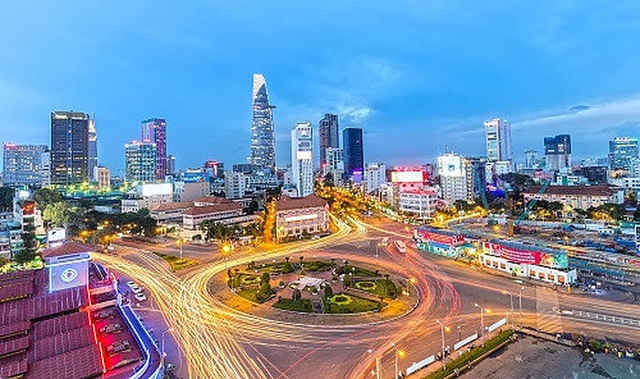
A corner of Ho Chi Minh City - Viet Nam's largest economic engine
The nation continues to receive positive assessments from international organizations regarding the quality of its business environment and the effectiveness of its economic reforms.
The Heritage Foundation noted that since the Index of Economic Freedom was first published in 1995, few economies of comparable size have achieved such significant improvements as Viet Nam in its transition toward a market-oriented economy.
The most noteworthy aspect of this year's report is not Viet Nam's ranking but its long-term progress.
When the Heritage Foundation first introduced the index in 1995, the country scored only 41.7 points. After more than three decades of Doi Moi and international economic integration, the country's score has risen to 64.4 points—an increase of more than 20 points.
This improvement has elevated Viet Nam from the category of economies with low levels of economic freedom to the "moderately free" category. Viet Nam's current score also exceeds both the global average of 59.9 points and the Asia-Pacific regional average of 58.6 points.
Today, Viet Nam is not only among the world's leading rice exporters but also an important player in the global electronics supply chain, attracting major technology companies to establish manufacturing operations in the country.
Many international organizations regard Viet Nam as one of the world's most dynamic economies. Sustained economic growth over many consecutive years, a young workforce, strong adaptability, and a steadily improving investment climate have made the country an increasingly attractive destination for international capital.
The Heritage Foundation noted that expanding trade, promoting foreign investment, and gradually developing the private sector have been important drivers of Viet Nam's economic growth.
Data in the report showed that Viet Nam has achieved a high degree of economic integration. Its total trade volume is equivalent to approximately 164.8 percent of GDP, reflecting the economy's close integration with global markets.
Viet Nam also performed strongly in several component indicators. Its fiscal health score reached 96.9 points, placing it among the highest in the world, while its tax burden score stood at 89.5 points. Public debt remains at around 31.3 percent of GDP, significantly lower than that of many advanced economies.
These factors contribute to a stable foundation for long-term growth and help maintain Viet Nam's attractiveness to international investors.
The Index of Economic Freedom is compiled by the Heritage Foundation to assess the degree of economic freedom across countries and territories around the world. The 2026 edition evaluates 184 economies based on 12 quantitative and qualitative indicators grouped into four broad categories: the rule of law, government size, regulatory efficiency, and market openness.
Specifically, the assessment covers property rights, government integrity, judicial effectiveness, government spending, tax burden, fiscal health, business freedom, labor freedom, monetary freedom, trade freedom, investment freedom, and financial freedom./.