
Prime Minister orders prompt measures to ensure power supply through 2030
VGP - Prime Minister Le Minh Hung tasked ministries, localities and relevant agencies to promptly implement measures to ensure adequate electricity supply through 2030 and beyond, stressing that power shortage must not occur under any circumstances.
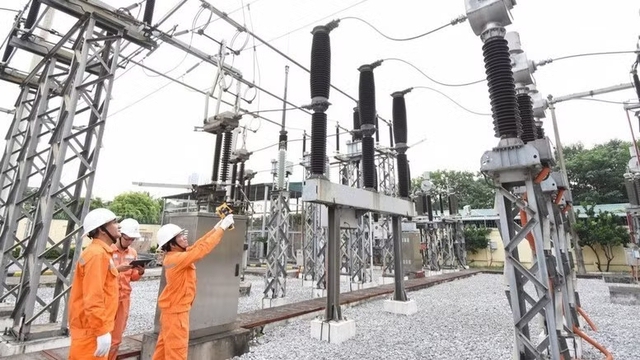
Prime Minister Le Minh Hung orders ministries, localities and relevant agencies to promptly implement measures to ensure sufficient electricity supplies through 2030 and beyond
The Government Office issued Official Dispatch No. 10790/VPCP-CN on October 22, conveying the Prime Minister's instructions to the Minister of Industry and Trade, secretaries of provincial and municipal Party Committees, and Chairpersons of provincial and municipal People's Committees.
The Prime Minister stressed that ensuring national energy security and adequate electricity supply is fundamental to achieving socio-economic development goals and constitutes a particularly important political task for the entire political system.
Accelerating rooftop solar power and energy storage
In the immediate term, the Ministry of Industry and Trade must direct and urge ministries, agencies and localities to accelerate the development of self-produced, self-consumed rooftop solar power systems at households, offices, public buildings, and production and business establishments.
The installation of battery energy storage systems (BESS) should also be encouraged to reduce peak-hour electricity demand and increase on-site energy self-sufficiency.
The Ministry of Industry and Trade must propose rooftop solar development targets for each locality, particularly in northern provinces, specifying the number of installations and deadlines for bringing them into operation. The proposal must be completed before October 30.
By December 2026, the ministry must guide and urge localities to introduce support policies for households installing self-produced, self-consumed rooftop solar systems.
Investors must ensure that the Na Duong 2 and Quang Trach I thermal power plants are completed and begin commercial operation in 2026.
The ministry is also tasked with accelerating eligible concentrated solar power projects, floating solar installations on hydropower reservoirs, and associated grid infrastructure included in the revised Power Development Plan VIII. Priority must be given to projects in northern Viet Nam, including those on the Lai Chau and Son La hydropower reservoirs.
Meanwhile, Viet Nam Electricity (EVN) must study and invest in BESS at substations and other suitable locations, with the systems scheduled to become operational in 2027.
By December, the Ministry of Industry and Trade, in coordination with the Ministry of Finance, the Ministry of Justice and relevant agencies, must develop mechanisms and guidelines to accelerate energy storage development, particularly rooftop solar power combined with BESS in industrial parks and clusters in northern provinces.
The Prime Minister called for stronger electricity conservation measures, requiring annual savings of at least 3 percent of total national electricity consumption and at least 10 percent during peak hot-weather months from April to July.
Demand management and load shifting must help reduce peak-hour electricity demand by at least 3,000 MW, while power losses across the electricity system must be reduced to below 6 percent.
Reviewing power projects for 2028–2030 and beyond
For the 2028–2030 period and subsequent years, the Ministry of Industry and Trade must coordinate with the Ministry of Finance and major State-owned groups, including EVN, the Viet Nam National Industry–Energy Group (Petrovietnam) and the Viet Nam National Coal and Mineral Industries Group, to review power generation and transmission projects and assign clear responsibilities for implementation.
The ministry must identify projects facing delays, financing difficulties and other obstacles requiring resolution. Where necessary, it must propose the use of State budget funds for urgent power projects and report to the Prime Minister before October 30, 2026.
The Prime Minister also called for tighter oversight of projects after investment licences are issued and strict action against investors that delay implementation or violate regulations.
The Ministry of Industry and Trade will be held accountable if planned projects are not implemented or fail to enter operation on schedule. It will also bear ultimate responsibility if electricity shortages occur under any circumstances.
The urgency of these measures comes amid Viet Nam's continued reliance on coal-fired power, which accounted for around half of the country's electricity generation and imports in the first eight months of 2026. Under the country's current power development plan, coal-fired power generation is to be phased out by 2050.
Bridging the gap between the current energy mix and the long-term phase-out target requires a comprehensive strategy to replace coal's multiple functions in the power system, with alternative sources and supporting infrastructure in place before coal-fired plants are retired.
According to EVN, Viet Nam's total electricity generation and imports reached approximately 322.81 billion kWh in 2025. Coal-fired power plants generated 144.78 billion kWh, accounting for 44.85 percent of the total. Hydropower contributed 33.25 percent, while renewable energy accounted for around 12.5 percent, with gas-fired power and electricity imports making up the remainder.
In the first eight months of 2026, coal-fired power generation reached 119.24 billion kWh, representing 50.6 percent of total electricity generation and imports, up 1.3 percentage points from the same period in 2025.
The above figures underscore the importance of accelerating investment in alternative power sources, energy storage and grid infrastructure to ensure a reliable electricity supply while advancing the country's long-term energy transition./.