
Breakthrough year for transport infrastructure
VGP - Transport infrastructure development has become a hallmark in Viet Nam in 2025.
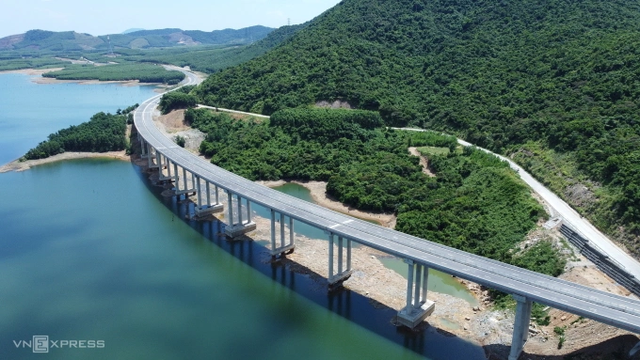
The North–South Expressway, Vung Ang–Bung section, passing through the central province of Ha Tinh - Photo: vnexpress
This year marks a major milestone for the eastern North–South expressway network. A number of projects under the second phase of the North–South Expressway (during 2021–2025) passing through the South Central Coast and the Mekong Delta is set to technically open to traffic on December 19, completing a north–south expressway axis stretching from the northern province of Lang Son to southernmost province of Ca Mau.
Alongside this main north–south axis, key regional connector expressways such as Bien Ho–Vung Tau, Khanh Hoa–Buon Ma Thuot, and Chau Doc–Can Tho–have formed new transport corridors for the Central Highlands and the Southern Key Economic Zone.
Several sections in Ring Road 4 in Ha Noi and Ring Road 3 in Ho Chi Minh City will be technically opened to traffic within the year.
According to the Ministry of Construction, by this year-end, Viet Nam will have 3,803 kilometers of expressways, including 3,345 kilometers of main routes and 458 kilometers of access roads (exceeding the target of 3,000 kilometers).
Over the past five years, nearly 2,000 kilometers have been completed, almost doubling the figure recorded in the previous decade.
With a roadmap to expand the expressway network to 5,000 kilometers by 2030, a modern transport system is expected to become the backbone of national logistics development, stimulate urban urbanization, and enhance Viet Nam's international competitiveness.
Largest airport in Viet Nam welcomes first technical flight
On December 15, Long Thanh International Airport welcomed its first technical flight, preparing for official operations in mid-2026. The airport is expected to become an international transit hub, easing pressure on Ho Chi Minh based-Tan Son Nhat Airport and elevating Viet Nam's position in the regional aviation network.
In Ho Chi Minh City, Terminal 3 at Tan Son Nhat Airport, with a designed capacity of around 20 million passengers per year, was also put into operation this year.
As Terminal 3 mainly serves domestic flights, it helps increase the airport's total capacity to approximately 50 million passengers annually.
In the North, the expansion of Terminal 2 at Noi Bai International Airport has also been completed, meeting strong growth in international travel demand and maintaining its role as the largest international aviation gateway in northern Viet Nam.
Alongside public investment, this year has seen a strong return of private-sector capital in airport development projects such as Quang Tri Airport, the Phu Quoc Airport expansion in the southern province of An Giang, and Gia Binh Airport in the northern province of Bac Ninh.
Gia Binh project has a total investment of VND 195 trillion (US$7.404 billion), targeting a capacity of 30 million passengers by 2030 and 50 million by 2050.
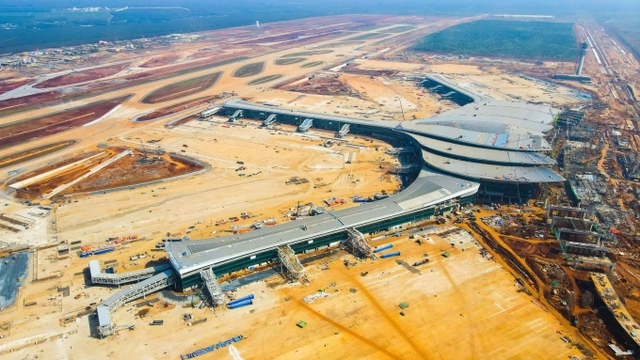
Long Thanh International Airport in the southern province of Dong Nai in the process of constructing its final components, preparing for official operations in mid-2026
Viet Nam's railway and metro development booming
On December 19, construction began on the Lao Cai–Ha Noi–Hai Phong railway project, with a total investment of over VND 203 trillion (US$7.708 billion). It is regarded as a strategic transport axis, linking the economic corridor from the northern border directly to major seaports.
In major cities, the development of metro systems are being accelerated after years of delays. Ha Noi has begun launching Metro Line 2 (Nam Thang Long–Tran Hung Dao) and Line 5 (Van Cao–Hoa Lac). Meanwhile, Ho Chi Minh City has started construction of Metro Line 2 (Ben Thanh–Tham Luong) and Ben Thanh–Can Gio metro line.
Developing seaport system meets int'l standards
In the North, two new deep-water container terminals at Hai Phong City's Lach Huyen port have been put into operation, with an annual handling capacity of 1.5 million TEUs.
Capable of accommodating the world's largest container vessels, the port enables Vietnamese export cargo to be shipped directly to Europe and the U.S. without transshipment.
In the Central region, key project components of the Lien Chieu Port in the central city of Da Nang are under construction. This mega container port is expected to open up a new logistics space for the Central region and the East–West Economic Corridor.
In the South, the Cai Mep–Thi Vai port complex continues to expand its navigation channels and increase channel depth. The ability to receive large vessels ranging from 160,000 to 200,000 DWT enhances operational capacity and reinforces its position as an international transshipment gateway port.
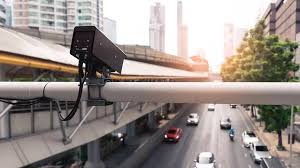
More than 1,800 new AI-powered cameras installed along ring roads, radial routes, and major intersections in Ha Noi
Digital infrastructure enhances urban traffic management
In Ha Noi, the city police have installed more than 1,800 new AI-powered cameras along ring roads, radial routes, and major intersections. The capital aims to deploy more than 40,000 cameras by 2030, including over 16,000 dedicated to traffic safety, environmental management, and urban order.
Meanwhile, Ho Chi Minh City has also installed dozens of AI cameras on central roads and at accident-prone "black spots" to automatically record traffic violations./.