
UNESCO advances STEAM education for girls in Viet Nam
VGP - The launching ceremony of the third phase of the We Are ABLE project to help expand gender-transformative learning opportunities for girls in Viet Nam took place in Ha Noi on March 24.
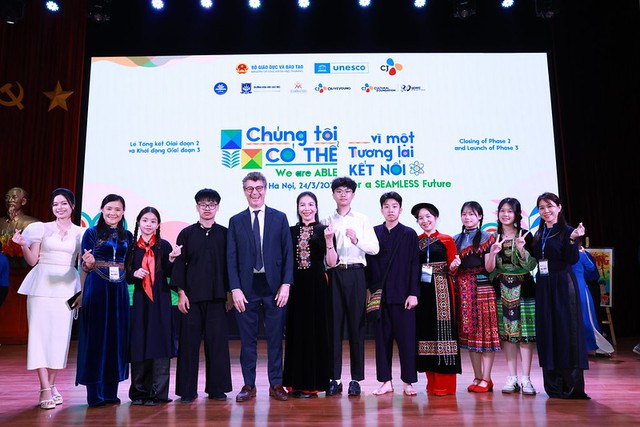
UNESCO Representative to Viet Nam Jonathan Wallace Baker (fifth to left) at the launching ceremony - Photo: unesco.org
The initiative was jointly organized by the UNESCO, the Ministry of Education and Training and CJ Group to strengthen science, technology, engineering, arts/design and mathematics (STEAM) education for girls, particularly those in disadvantaged and ethnic minority communities.
The second phased, carried out from 2023 to 2025, reached more than 8,000 students and their families in Cao Bang, Vinh Long, and Khanh Hoa provinces, strengthened the capacities of more than 650 teachers, and mobilized 300 youth leaders to promote inclusion and gender equality in schools and communities. The initiative contributed to Viet Nam's national policy dialogue on addressing gender gaps in education.
As Viet Nam's demand for STEAM skills grows, girls continue to face barriers to participation, particularly in ethnic minority communities. Women account for only around 37 percent of the STEM workforce, highlighting the need for more gender-transformative approaches.
Over the next three years, Phase 3, themed "We Are ABLE for a Seamless Future: From Learning to Leading through STEAM Education" will support students, especially girls and learners from ethnic minority communities, to build creativity, problem-solving skills and confidence to pursue pathways in science, technology and innovation.
The initiative will focus on three main areas: strengthening the capacities of teachers and education leaders, expanding hands-on learning opportunities for students, and fostering partnerships among schools, businesses, innovation communities and women leaders in science and technology.
Addressing the event, UNESCO Representative to Viet Nam Jonathan Wallace Baker said, with the initiative, UNESCO is honored to support Viet Nam in creating learning environments where all students can imagine, innovate and lead.
Approximately 6,000 students, including 3,000 girls, are expected to benefit directly from the phase 3. The initiative contributes to Viet Nam's national priorities to improve education quality, reduce gender gaps in science and technology, and prepare future talent, recognizing that quality education is key to achieving the Sustainable Development Goals./.