
Ha Noi honored with UNESCO “Global Learning City” recognition
VGP - The Ha Noi People’s Committee held a ceremony on January 29 at Van Mieu – Quoc Tu Giam (the Temple of Literature) to receive UNESCO’s recognition of the capital as a member of the Global Network of Learning Cities.
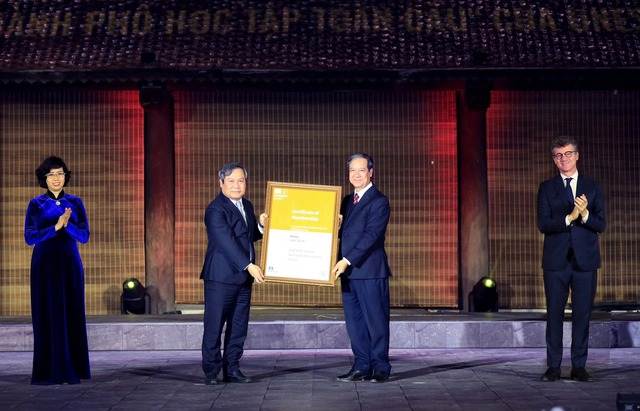
Chairman of the Ha Noi municipal People's Committee Vu Dai Thang (L) and Minister of Education and Training (MOET) Nguyen Kim Son receive the UNESCO’ Certificate recognizing the capital city as a member of the Global Network of Learning Cities.
The designation represents international recognition of Ha Noi's sustained and innovative efforts to build a comprehensive learning society, where all citizens have access to lifelong learning opportunities, contributing to sustainable, creative and inclusive socio-economic development.
Chairman of the Ha Noi municipal People's Committee Vu Dai Thang said the capital has prioritized improving institutional frameworks and policies, increasing investment in education and training, and fostering an open, flexible and inclusive learning environment to enable lifelong learning for all.
He noted that the recognition further enhances Ha Noi's prestige and cultural legacy already acknowledged by UNESCO, demonstrating to the international community the city's consistent commitment to building an education system grounded in peace, equity and sustainable development – key pillars of a "City for Peace" and a "Creative City".
The title also promotes deeper international integration through expanded cooperation and knowledge-sharing with more than 400-member cities across 91 countries. Stressing that the development of a learning city is an ongoing journey, Thang expressed confidence that with its millennia-old cultural heritage, Ha Noi will become an exemplary learning city and a beacon of wisdom and humanity regionally and globally.
UNESCO Chief Representative to Viet Nam Jonathan Wallace Baker said the recognition is both an honor and a responsibility for Ha Noi. It reflects the city's long-standing commitment to placing people, learning and inclusion at the centre of development, while reaffirming its determination to build an inclusive learning society where no one is left behind.
UNESCO hopes Ha Noi will continue to inspire and support other localities, helping expand the global learning city movement so that lifelong learning becomes a shared foundation for sustainable development, he said.
Baker also praised Ha Noi's pioneering role in promoting equity and inclusion, particularly in ensuring meaningful learning opportunities for women and girls, older persons, young people and vulnerable groups. He highlighted the city's application of UNESCO's Happy Schools Initiative, which integrates learners' mental wellbeing, positive relationships, safe and green environments and psychosocial support into quality education, noting that effective learning must also be humane.
As Viet Nam's leading political, economic, cultural and educational hub, Ha Noi plays a central role in training high-quality human resources and nurturing talent. The capital hosts more than 70 percent of the country's universities, research institutes and science and technology organizations, accounting for 82 percent of laboratories and over 65 percent of Viet Nam's top scientists./.