To Lam holds talks with European Council President António Costa
VGP - General Secretary and President To Lam held talks with European Council President António Costa in Brussel, Belgium, on October 22 (local time).
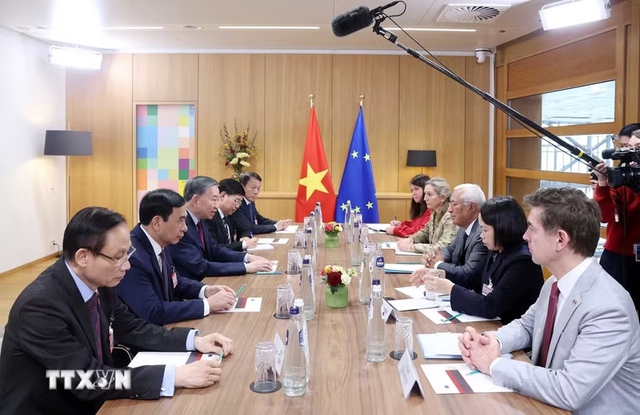
General Secretary and President To Lam holds talks with European Council President António Costa, Brussel, Belgium, October 22 (local time), 2026 - Photo: VNA
Costa reiterated that Viet Nam is an important partner of the EU in the Indo-Pacific region, expressing his confidence that both sides would continue to build on their foundation of political trust and positive cooperation outcomes to deepen their Comprehensive Strategic Partnership.
He reaffirmed the EU's willingness to strengthen substantive cooperation with Viet Nam via effectively implementing EU programs and initiatives, including the Global Gateway strategy, promote high-quality investment, develop sustainable connectivity infrastructure, and advance energy transition.
The host underscored the importance of strengthening cooperation in experience-sharing and capacity-building in maritime security and safety, cybersecurity and crisis management; joining hands in responses to non-traditional challenges, particularly climate change and emerging challenges related to technology and artificial intelligence.
The EU attaches importance to strengthening its relations with ASEAN, with Viet Nam being one of its leading partners, as the EU and ASEAN work towards upgrading their relations into a Comprehensive Strategic Partnership by 2027, marking the 50th anniversary of the establishment of their ties, stated Costa.
He reiterated the EU's support for ASEAN centrality and Viet Nam's principled stance on the peaceful settlement of disputes in accordance with international law, particularly the 1982 United Nations Convention on the Law of the Sea (UNCLOS), thereby maintaining peace, stability, security, safety and freedom of navigation and overflight in the seas and oceans.
To, for his part, spoke highly of the role of the European Council and President Costa personally in shaping the EU's strategic priorities, enhancing unity and consensus among member states, strengthening the bloc's autonomy and resilience, and contributing to peace, stability, cooperation and development in the region and around the world.
Viet Nam considers the EU one of its foremost priority partners, with substantial shared interests and considerable potential for long-term cooperation, he noted, adding that the Southeast Asian nation expects to translate commitments into concrete results and practical cooperation projects that support development and improve the livelihoods of people on both sides.
He urged both sides to further boost economic, trade and investment cooperation and continue to utilize the potential and advantages offered by the EU-Viet Nam Free Trade Agreement (EVFTA).
To expressed thanks to the EU for recognizing Viet Nam's efforts and removing the country from Annex I of the EU list of non-cooperative jurisdictions for tax purposes.
The guest called for closer coordination to swiftly resolve long-standing issues, including lifting the EU's "yellow card" warning against Vietnamese seafood exports, and speeding up the ratification of the EU-Viet Nam Investment Protection Agreement (EVIPA).
The two leaders welcomed the positive development of Viet Nam-EU relations after more than 36 years of diplomatic ties, particularly following the elevation of bilateral relations to a Comprehensive Strategic Partnership in January this year.
They vowed to step up all-level dialogue, contacts and exchanges, particularly at the highest level, to consolidate political trust and enhance mutual understanding.
Sharing a common vision of developing a sustainable blue economy, protecting the oceans and ensuring maritime security, the two leaders underlined the need to promote marine economic cooperation as a new pillar of the bilateral relations.
They vowed to strengthen exchanges, consultation and coordination at multilateral forums, uphold multilateralism, the United Nations Charter and international law, and further promote ASEAN-EU relations, thereby contributing positively to peace, stability, cooperation and development in the Indo-Pacific region./.