Speech by Prime Minister Le Minh Hung at Autumn Economic Forum 2026
VGP - Below is the speech delivered by Prime Minister Le Minh Hung on October 28 at the high-level plenary session of the Autumn Economic Forum in Ho Chi Minh City.
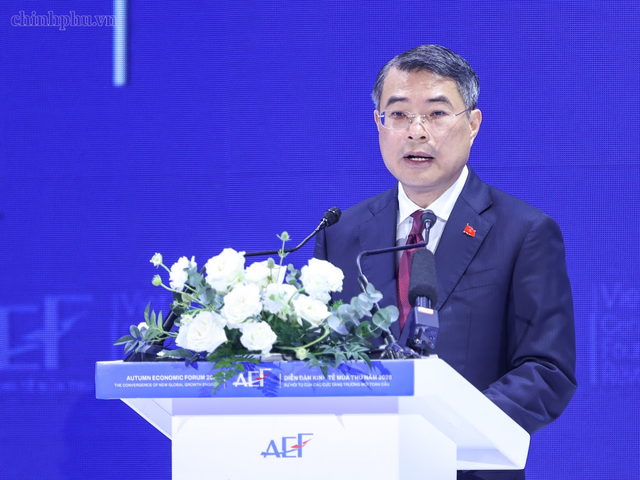
Prime Minister Le Minh Hung addresses the high-level plenary session of the Autumn Economic Forum in Ho Chi Minh City, October 28, 2026. Photo: VGP
Mr. Stephan Mergenthaler, Managing Director of the World Economic Forum,
Heads of Delegations, Ambassadors, Representatives of International Organizations in Viet Nam, Business Leaders, Experts, and Scholars,
Leaders of Central Commissions, Ministries, Agencies, and Localities,
On behalf of the Government of Viet Nam, I would like to extend a warm welcome to all distinguished guests gathering in Ho Chi Minh City for the Autumn Economic Forum 2026 – Convergence of New Global Growth Poles.
I express my sincere appreciation to the World Economic Forum (WEF) and our partners for their steadfast companionship over the years, thereby contributing to making the Autumn Economic Forum an open, substantive platform for dialogue among the Government, businesses, and the scientific community.
The networking activities, policy exchanges, knowledge sharing, and technology showcases over the past two days demonstrate the deep interest, trust, and commitment to cooperation from the international community toward Viet Nam as a whole, and toward key innovation hubs and growth poles like Ho Chi Minh City in particular. At the same time, these efforts have opened up numerous opportunities to connect and identify new growth drivers.
The Forum's theme, "Spirit of Cooperation in a New Era," poses a timely question: In a rapidly changing global context marked by rapid fluctuations and changes, how can we cooperate not only to adapt to changes and overcome challenges, but also to proactively build new drivers of development for a better future?
Ladies and Gentlemen,
The world is undergoing profound transformations that present new development opportunities while posing formidable challenges to nations. Strategic competition among major powers is intensifying; conflicts and wars persist in various forms, leading to increasingly stronger multipolar trends, policy adjustments, economic fragmentation, and supply chain restructuring; while traditional and non-traditional security challenges become increasingly complex and intertwined.
Meanwhile, breakthrough developments in science and technology—particularly artificial intelligence—alongside digital transformation, green transition, and energy transition are fundamentally reshaping production methods, development models, and global growth structures.
In this context, enhancing self-reliance and strengthening international cooperation are two closely linked imperatives. No country can achieve rapid and sustainable development in isolation; no global challenge can be effectively resolved through unilateral efforts alone.
More than ever, the world needs to reinforce trust, uphold multilateralism, enhance dialogue, and promote cooperation grounded in respect for international law and the legitimate interests of all nations.
In this new stage of development, only solidarity and cooperation—sharing responsibility, taking collective action, integrating markets and resources, and connecting knowledge, technology, and people—can deliver sustainable and inclusive development while building resilience against future shocks and volatility.
Furthermore, cooperation must move beyond declarations or commitments to be translated into substantive mechanisms, feasible projects, and tangible, measurable outcomes.
Ladies and Gentlemen,
Throughout Viet Nam's reform process, deepening international integration has consistently been a firm policy and a strategic priority aimed at harnessing internal strengths and leveraging external resources for national construction and development.
Guided by a policy of proactive, active, comprehensive, and effective international integration, Viet Nam has transformed from a country facing severe hardships into a dynamic economy with remarkably high GDP growth, a safe and attractive investment destination, a reliable partner, and an active, responsible member of the international community.
In the first nine months of 2026, Viet Nam's economy sustained strong growth alongside solid macroeconomic stability, controlled inflation, and guaranteed major economic balances. Nine-month GDP growth reached 9.01 percent, the highest rate since 2011; total import-export turnover exceeded US$987 billion to date, a year-on-year increase of over 30 percent, and is projected to surpass US$1,100 billion for the full year 2026. In October 2026 alone, Viet Nam achieved a trade surplus of over US$5.7 billion. Registered FDI reached US$50.36 billion (up 76.4 percent), realized FDI reached US$21.07 billion (up 12.1 percent), and total social investment capital in the first nine months reached over US$120 billion (up 15.1 percent). In the 2026 Global Innovation Index, Viet Nam ranked 43rd out of 139 economies, leading the world in the proportion of high-tech exports and creative goods exports as a share of total trade volume. Viet Nam also officially joined the upper-middle-income group in July 2026.
Today, Viet Nam is entering a new stage of development with the utmost determination and effort to successfully realize its two 100-year strategic goals: becoming a developing country with modern industry and upper-middle income by 2030, and a developed, high-income nation by 2045.
We identify the 2026–2030 period as a pivotal phase, striving for an average annual GDP growth rate of 10 percent or higher, anchored in maintaining macroeconomic stability, controlling inflation, safeguarding major balances, enhancing growth quality, and ensuring sustainable development.
To realize these goals, Viet Nam has mapped out a strategic roadmap to decisively reform its development model; strengthen the capacity, quality, and competitiveness of the economy; revitalize traditional growth drivers while developing new economic sectors driven primarily by science, technology, innovation, and digital transformation; and comprehensively advance culture, education, healthcare, and social development.
In this new era, Viet Nam's international integration is being elevated to a higher level. We affirm that high growth must go hand-in-hand with higher productivity; attracting foreign investment must be aligned with enhancing domestic corporate capacity; and deep integration must be coupled with boosting economic resilience and self-reliance. This is not only a process of reforming the growth model, but also a fundamental shift in development mindset, national governance, and the ways we connect and collaborate globally.
In this spirit, Viet Nam is vigorously reforming and perfecting its laws, institutions, and national governance in alignment with international standards and practices. This developmental orientation aims to unlock new development space, thoroughly remove institutional bottlenecks, and enable localities, regions, and growth poles—especially mega-cities—to unleash their full potential.
At the same time, we are comprehensively implementing strategic policies to advance science, technology, innovation, and digital transformation; foster comprehensive education and high-quality human resources; and strongly encourage the development of the private sector, state-owned enterprises, and the quality and efficiency of foreign-invested sectors.
These directions convey a consistent message: Viet Nam not only seeks to remain an attractive destination for capital flows and emerging technologies, but is determined to become an increasingly reliable partner, a key link in global supply and value chains, an innovation hub, and a place where partners co-create new development models and growth drivers.
To foster the "Spirit of Cooperation in a New Era," we hope international partners will not merely "invest in Viet Nam," but "invest with Viet Nam"; not just "produce in Viet Nam," but partner in research and development (R&D), foster innovation, and co-create new value chains with regional and global competitiveness.
In that spirit, I propose several concrete areas for our discussion today:
First, accelerating co-innovation partnerships between multinational corporations and Vietnamese local authorities/businesses. Leveraging its strategic geographical location, natural resources, and human capital, Viet Nam must evolve from a production base into an R&D hub, particularly in strategic technology sectors such as artificial intelligence, semiconductors, and advanced materials.
Second, partnering with WEF and global entities on programs to nurture digital and advanced scientific-technological talents, assisting Vietnamese enterprises and workforce in building capacity to adopt, apply, and master advanced technologies.
Third, exploring regulatory sandboxes for strategic technologies. Viet Nam stands ready to collaborate with tech corporations to establish controlled testing environments (sandboxes), enabling the rapid, safe, and widespread deployment of pioneering technologies like AI and new energy in practical applications.
Fourth, strengthening cooperation to mobilize medium- and long-term capital for development. The international financial center in Ho Chi Minh City and Da Nang can and will serve as effective bridge connecting global long-term capital with Viet Nam's development needs in infrastructure, energy, green transition, and innovation.
Ladies and Gentlemen,
Today, no country can achieve sustainable development by soley pursuing its interests. Viet Nam remains ready to be a friend, a reliable partner, and an active, responsible member of the international community. We stands ready to listen, learn, share experiences, and walk alongside our partners to address common challenges and shape new growth opportunities.
The Government of Viet Nam expects that, with the partnership of the World Economic Forum and partners, the Autumn Economic Forum will become a vibrant platform to initiate practical cooperative initiatives, delivering tangible and long-lasting outcomes. The Government of Viet Nam values the candid insights of the business community; for every feasible proposal, we will designate a clear lead agency; for every potential project, a concrete roadmap will be established; and for every legitimate concern, responsible authorities will be tasked to resolve it promptly.
The four pillars of this year's Forum—the role of mega-cities; breakthrough technologies and innovation ecosystems; models of cooperation in a new era; and the role of the private sector—must be integrated into a unified action plan that is focused, targeted, and outcome-oriented. In this framework, the Government acts as an enabler of institutions and development environments; local authorities proactively and decisively implement policies; domestic and foreign enterprises pioneer in investment and innovation; the scientific community provides knowledge and solutions; and international partners share expertise and co-deploy resources.
Ladies and Gentlemen,
The future belongs not merely to nations with the largest resources or the most advanced technologies, but to those capable of connecting resources, inspiring creativity, and collaborating effectively for the common good. At today's Forum, Viet Nam sends a clear message: ready to cooperate for mutual development; ready to share for collective progress; ready to innovate to co-create value; and ready to act for a peaceful, stable, prosperous, and sustainable future.
I wish the Forum great success.
I wish you all good health, happiness, and continued success.
Thank you very much./.