THE SOCIALIST REPUBLIC OF VIET NAM
Government News
Vietnamese, Chinese foreign ministers hold talks in Beijing
VGP - Le Hoai Trung, Vietnamese Minister of Foreign Affairs and Special Envoy of the General Secretary held talks with Chinese Minister of Foreign Affairs Wang Yi in Beijing on February 3, during which the two sides agreed to further cement and deepen and substantiate bilateral relations.
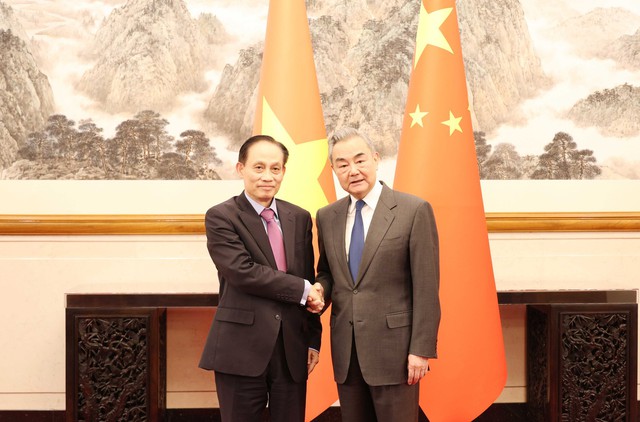
Vietnamese Minister of Foreign Affairs and Special Envoy of the General Secretary Le Hoai Trung (L) and Chinese Minister of Foreign Affairs Wang Yi, Beijing on February 3, 2026 - Photo: VNA
The two foreign ministers held in-depth discussions on measures to effectively implement high-level agreements and common perceptions reached by leaders of the two Parties and States, in line with the six major orientations guiding Viet Nam–China relations. They also exchanged views on regional and global issues of mutual concern, pledging to strengthen multilateral coordination and make responsible contributions to peace, cooperation, and development in the region and the world.
Le briefed Wang on the key outcomes and success of the 14th National Congress of the Communist Party of Viet Nam (CPV), highlighting its new theoretical and practical insights. He reaffirmed the CPV's determination to implement the Congress' guidelines, overall goals, key tasks, and strategic breakthroughs, aiming for rapid and sustainable development and the building of a developed country with a socialist orientation.
The Vietnamese minister also outlined new thinking in the CPV's foreign policy as set out at the 14th Congress, notably the addition of "self-strengthening" to the longstanding principles of independence, self-reliance, peace, friendship, cooperation, development, and the multilateralization and diversification of external relations. For the first time, diplomacy and international integration are defined as "key and regular" task on par with national defense and security.
He suggested the two countries tclosely coordinate to successfully organize upcoming high-level visits, enhance substantive cooperation in emerging priority areas such as science and technology, innovation, and high-quality human resource training, and accelerate strategic transport connectivity, particularly railway links. He also called for increased high-quality investment flows, more balanced and sustainable economic and trade ties—including greater imports of Vietnamese agricultural and aquatic products—and stronger cooperation in culture, health care, and people-to-people exchanges to further solidify the social foundation of bilateral relations.
For his part, Wang congratulated the CPV on the successful organization of its 14th National Congress. He affirmed that the Communist Party of China (CPC) Central Committee, with Xi Jinping at its core, consistently supports the CPV, led by General Secretary To Lam, in guiding the Vietnamese people to successfully implement the Congress' Resolution and advance socialism suited to Viet Nam's conditions in the new era.
Wang noted that the Chinese Party and State attach great importance to consolidating and developing relations with Viet Nam and to promoting the building of a China–Viet Nam community with a shared future of strategic significance. He expressed China's readiness to facilitate high-level and all-level exchanges, enhance Party-to-Party cooperation, and further strengthen political trust.
He also proposed boosting cooperation in areas of shared needs and strengths, with a focus on standard-gauge railway connectivity, cross-border economic cooperation, breakthroughs in science and technology collaboration, and the development of new-quality productive forces. Wang stressed the importance of sustaining people-to-people exchanges, particularly among younger generations, to strengthen public support for bilateral relations./.