THE SOCIALIST REPUBLIC OF VIET NAM
Government News
Singapore highly values Viet Nam's development prospect: Prime Minister Lawrence Wong
VGP - Singapore highly appreciates Viet Nam’s role, potential, and development prospect, and wishes to continue accompanying the country in its development process, underlined Prime Minister Lawrence Wong.
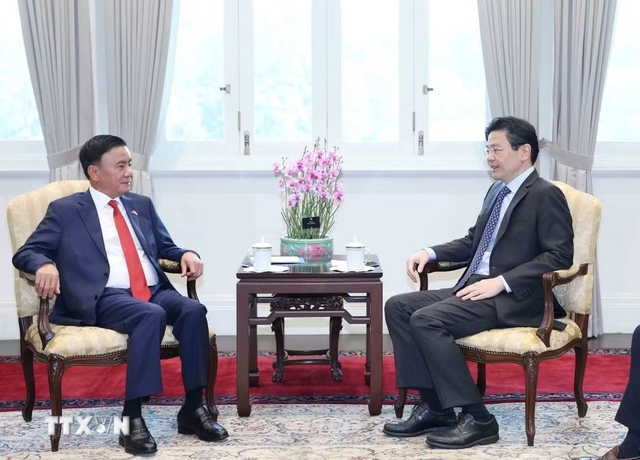
Standing member of the Communist Party of Viet Nam (CPV) Central Committee's Secretariat Tran Cam Tu (L) pays a courtersy call on Prime Minister Lawrence Wong, Singapore, August 25, 2026 - Photo: VNA
Wong made that above statement during his meeting with Politburo member, Standing member of the Communist Party of Viet Nam (CPV) Central Committee's Secretariat Tran Cam Tu in Singapore on August 25.
The Prime Minister highlighted the significance of the visit and the first-ever Viet Nam–Singapore Strategic Dialogue, describing it as a new development in bilateral relations that emcompasses the three pillars of external relations—Party-to-Party diplomacy, State diplomacy, and people-to-people diplomacy—thereby strengthening political trust and injecting new momentum for the Comprehensive Strategic Partnership between the two countries.
There remains vast room for both sides to move cooperation beyond traditional areas toward fields with greater technological, knowledge-based, and value-added content, said Lawrence Wong.
Tran, for his part, affirmed that Viet Nam treasures the relations with Singapore and expects to work with Singapore to further advance the Comprehensive Strategic Partnership in a deep, substantive, and effective manner, in line with the interests and long-term development visions of both countries.
The two sides agreed that putting the Strategic Dialogue mechanism into operation would open up a channel for direct, regular, and strategic-level exchanges between the two Parties.
Through this mechanism, leaders from both sides can engage in in-depth discussions on Party building, policy formulation, governance, and national development, while sharing views on strategic issues of common concern, thereby strengthening the guiding role of the Party-to-Party channel in bilateral relations, they stressed.
The two leaders pledged to maintain all-level delegation exchanges and contacts, make full use of existing cooperation mechanisms, and strengthen linkages between Party and State agencies, the National Assembly, localities, and people's organizations, creating a strong political foundation for the effective implementation of the Comprehensive Strategic Partnership.
The two sides affirmed that science, technology, and innovation should become an important pillar of Viet Nam–Singapore relations.
They vowed to strengthen connectivity in emerging technologies, artificial intelligence, digital transformation, the digital economy, semiconductor technology, clean energy, and green finance; leverage the complementary strengths of the two innovation ecosystems; and promote linkages among research centers, universities, businesses, and innovation organizations.
The Vietnamese leader proposed promoting a cross-border innovation cooperation model based on the "three stakeholders of the two countries," strengthening linkages among the government, academia, research institutes, and businesses of Viet Nam and Singapore.
Under this model, entities from the two countries could jointly conduct research, co-develop and co-produce products, and jointly create value to serve each country's development needs, with a view to providing competitive products and solutions for the ASEAN and regional markets.
The two leaders agreed to expand exchange programs and share experience in Party building, governance, policy formulation, official training, and human resource development for the political systems of both countries, regarding these as one of the foundations for long-term and sustainable cooperation.
Both sides concurred to translate shared understandings and high-level agreements into concrete programs and projects with clear objectives, roadmaps, and deliverables, with businesses serving as one of the central forces in bringing cooperation agreements into practice.
The two leaders pledged both countries will continue close coordination within ASEAN and multilateral mechanisms, contributing to the reinforcement of ASEAN solidarity and unity, resilience, and centrality in the regional architecture./.