
THE SOCIALIST REPUBLIC OF VIET NAM
Government News
How much Vietnamese workers pay for employment abroad?
VGP - The average amount paid by Vietnamese migrant workers to secure employment abroad decreased by 23.8 per cent, from VND 164.9 million (US$6,342) in 2021 to VND 125.7 million (US$4,834) in 2025.
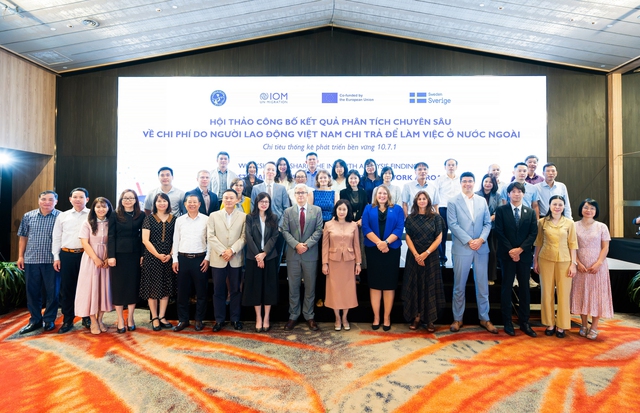
Delegates attend the workshop announcing the report "In-depth Analysis Report of Costs Borne by Vietnamese Workers for Employment Abroad – Statistical Sustainable Development Goal Indicator 10.7.1", Ha Noi, September 8, 2026 - Photo: VGP
The above figures were released in the report "In-depth Analysis Report of Costs Borne by Vietnamese Workers for Employment Abroad – Statistical Sustainable Development Goal Indicator 10.7.1", which was announced at a workshop held in Ha Noi on September 8.
The workshop brought together leaders and representatives from government ministries and agencies, United Nations agencies, development partners, academia and other relevant organizations to discuss the role of official labor migration statistics in informing policymaking, strengthening labor migration governance, protecting migrant workers and monitoring Viet Nam's progress towards the Sustainable Development Goals (SDGs).
The report was prepared by the National Statistics Office (NSO), drawing on data from the 2025 Labour Force Survey and the 2025 In-depth Survey of Migrant Workers1 with technical support from the International Organization for Migration (IOM) for the survey and analysis, and funding from the European Union (EU) and the Government of Sweden.
According to the report, Viet Nam continues to make progress in developing and using comprehensive, reliable and timely statistical data to monitor labor migration.
The report highlights several positive trends. Average earnings during the first month of employment abroad increased by 25.4 per cent, from VND 22.4 million (US$862) to VND 28.1 million (US$1,080).
As a result, SDG Indicator 10.7.1, which measures the total costs borne by workers to obtain employment abroad as a proportion of their earnings during the first month of employment at destination, fell from 7.4 in 2021 to 4.5 in 2025.
This means that the average cost of securing employment abroad was equivalent to approximately 4.5 months of earnings in 2025, compared with 7.4 months in 2021.
In addition to the overall findings, the report provides analysis by sex, area of residence, skill level, destination country and job-search channel, highlighting the diversity of characteristics and experiences among different groups of Vietnamese workers employed abroad.
The 2025 In-depth Survey of Migrant Workers also provides additional insights into specific aspects of the labor migration experience, including working conditions, access to support mechanisms, employment status upon return, the use of acquired skills, and intentions to re-migrate in the future. These findings shed further light on the factors shaping migrant workers' experiences and provide evidence to support policy analysis.
Addressing the event, Director General of the National Statistics Office Nguyen Thi Huong emphasized, statistical data provide a more comprehensive picture of Vietnamese workers employed abroad, their migration journeys and the factors influencing their migration decisions. In doing so, they provide evidence to support research and analysis, as well as the monitoring of development goals.
Migration is not only a labor issue, but also a development issue that requires cooperation across institutions, sectors and borders, Deputy Head of Cooperation, Delegation of the European to Viet Nam Gonzalo Serrano De La Rosa.
Through a Team Europe approach, encompassing the EU and EU Member States, we are committed to working with Viet Nam and our partners to strengthen the evidence and institutional capacity needed for effective migration governance. By investing in people, knowledge and informed policymaking, we can help ensure that labor mobility supports sustainable development and creates lasting benefits for societies and economies", he shared.
Looking ahead, the report recommends continued efforts to strengthen the international labor migration data system, improve the continuity and comparability of data, and enhance the effective use of data in policy development and implementation.
These efforts are important for advancing safe, orderly and regular migration and strengthening the protection of migrant workers' rights and legitimate interests./.