
THE SOCIALIST REPUBLIC OF VIET NAM
Government News
EuroCham: Resolution No. 10-NQ/TW boosts European investors' confidence in expanding presence in Viet Nam
VGP - The Politburo's Resolution No. 10-NQ/TW has been widely welcomed by the European business community as a major shift in Viet Nam's investment attraction strategy—from focusing primarily on capital inflows to building a high-quality FDI ecosystem, according to EuroCham Chairman Bruno Jaspaert.
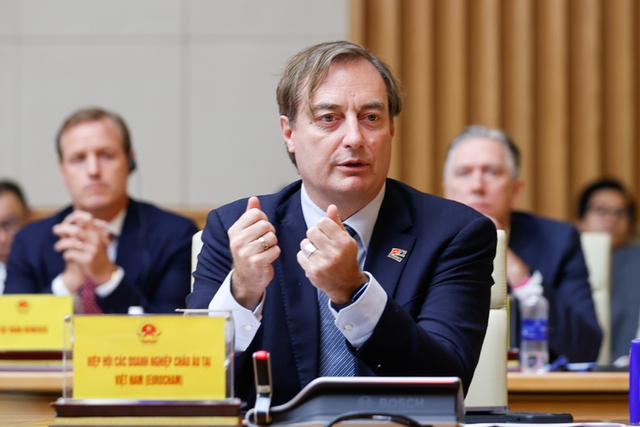
EuroCham Chairman Bruno Jaspaert
Speaking to the Government News, Jaspaert highlighted the opportunities the Resolution creates for European businesses, as well as the areas Viet Nam should continue improving to become a leading destination for high-tech, innovation-driven and green investment.
New opportunities for European investors in Viet Nam
Jaspaert said Resolution No. 10 is significant because it sends a clear message about how Viet Nam views foreign investors. For many years, foreign direct investment was largely regarded as a source of capital and employment. Today, that perspective has evolved significantly. The Government has made it clear that foreign-invested enterprises are expected to become long-term partners in Viet Nam's development, contributing not only capital but also technology, innovation, skills and sustainable development.
For European businesses, that distinction is particularly important. Investment decisions are made with a long-term horizon measured in decades rather than quarters. When the Government formally recognizes FDI as an integral part of the economy and backs that vision with reforms to improve the investment climate, it gives corporate boards greater confidence to make long-term investment decisions and expand their operations.
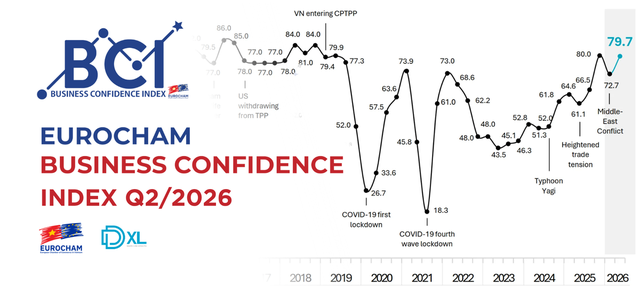
The Q2 2026 Business Confidence Index (BCI) report reveals a renewed surge in European business confidence, with the index rising to 79.7 points in Q2 from 72.7 in Q1, underscoring Viet Nam's resilience amid volatile global environment.
The timing is equally strategic. Companies are navigating one of the most volatile global business environments in recent history, yet EuroCham's Business Confidence Index (BCI) reached 79.7 points in the second quarter of 2026, approaching its highest level in seven years. More than half of EuroCham members now regard Viet Nam as one of their core strategic markets, while 69 percent expect business conditions to improve further in the coming quarter.
The BCI reflects the broader macroeconomic picture as Viet Nam continues to strengthen its position as one of Asia's fastest-growing economies. In the first half of 2026 alone, the country's GDP expanded by an impressive 8.18 percent. Combined with Viet Nam's rise to 27th place in IMD's World Competitiveness Ranking and FTSE Russell's planned upgrade of Viet Nam to Secondary Emerging Market status this September, the message is unmistakable.
"What truly distinguishes Viet Nam in an increasingly competitive region is that the Government is not merely talking about growth but is institutionalizing that ambition through national resolutions and proactively implementing institutional reforms to achieve it," Jaspaert said.
The conversation has now shifted from attracting investment at all costs to attracting the right quality of investment. Resolution No. 10 further reinforces that transition. Together with reforms to administrative procedures and policies promoting innovation and private sector development, the Resolution signals that Viet Nam intends to compete on quality rather than simply low costs. That is precisely the direction European investors have been looking for.
Accompanying Viet Nam's green transition
Jaspaert stressed that European businesses have long viewed sustainability not as a compliance exercise but as a core business strategy.
As Europe advances its Green Deal and net-zero ambitions, European companies are increasingly looking for investment destinations where economic growth goes hand in hand with environmental protection, efficient resource use and responsible governance. This is where Viet Nam has a tremendous opportunity.
EuroCham serves as a bridge between European investors and Vietnamese policymakers and regulators. Through regular policy dialogues and constructive public-private engagement with ministries and agencies, EuroCham continuously advocates for a regulatory framework that facilitates sustainable investment flows. This includes discussions on environmental impact assessments, licensing procedures, renewable energy development, circular economy policies and the adoption of Environmental, Social , and Governance) - ESG standards, with the aim of ensuring that environmental considerations are integrated into investment decisions from the outset.
For European companies committed to ESG principles, sustainability is not only about deploying green technologies, but also about creating the right ecosystem to support them. Meeting Europe's sustainability requirements depends on a skilled workforce of engineers, environmental specialists and compliance professionals capable of implementing increasingly sophisticated standards. It also requires efficient product testing procedures, internationally recognized certification systems and transparent conformity assessment processes. When testing or certification takes longer than in competing markets, businesses face longer time-to-market.
Administrative efficiency is another key driver of sustainability. Companies should be able to devote more resources to innovation, carbon reduction and workforce development rather than navigating overlapping approval procedures or inconsistent implementation. Every unnecessary delay slows the deployment of greener technologies.
Viet Nam has demonstrated remarkable ambition through its commitment to achieving net-zero emissions by 2050 and Resolution No. 10's focus on attracting high-quality investment.
The next step is to ensure that the supporting ecosystem keeps pace by developing a highly skilled talent pool, strengthening testing and standards infrastructure, and continuing to streamline administrative procedures.
Together, these factors will be just as critical to Viet Nam's competitiveness as investments in expressways, industrial parks and other physical infrastructure.
Resolution No. 10-NQ/TW marks a strategic shift in Viet Nam's approach to foreign direct investment (FDI), recognizing the foreign-invested sector as an integral part of the national economy and a key driver of long-term development.
The Resolution aims to attract high-quality, technology-driven, innovation-oriented and environmentally sustainable investment, moving beyond a focus on capital inflows. It prioritizes projects that promote technology transfer, innovation, digital transformation, green growth, research and development (R&D), and stronger linkages between foreign-invested enterprises and domestic businesses.
To achieve these goals, the Resolution calls for continued reforms to improve the investment climate, including streamlining administrative procedures, enhancing policy transparency and predictability, developing high-quality human resources, upgrading infrastructure, and strengthening institutions. It also seeks to ensure fair competition and create a stable, efficient and internationally competitive business environment.
Ultimately, Resolution No. 10 aims to position Viet Nam as a leading destination for high-value FDI while leveraging foreign investment to enhance productivity, competitiveness and sustainable economic growth.