
Nordic countries share experience to support Viet Nam’s reform and digital transformation
VGP - Digitalization serves as a powerful enabler, but institutional clarity and public trust remain fundamental. As Viet Nam’s ongoing reforms demonstrate a strong commitment to modernization and institutional strengthening, the Nordic countries also stay committed to maintain dialogue and cooperation with Viet Nam towards these goals in the country’s new era of development.
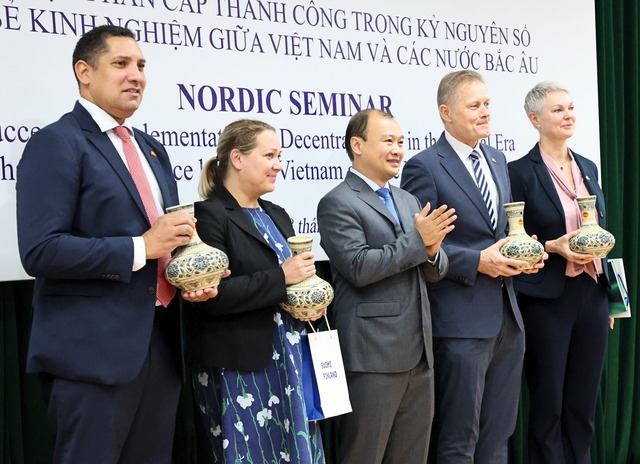
Associate Professor, Dr Le Hai Binh, Member of the Party Central Committee and Permanent Vice President of the Ho Chi Minh National Academy of Politics (center) presets gifts for the four Nordic ambassadors, Ha Noi, March 18. 2026 - Photo: VGP/Huong Giang
Within the framework of the cooperation programme, the Ho Chi Minh National Academy of Politics, in coordination with the Nordic Embassies (Denmark, Finland, Norway and Sweden), co-organised the 9th Annual Nordic Seminar under the theme: "Successful implementation of decentralization in the digital era - sharing experience between Viet Nam and the Nordic Countries" on March 18 in Ha Noi.
This year's conversations were closely aligned with Viet Nam's current priorities and serves as a strategic forum for policymakers and experts to exchange high-level governance experiences. Discussions centred on building a modern welfare state, optimizing taxation, and leveraging digital transformation to ensure that public services are effective, transparent, and citizen-centred. These efforts aim to strengthen institutional performance and support the country's next phase of development.
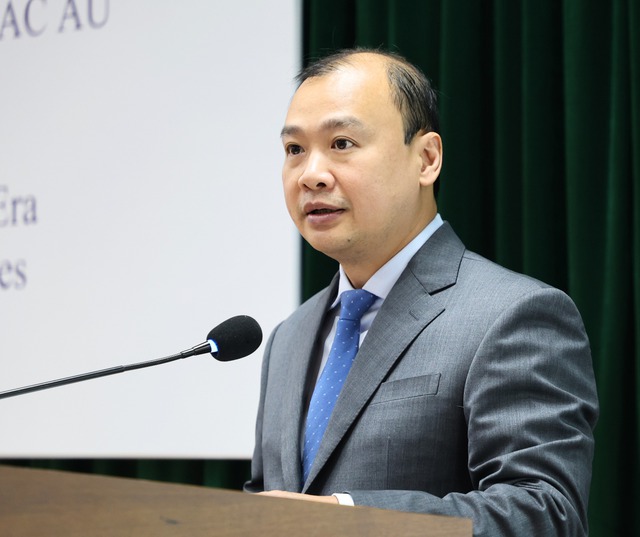
Associate Professor, Dr Le Hai Binh, Member of the Party Central Committee and Permanent Vice President of the Academy - Photo: VGP/Huong Giang
Associate Professor, Dr Le Hai Binh, Member of the Party Central Committee and Permanent Vice President of the Academy said that the seminar would provide both scientific basis and practical references for improving institutional frameworks and governance practices in Viet Nam, as well as supporting training, capacity-building, research and policy advisory activities at the Academy and nationwide.
It would also help to further strengthen and deepen the longstanding cooperation and friendship between Viet Nam and the Nordic countries.
Nordic perspectives offered unique experiences on decentralization, digital governance, and public service delivery. As the Nordic Ambassadors stated: "Decentralization in the digital era is not only about transferring authority, it is about strengthening public trust, accountability and service delivery. The Nordic experience shows that digital tools, when combined with clear institutional roles and fiscal responsibility, can empower local governments while ensuring national coherence. At the same time, digital solutions must be user-friendly, accessible and inclusive, designed not only for the digitally advanced, but also for citizens with limited digital literacy. We are pleased to share our experiences and support Viet Nam's reform and digital transformation journey."
The Nordic countries consistently rank among the world's top performers in welfare provision, digital transformation and public administration. Their governance models are widely recognized for combining universal social protection, advanced digital public services and high levels of transparency and public trust.
The seminar demonstrated clear momentum for continued Nordic–Viet Nam cooperation on digital governance and public‑sector innovation, with both sides identifying concrete opportunities for joint progress.
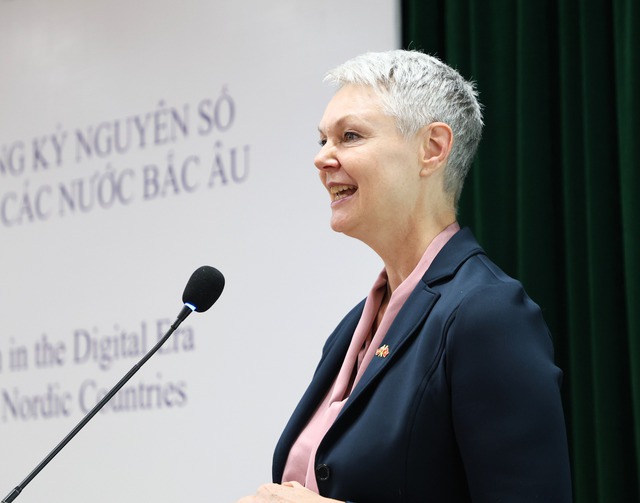
Norwegian Ambassador to Viet Nam Hilde Solbakken - Photo: VGP/Huong Giang
Norwegian Ambassador to Viet Nam Hilde Solbakken said that in Norway, digitalization has helped modernize the welfare state by making services more accessible, coordinated and efficient. Integrated digital health records, social care and remote care technologies have strengthened the care economy, particularly in responding to ageing populations. However, technology alone is not enough; it must be accompanied by strong data protection, inclusive design and public trust."
Danish Ambassador Nicolai Prytz added that broadening the tax base is not only about increasing revenue. It is also about fairness, transparency and strengthening trust between citizens and businesses, and the state. Denmark demonstrates how a transparent, equitable and citizen-centred tax system can operate effectively, supported by the dynamic use of digital tools. Ensuring that these digital solutions are user-friendly is essential to facilitate taxpayer compliance."
Swedish Ambassador Johan Ndisi stressed that our Swedish experience suggests that decentralization, supported by digital transparency, is not about a loss of oversight; it is about gaining greater administrative precision. By providing local authorities with the digital tools and autonomy to manage their own budgets and services, we don't just improve delivery - we spark grassroots innovation.
As Viet Nam addresses an aging population, proactive, evidence-based reforms are essential. Sustainable welfare is not a burden, but a strategic investment in both fiscal balance and social stability. It is encouraging to see Viet Nam embracing this spirit of streamlining and digital-first governance."
Finnish Ambassador Pekka Voutilainen said that equally important is Finland's investment in digital literacy, inclusive policymaking, and evidence-based governance, which allows digital tools to strengthen participation, responsiveness, and social cohesion. By combining technology with trust-based governance and education, Finland demonstrates how digital transformation can reinforce democratic institutions and make public administration more resilient in times of rapid change.
Finland also recognises the vital role of its business community in driving digital innovation and stands ready to foster connections between Finnish firms and Vietnamese partners to help strengthen the digital tools that support Viet Nam's governance efforts."
Viet Nam is currently undertaking one of its most ambitious agendas in decades, focusing on streamlining its government apparatus, expanding decentralization to local authorities, and accelerating digital transformation across the public sector. These reforms aim to modernize governance, strengthen institutions and support the continuing development as the country enters a new era. Key initiatives include restructuring ministries and administrative units to create a leaner and more efficient public sector, digitizing thousands of administrative procedures through unified platforms such as the National Public Service Portal and digital ID systems and enhancing transparency and service delivery for citizens and businesses.
The seminar's theme closely aligns with the implementation of Viet Nam's current strategic policies of the CPV and the State, in particular Resolution 57 on science and technology, innovation, and digital transformation, and Resolution 66 on institutional reform, decentralisation, and delegation of authority. It provides an opportunity for policymakers, implementers, scientists, and experts to share experiences in high-level governance.
On this occasion, four Nordic experts delivered keynote presentations on topics including tax reform and decentralisation, digital welfare systems and the care economy, and demographic perspectives on welfare systems and social protection, offering comparative insights and practical experiences from the Nordics. On this basis, policy options and implementation strategies were also discussed in the context of Viet Nam's ongoing reform priorities.
Finland has long invested heavily in its education system and nationwide digital-skills programs. As a result, 82 percent of its population possesses basic digital skills, far exceeding the EU average of 55.6 percent, according to the Digital Decade 2025 report. This strong foundation enables citizens and businesses to access, use, and swiftly adapt to digital public services, thereby driving robust digital transformation across both the public and private sectors.
Norway's welfare model is characterized by universal access, strong municipal responsibility, and high levels of public trust. Municipalities play a central role in delivering health, social care and employment services, while national authorities provide clear frameworks, financing mechanisms and digital infrastructure. This balance has enabled decentralization to function effectively without compromising equity or service quality.
Denmark is among the world's leading countries in the digitization of the public sector, known for its innovative and citizen-cantered approach to public services and high-performing local governments that enjoy a high level of public trust. Danish municipalities have broad autonomy over health, social care and education, supported by strong fiscal frameworks and close coordination between national and local authorities. Denmark has developed its advanced digital governance systems in close partnership with private companies.
Sweden's comprehensive social protection system is the result of continuous evolution, designed to remain resilient amidst demographic shifts and labour market changes. In this regard, maintaining social equity can provide helpful perspectives.