Int’l press highlights significance of Viet Nam’s election day
VGP - Viet Nam’s election of deputies to the 16th National Assembly and People’s Councils at all levels for the 2026–2031 term attracted wide attention from international experts and major media outlets.
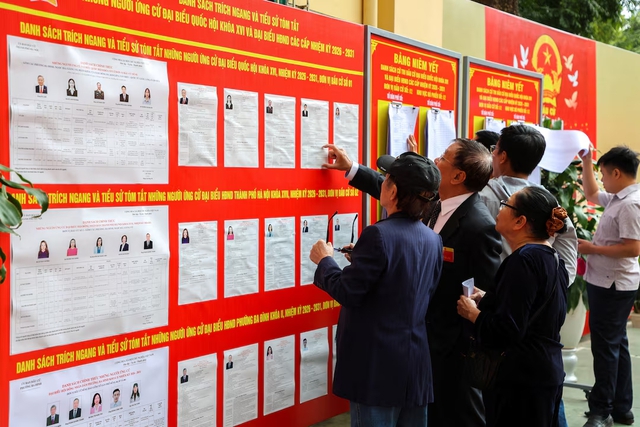
A man casts his ballot at a polling station during a parliamentary election, in Ha Noi, Viet Nam, March 15, 2026 - Photo: REUTERS/Thinh Nguyen
Reports have highlighted the scale, political significance and several new features of the vote, describing it as an important political event held shortly after the 14th National Congress of the Communist Party of Viet Nam.
According to China Central Television (CCTV), voters across Viet Nam cast ballots to elect 500 deputies to the 16th National Assembly from a total of 864 candidates. At the same time, voters selected representatives for People's Councils at all levels for the new five-year term. Chinese media described the election as a major political activity demonstrating broad public participation in the selection of representatives to state bodies.
Cuban news agency Prensa Latina reported that more than 78 million Vietnamese voters were eligible to exercise their voting rights at over 772,000 polling stations nationwide. Official figures show that the candidate lists included more than 126,000 people for positions at different levels of government, including 864 candidates for the National Assembly, 4,227 candidates for provincial-level People's Councils and more than 121,000 candidates for commune-level councils.
Prensa Latina also noted that the candidate structure reflects diverse representation across social groups, with a relatively high proportion of women, ethnic minority candidates and first-time candidates. The report described this as a notable feature of the election and an indication of efforts to strengthen representation in Viet Nam's elected bodies.
Sharing this view, Ramla Khalidi, Resident Representative of the United Nations Development Programme (UNDP) in Viet Nam, said current trends appear encouraging. She noted that since the 15th National Assembly, women's representation has increased at several levels. In preparation for the 16th National Assembly, women account for around 40–45 percent of the candidate list, suggesting a strong possibility that the legal target of 35 percent female deputies could be achieved. A similar trend is seen among ethnic minority candidates, who currently make up about 22 percent of the candidate list, exceeding the target of 18 percent.
International observers also place the election within the broader context of Viet Nam's ongoing reform and development process. As the global economy undergoes significant changes and restructuring, researchers say consolidating the state apparatus through elections plays an important role in maintaining stability and creating a foundation for long-term development policies.
Matthew Smith, a researcher at Yuanta Financial Holding, highlighted three key factors shaping the country's development prospects.
Major Asian media outlets including The Straits Times, Channel NewsAsia, NHK, Bangkok Post, The Sun and The Hindu described the election as an expression of citizens' participation in political life. Reports noted that the vote is not only a major political event but also part of broader efforts to strengthen the state apparatus, promote reforms and lay the groundwork for the country's next stage of development.
Meanwhile, Sputnik highlighted several new aspects of the election's organization, including the introduction of a two-tier local government model, the combination of in-person and online election campaigning and the expanded use of information technology.
The use of electronic identification applications and QR codes to access candidate information or change polling locations was seen as a step forward in the digital transformation of state administration.
Major Western news agencies such as Reuters, Agence France-Presse and Associated Press also reported on the event, noting Viet Nam's continued political stability and steady economic growth in Southeast Asia.
Images of red flags with yellow stars and election banners lining streets in Ha Noi and other localities created a vibrant atmosphere on election day as voters exercised their civic rights and responsibilities./.