FAO: Viet Nam moves towards a more modern, sustainable and high-value agricultural sector
VGP - Vinod Ahuja, FAO Representative in Viet Nam said he is impressed by Viet Nam’s clear determination to move toward a more modern, sustainable and high-value agricultural sector.
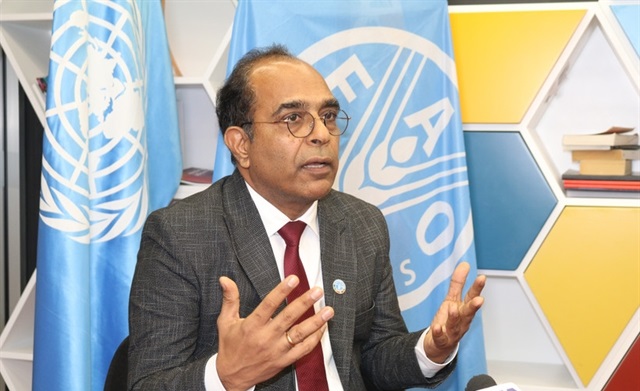
FAO Representative in Viet Nam Vinod Ahuja
Vinod Ahuja made the assessment in an interview on the threshold of the Lunar New Year of the Horse.
What are your strongest impressions of Viet Nam in 2025, especially in terms of sustainable agriculture?
FAO Representative Vinod Ahuja: Across many provinces, I have seen farmers and local authorities paying much greater attention to how food is produced, not only how much is produced. There is growing interest in reducing the overuse of chemicals, improving soil health, saving water, and protecting the environment, while still maintaining strong productivity. This is a very positive shift.
Another important impression is the strong role of innovation. Digital tools are increasingly used for weather information, market prices, traceability and farm management. Young farmers and agro-entrepreneurs are becoming more active, bringing new ideas into traditional farming systems.
I am also impressed by how sustainability is being linked with economic opportunity. Programs such as OCOP, value-chain development, specialty rice, fruits, seafood and coffee show that Viet Nam is not only producing more food, but better food – food that meets higher quality standards and can compete in international markets.
What are your expectations for Viet Nam's economic development in 2026 and the Year of the Horse?
FAO Representative Vinod Ahuja: I am very optimistic about Viet Nam's economic outlook in 2026.
Viet Nam has shown strong resilience in recent years despite global uncertainties. The country continues to benefit from a young and dynamic population, a growing middle class, increasing integration into global markets, and a reputation as a reliable trading partner.
In agriculture and food systems, several directions are likely to shape progress in the coming year.
Viet Nam is expected to continue diversifying its agricultural production, moving gradually from reliance on bulk commodities toward a more balanced mix that includes higher-value products such as processed foods, specialty rice, fruits, seafood and certified sustainable products.
At the same time, stronger links between agriculture, industry and services, such as logistics, food processing, tourism and digital services, will create new opportunities for rural economies and generate higher incomes.
Greater attention to climate will also be essential. Investments in climate-smart agriculture, water management and disaster risk reduction will help protect growth from climate shocks.
The Year of the Horse is often associated in Vietnamese culture with energy, perseverance and forward movement. These qualities reflect well the current stage of Viet Nam's development – a country that continues to move forward with confidence, while adapting to a rapidly changing world.
What recommendations would you give to strengthen food security and Viet Nam's contribution to the global food supply, given climate change and economic uncertainty?
FAO Representative Vinod Ahuja: Viet Nam already plays a very important role in global food supply, especially for rice, seafood, coffee and several other products. Strengthening this role while ensuring domestic food security will require a careful balance.
Continued investment in climate-resilient agriculture is critical. This includes drought- and salt-tolerant crop varieties, efficient irrigation systems, better soil management and diversified farming systems. These measures reduce risks from floods, droughts and salinity, particularly in vulnerable areas such as the Mekong Delta.
In addition, reducing food loss and waste through better storage, cold chains, packaging and logistics can significantly increase available food supply without expanding farmland.
Another critical priority is strengthening smallholder farmers and cooperatives. Small farmers remain the backbone of food production. Access to training, credit, insurance, markets and technology will allow them to invest, innovate and remain productive even under difficult conditions.
Improving food safety and quality standards will protect consumers and open access to more demanding export markets, increasing value and building trust in Vietnamese products worldwide.
As a final point, maintaining open and predictable trade is essential. During global crises, reliable exporters play a stabilizing role. Viet Nam's reputation as a dependable supplier contributes not only to its own economy, but also to regional and global food security.
What are your expectations for Viet Nam's political, economic and social trajectory over the next decade, as the country moves toward 2030 and 2045?
FAO Representative Vinod Ahuja: From FAO's perspective, Viet Nam's long-term success will depend above all on how effectively it continues to strengthen its food systems, rural economy and resilience to climate change.
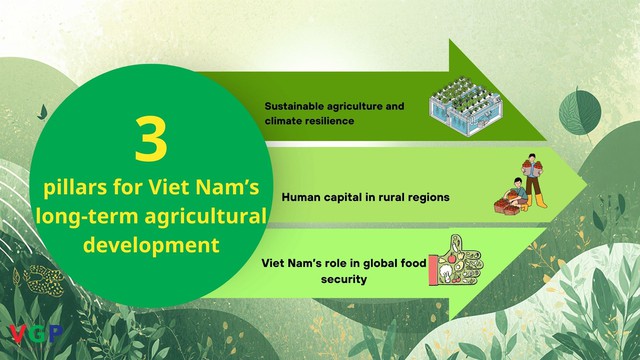
Over the next decade, three areas will be especially important.
The first is sustainable agriculture and climate resilience. Viet Nam is already a global leader in rice, fisheries, coffee and many other products. The next step is to further shift toward higher-value, lower-emission and more climate-resilient production systems, especially in vulnerable regions such as the Mekong Delta and the Central Highlands. This will be essential to protect farmer incomes, food security and export competitiveness in the face of rising temperatures, salinity and extreme weather.
The second area is human capital in rural regions. Continued investment in farmers' skills, digital tools, food safety and agribusiness development will help young people see agriculture as a modern and attractive profession. Strong cooperatives and small enterprises will also be key to creating stable jobs and reducing inequality between rural and urban areas.
The third area is Viet Nam's role in global food security. As one of the world's major food exporters, Viet Nam is well placed to contribute to more stable and reliable food supply for the region and beyond, even during times of global uncertainty. This requires continued focus on quality standards, sustainability, traceability and responsible use of natural resources.
FAO looks forward to continuing to support these priorities through technical cooperation, policy advice and partnerships. From our standpoint, progress in these areas will strongly shape Viet Nam's economic, social and environmental outcomes over the coming decades.
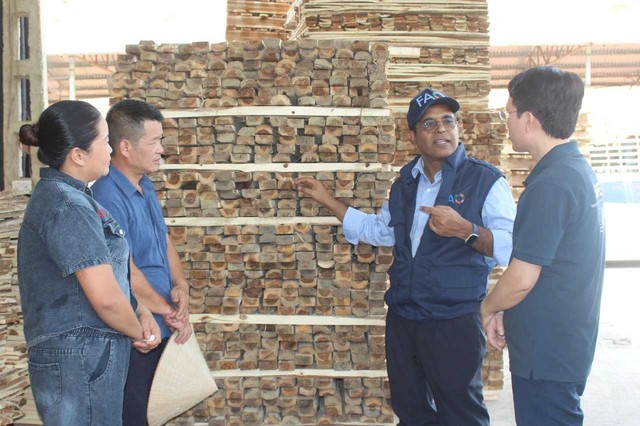
FAO Representative in Viet Nam Vinod Ahuja (2nd from R)
What are FAO's plans to support Viet Nam and the Ministry of Agriculture and Environment in the future?
FAO Representative Vinod Ahuja: FAO will continue to work closely with the Government of Viet Nam, and in particular with the Ministry of Agriculture and Environment, as a long-term technical partner. Our support focuses on several priority areas.
A key area is sustainable and climate-smart agriculture, including policies and programs that promote efficient water use, soil protection, lower greenhouse gas emissions and diversified farming systems.
Another area is food systems transformation. This includes improving food safety, nutrition, value chains, agro-processing and links between farmers and markets, so that agriculture creates more income and better jobs.
FAO also supports digital transformation in agriculture – for example, through traceability systems, farm advisory services, early warning systems for pests and diseases, and digital tools for data collection and planning.
Capacity building is equally important. We work with national and provincial institutions to strengthen technical skills, data systems and policy analysis.
Finally, FAO plays a convening role by bringing together government agencies, development partners, research institutions and the private sector to promote dialogue, coordination and investment in priority areas. Our overall objective is to support Viet Nam in building food systems that are productive, resilient, environmentally responsible and inclusive, leaving no one behind.
As the Lunar New Year approaches, what is your message to the Vietnamese people, and how do you personally feel about Tet?
FAO Representative Vinod Ahuja: I think Tet is much more than a holiday. It is a time when the whole country slows down, when families reunite, when people remember their roots and look ahead with hope. The sense of renewal and optimism that Tet brings is truly special.
For someone coming from another country, witnessing these traditions – visiting family homes, preparing special meals, honoring ancestors, decorating streets with flowers – is deeply moving. It shows how strongly values of respect, solidarity and community are embedded in Vietnamese society.
I believe these values are also a strong foundation for Viet Nam's future development. They create trust, social stability and a sense of shared responsibility, which are essential for long-term progress.
As Viet Nam welcomes the Lunar New Year, I would like to extend my warmest wishes to all Vietnamese people and to your families, wherever you may be celebrating. I also wish prosperity to farmers, workers, entrepreneurs and young people across the country, whose daily efforts contribute so much to Viet Nam's development.
Having the opportunity to live and work in Viet Nam during this special season is truly a privilege. Tet reflects the deep values of Vietnamese society: respect for family, gratitude to previous generations, solidarity within communities and hope for new beginnings. These are values that resonate strongly with the mission of the United Nations and with FAO's work to promote human well-being, dignity and sustainable development
Thank you so much!