
Energy efficiency could boost Viet Nam’s GDP: UNDP research
VGP - New research released by the UNDP finds that a 10 percent improvement in energy efficiency could boost Viet Nam’s GDP by around 1 percent.
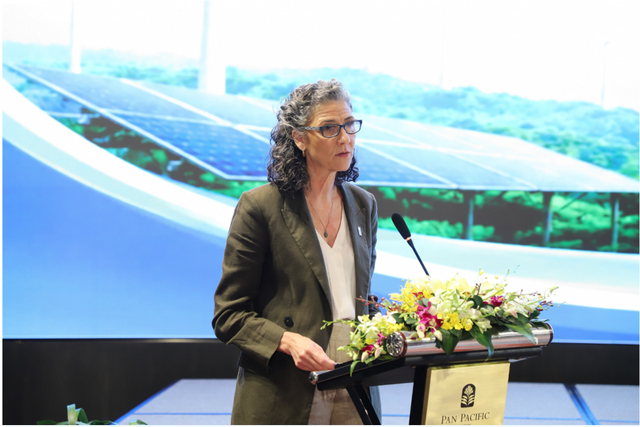
UNDP Resident Representative Ramla Khalidi addresses the event - Photo: tapchicongthuong
According to the research, the improvement in energy efficiency may help reduce energy consumption and emissions, and raise disposable incomes across all household groups, demonstrating how well-designed energy transition policies can deliver economic, environmental and social benefits simultaneously.
The findings are drawn from a range of policy scenarios tested using a new set of analytical tools unveiled at a workshop in Ha Noi on July 13.
Designed to support evidence-based policymaking, the tools enable Viet Nam's policymakers to assess how different energy-transition policies could affect economic growth, emissions and the incomes of different household groups, including the most vulnerable.
These tools are built around a new Energy-focused Social Accounting Matrix (ESAM), a comprehensive economic dataset that maps the links between production, energy use, household income and emissions within a single analytical framework.
The ESAM was developed by the Institute for Policy and Strategy Studies (IPSS) in collaboration with the University of Copenhagen, the Viet Nam National Statistics Office and UNDP in Viet Nam.
The research also explored policy options that may involve more difficult economic and social trade-offs. The modelling suggests that a tax of US$15 per ton of carbon dioxide equivalent could reduce emissions by approximately 2.9 per cent by increasing the relative cost of carbon-intensive activities. However, GDP could decline by around 0.8 per cent and, in the absence of compensatory measures, household incomes could fall across income groups.
These findings underscore the importance of carefully designing carbon-pricing policies to reduce emissions while safeguarding vulnerable households and supporting a just transition.
In her remarks at the workshop, UNDP Resident Representative Ramla Khalidi highlighted the ESAM as a valuable tool for helping policymakers assess the economic, social and distributional impacts of energy transition policies.
The value of a tool like the ESAM lies in helping policymakers understand these trade-offs and design policies that advance energy security, environmental sustainability and, crucially, equity. Importantly, the ESAM can continue to be applied and updated by Vietnamese institutions as new policy questions arise, she said.
As Viet Nam accelerates its transition towards a low-carbon economy, robust evidence and forward-looking policy analysis will be critical to ensuring that growth, energy security, emissions reduction and social inclusion advance together./.