
Business community key to Viet Nam's Net Zero journey: Deputy Prime Minister
VGP – The business community must regard green transformation and environmental, social and governance (ESG) practices as a strategic imperative for long-term growth and a key opportunity to enhance competitiveness, Deputy Prime Minister Nguyen Van Thang said on July 8.
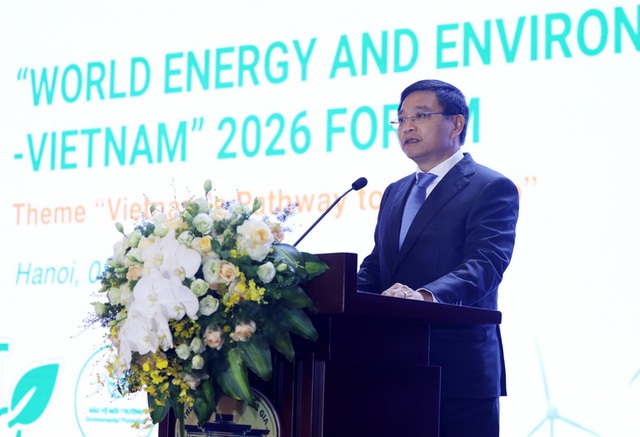
Deputy Prime Minister Nguyen Van Thang at the World Energy and Environment – Viet Nam 2026 Forum in Ha Noi
Speaking at the World Energy and Environment – Viet Nam 2026 Forum under the theme "Viet Nam Concretizes the Path to Net Zero," in Ha Noi on Wednesday, the Deputy Prime Minister said the country is entering a new era of development in which ensuring energy security, accelerating the green transition and strengthening national competitiveness have become more urgent than ever.
He described the forum as an opportunity to translate commitments into concrete actions, turn strategies into practical projects and mobilise the participation of the entire society, particularly the pioneering role of the business community.
"The theme of forum goes beyond energy and the environment. It is about the nation's development strategy—achieving faster but greener growth, deeper yet more sustainable international integration, attracting higher-quality investment and strengthening Viet Nam's global standing while fulfilling its international responsibilities," he said.
The Deputy Prime Minister noted that climate change is one of the greatest global challenges, with profound impacts on socio-economic development. As a rapidly growing and highly open economy with rising energy demand, Viet Nam is among the countries most vulnerable to climate change.
At the COP26 Climate Conference, Viet Nam committed to achieving net-zero emissions by 2050. That commitment has since been translated into concrete policies through Resolution No. 70 on ensuring national energy security through 2030 with a vision to 2045 and Resolution No. 253 on mechanisms and policies for national energy development during 2026–2030.
The Government is also drafting a new resolution that will continue to place environmental protection, green transition and energy transition at the centre of the country's development strategy.
Four strategic priorities
To make the energy transition the cornerstone of Viet Nam's Net Zero roadmap, Deputy Prime Minister Nguyen Van Thang outlined four strategic priorities.
The first is pursuing an effective and sustainable energy transition by improving policies, diversifying energy sources, promoting renewable energy, modernising transmission and storage infrastructure and developing a competitive electricity market with stronger private-sector participation.
He stressed that Viet Nam would not abruptly phase out conventional energy sources but would instead improve their efficiency, apply advanced technologies to control emissions and gradually reduce their share under an appropriate roadmap. The transition, he said, must ensure adequate energy supplies for growth, meet emissions-reduction commitments and deliver a just transition for workers, businesses and local communities.
The second priority is upholding the principle of not sacrificing the environment for economic growth by strengthening environmental protection, restoring ecosystems, promoting the circular economy and accelerating green production and consumption. Emissions reduction should go hand in hand with reforming the growth model and improving the ESG standards and competitiveness of Vietnamese products in global supply chains.
The third priority focuses on developing green finance and the carbon market as key pillars of the transition. The Government will continue to improve the legal framework, expand green credit and green bonds, introduce tax incentives for green projects, attract concessional finance and advanced technologies, and further develop the domestic carbon market.
The fourth priority is to maximise the role of businesses and local authorities. The Deputy Prime Minister said enterprises across all economic sectors are the decisive force behind Viet Nam's Net Zero journey and should lead emissions-reduction efforts, integrate ESG into long-term business strategies and invest in clean technologies. Localities, particularly those with strong renewable energy potential, should improve planning, streamline administrative procedures and create favourable conditions for green investment.
The Deputy Prime Minister affirmed that the Government would continue to accompany local authorities and businesses, listen to their concerns and remove obstacles to facilitate the green transition.
He assigned the Ministry of Industry and Trade to continue advising the Government on measures to ensure national energy security while accelerating clean energy development and modernising electricity transmission, distribution, storage and dispatch systems.
The Ministry of Agriculture and Environment was tasked with completing the national greenhouse gas inventory system, strengthening emissions management, promoting the carbon market, protecting ecosystems and enhancing climate resilience.
Meanwhile, the Ministry of Finance and the State Bank of Viet Nam were instructed to accelerate green finance instruments, including green credit and green bonds, and develop blended finance and risk-sharing mechanisms to mobilise greater resources for the green transition.
Local authorities were urged to update development plans, prepare pipelines of green projects, improve the investment climate and remove administrative bottlenecks to facilitate clean energy, circular economy and emissions-reduction projects.
The Deputy Prime Minister also called on the business community to view green transformation and ESG governance as a strategic imperative and an opportunity to strengthen competitiveness by upgrading technologies, conducting greenhouse gas inventories, improving environmental data transparency and actively participating in the carbon market.
He urged the Viet Nam Chamber of Commerce and Industry (VCCI) to strengthen its role as a bridge between the Government and businesses by promptly reflecting enterprises' concerns and coordinating with ministries and localities to develop green transition support programmes, particularly for small and medium-sized enterprises.
The Deputy Prime Minister also called on the International Renewable Energy Agency (IRENA), international environmental organizations and developed countries to provide more practical support for Viet Nam and its businesses in implementing the country's emissions-reduction roadmap.
Expressing confidence in Viet Nam's prospects, he said the country's Net Zero target would be achieved through the strong political commitment of the Party and State, the concerted efforts of the entire political system, the active participation of the business community and people, and close cooperation with international partners.
Held alongside the forum, the "Viet Nam Net Zero – Green Path Exhibition" featured more than 50 booths showcasing green technologies, products, services, business models and innovations while providing a platform for cooperation, technology transfer, financing and investment in green transition projects.
The organising committee also honoured outstanding enterprises for their contributions to the green economy, recognising their efforts in technological innovation, energy efficiency, emissions reduction and sustainable business development./.