
Viet Nam's economy poised for sustained growth despite global challenges: ADB Country Director
VGP - Viet Nam's economic outlook remains positive after the economy expanded by 8.18 percent in the first six months of the year, highlighted Asian Development Bank (ADB) Country Director for Viet Nam Shantanu Chakraborty.
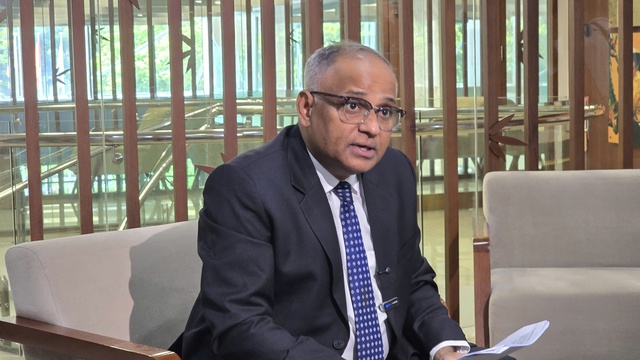
Asian Development Bank (ADB) Country Director for Viet Nam Shantanu Chakraborty - Photo: VGP/Van Cuong
The ADB Country Director said, the strong performance was underpinned by broad-based drivers, including industrial production, exports, foreign direct investment (FDI), public investment, services and domestic consumption, reflecting the economy's continued growth momentum and resilience.
However, Chakraborty cautioned that the external environment has become increasingly challenging. As one of the world's most open economies, Viet Nam remains highly vulnerable to fluctuations in global trade, tariffs, energy prices, exchange rates and weakening demand in key export markets. Faster import growth than exports also indicates expanding production but highlights the country's continued dependence on imported inputs.
Looking ahead to 2026 and 2027, the ADB believes Viet Nam should focus not only on maintaining rapid growth but also on strengthening its economic resilience. This requires preserving macroeconomic stability, diversifying export markets, developing stronger supporting industries and improving productivity to ensure sustainable long-term development.
Fundamental shift in Viet Nam's growth model is needed
According to Chakraborty, the country's next stage of development will require a fundamental shift in its growth model. To avoid the middle-income trap, Viet Nam can no longer rely primarily on capital accumulation, low-cost labor and FDI. Instead, future growth should increasingly be driven by higher productivity, innovation, advanced skills and a stronger domestic private sector.
Strategic technology industries—including semiconductors, artificial intelligence, unmanned aerial vehicles, digital technologies and green industries—have the potential to become new engines of growth.
Yet attracting investment into these sectors alone will not be sufficient. They require comprehensive foundations, including a highly skilled workforce, robust digital infrastructure, reliable energy supplies, effective intellectual property protection, internationally recognized standards, stronger applied research capabilities and a more competitive ecosystem of domestic enterprises.
The ADB also emphasized that economic growth must become more inclusive. Productivity improvements should translate into higher household incomes, better-quality employment and expanded opportunities for small and medium-sized enterprises.
Achieving these outcomes will require continued investment in education, workforce upskilling and reskilling, stronger linkages between domestic companies and FDI enterprises, as well as improved access to finance, technology and markets.
Significant progress in Viet Nam's reform agenda
Reflecting on Viet Nam's reform agenda, the ADB Country Director recognized significant progress in recent years, particularly in public administration, decentralization, improving the business environment and setting strategic directions for new growth drivers. These reforms, he said, provide encouraging signals for the country's medium- and long-term prospects.
Nevertheless, substantial structural bottlenecks remain. Viet Nam still needs to improve policy implementation, streamline investment procedures, facilitate land access, strengthen transport and energy infrastructure, enhance logistics, upgrade workforce skills, deepen capital markets and foster innovation, he suggested.
Domestic enterprises continue to face relatively low productivity, while linkages between local firms and FDI companies remain weaker than their full potential.
Regarding the role of the private sector, the ADB rejected the notion that Viet Nam should seek to reduce its reliance on foreign investment. Instead, the priority should be to strengthen domestic enterprises so they can better absorb technology, knowledge and opportunities generated by FDI and participate more deeply in global value chains.
The ADB further underscored the importance of developing deeper capital markets to diversify long-term financing sources beyond bank lending.
A stronger, more competitive and innovative domestic private sector, Chakraborty concluded, will be essential to building a more resilient, inclusive and sustainable growth model capable of withstanding future external shocks while supporting Viet Nam's long-term high-income aspirations./.