
Viet Nam’s economic growth remains resilient amid global challenges: ADB
VGP - Viet Nam’s economy is forecast to grow 7.2 percent in 2026 and 7.0 percent in 2027, compared to 8 percent in 2025, despite rising external risks amid heightened global uncertainty, according to the Asian Development Bank (ADB).
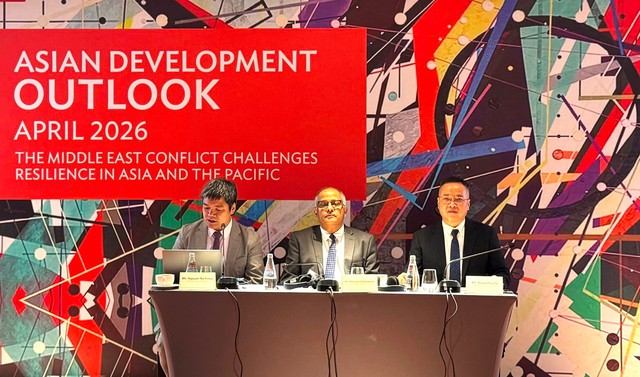
ADB Country Director for Viet Nam Shantanu Chakraborty (center) at the press conference on Asian Development Outlook in April
The Asian Development Outlook April 2026, released Friday by ADB, maintains a positive outlook for Viet Nam over the near term.
Strong exports ahead of the U.S. reciprocal tariff adjustments, expansionary policies, and sustained investment supported the country's solid economic growth last year. However, evolving U.S. trade measures, the conflict in the Middle East, and broader global uncertainties could curb exports and investment inflows, increasing pressure on this year's outlook.
"The Government of Viet Nam responded swiftly to the energy supply disruptions triggered by the conflict in the Middle East," said ADB Country Director for Viet Nam Shantanu Chakraborty.
"Time-bound fiscal measures, including tax relief, use of the stabilization fund, combined with flexible price adjustments and stronger supply coordination, have helped contain near-term inflationary pressures and support growth. Over the longer term, improving efficiency, diversifying energy sources, and accelerating the transition to clean energy will be critical to reducing vulnerability to future shocks," he added.
Downside risks remain significant. A prolonged conflict in the Middle East could disrupt flows of oil, gas and fertilizers through the Strait of Hormuz, raising shipping costs and causing delays. Together with the war in Ukraine, these developments are intensifying commodity price volatility and further straining global supply chains. Weaker growth in key trading partners could also narrow Viet Nam's trade surplus and dampen growth.
From a policy perspective, strengthening Viet Nam's corporate bond market will be essential to mobilize long-term financing beyond bank credit and support sustained investment. Enhancing transparency, ensuring consistent regulations, and broadening market participation will be key to improving investor confidence and enhancing market efficiency. If implemented effectively, ongoing reforms in this area can help position the corporate bond market as a stable source of long-term finance for sustainable and inclusive growth.
Earlier, international organizations such as the International Monetary Fund, World Bank generally project growth in the range of 6–6.5 percent, highlighting the country’s strong fundamentals, including its export-oriented manufacturing base, steady inflows of foreign direct investment, and improving macroeconomic stability.
The Government set a very ambitious economic target for 2026, marking the start of a new development phase at least 10 percent.