Viet Nam–EFTA Free Trade Agreement to expand opportunities for trade, investment, and innovation
VGP - The Viet Nam–European Free Trade Association (EFTA) Free Trade Agreement (FTA) is expected to mark a new chapter in economic relations between Viet Nam and Norway, Switzerland, Iceland, and Liechtenstein, expand market access, promote high-quality investment, and strengthen integration into global value chains.
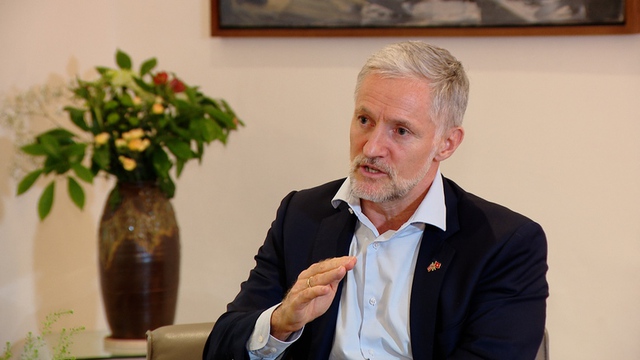
Norwegian Ambassador to Viet Nam Stein Iversen - Photo: VGP/Van Cuong
In a recent interview with VGP, ahead of the official signing ceremony, Norwegian Ambassador Stein Iversen and Swiss Ambassador Thomas Gass noted that after years of negotiations, the signing of the FTA represents a significant milestone that elevates cooperation between Viet Nam and EFTA member states to a new level.
Beyond expanding trade opportunities, the agreement establishes a stable, transparent, and predictable legal framework for business activities. It also sends a strong signal of support for rules-based free trade, reinforcing confidence and reducing uncertainty at a time when global commerce faces mounting geopolitical pressures.
Expanding opportunities for bilateral trade
According to Swiss Ambassador Gass, the agreement creates a legal framework that helps improve the competitive position of EFTA businesses in Viet Nam, offering advantages comparable to those Vietnamese companies already enjoy in certain partner markets.
The FTA is expected to boost two-way trade by making it easier for Vietnamese businesses to export high-quality products—including coffee, fruit, agricultural goods, textiles, and garments—to the promising EFTA market.
Meanwhile, Vietnamese consumers will gain easier access to premium European products, pharmaceuticals, and advanced technological solutions.
From Norway's perspective, Norwegian Ambassador Iversen noted that the seafood sector stands to benefit particularly strongly. Improved access to the Vietnamese market is expected to significantly enhance the competitiveness of Norwegian seafood, especially salmon.

Swiss Ambassador to Viet Nam Thomas Gass - Photo: VGP/Van Cuong
Promoting high-quality investment and value chain integration
Beyond trade, the FTA offers considerable potential for attracting high-quality investment and increasing the technological content of Viet Nam's economy.
Ambassador Gass highlighted that Swiss companies such as Schindler, ABB, Bühler, and Nestlé have operated in Viet Nam for decades across a wide range of sectors, including coffee processing, container port construction, energy equipment, smart grids, quality inspection, flavoring products, and banking software.
Notably, a major Swiss coffee company currently processes approximately 25 percent of Viet Nam's coffee production into high-value-added products for export to global markets. In the medical technology sector, Swiss companies manufacture hearing aids in Ho Chi Minh City to serve the broader Asian market.
Switzerland has also contributed to Viet Nam's economic modernization through technology in infrastructure construction, healthcare, pharmaceuticals, transportation, and industry. Partnerships between Vietnamese hospitals and universities and Swiss pharmaceutical companies are supporting the development of advanced medical treatments, including cancer therapies. Both sides are expected to deepen cooperation in research and innovation while accelerating public access to new technologies.
On the Norwegian side, Ambassador Iversen said that around 40 Norwegian companies are currently operating in Viet Nam. Maritime industries, shipbuilding, and aquaculture have become particularly strong areas of cooperation. Research institutes and businesses from both countries are collaborating across the entire seafood value chain—from breeding stock, feed, and equipment to production techniques and services—effectively combining Viet Nam's experience with Norway's capital and technical expertise.
The signing of the FTA is expected to strengthen investor confidence, encourage existing companies to expand their operations, and attract new investors to the Vietnamese market.
Linking trade with green transition and sustainable development
The green transition represents another major pillar of future cooperation between Viet Nam, Norway, and Switzerland.
Ambassador Stein Iversen emphasized the complementary relationship between the FTA and the Viet Nam–Norway Green Strategic Partnership. While the FTA provides the legal foundation for trade and investment, the Green Strategic Partnership sets political priorities and a roadmap for cooperation in promising areas such as offshore wind power, low-emission shipping, marine aquaculture, the circular economy, and forest protection.
These areas of cooperation can help align Viet Nam's development goals with Norway's technological capabilities, experience, and investment resources.
According to Ambassador Gass, Switzerland's advanced technologies in energy, agriculture, transportation, construction, and industry can help Viet Nam improve resource efficiency, enhance production quality, and reduce environmental impacts. Cooperation between universities in both countries also plays an important role in research, innovation, and workforce development for the green transition.
The diplomat praised Viet Nam's commitment to achieving net-zero emissions by 2050, adding that producing environmentally friendly goods that meet higher standards requires access to markets with strong purchasing power and consumers willing to pay a premium for quality and sustainability.
In his view, EFTA markets can provide exactly those opportunities while encouraging Vietnamese businesses to upgrade production processes and increase the value of their products.
Looking back on 55 years of diplomatic relations between Viet Nam and both Norway and Switzerland, the shift from development cooperation toward partnerships in trade, investment, technology, and sustainable development signals a promising new phase.
The Viet Nam–EFTA Free Trade Agreement, together with existing bilateral cooperation frameworks, is expected to become an important driver for businesses on both sides to better realize their shared potential, create greater added value, and make meaningful contributions to Viet Nam's long-term development goals./.