
Viet Nam makes strides in child labor prevention and elimination
VGP - Over the past 25 years, Viet Nam has made significant progress in preventing and eliminating child labor, including its worst forms.
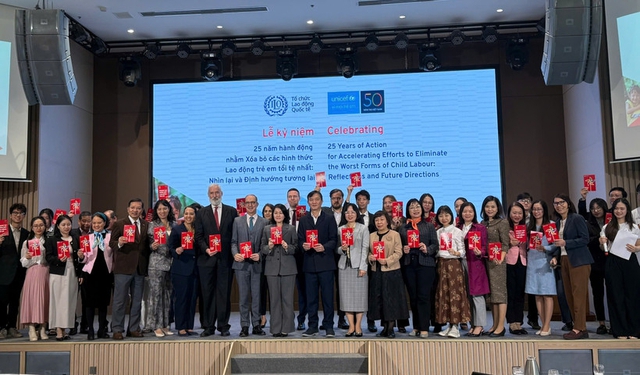
The 25th anniversary of Viet Nam's ratification of ILO Convention No.182, Ha Noi, December 17, 2025
The International Labor Organization (ILO), in coordination with the United Nations Children's Fund (UNICEF) jointly hosted a ceremony on December 17 to mark the 25th anniversary of Viet Nam's ratification of ILO Convention No.182 on the worst forms of child labor.
Since ratifying the Convention in 2000, Viet Nam has made significant progress in preventing and reducing child labor through legal reforms, national programs and strengthened inter-agency coordination.
According to national surveys conducted by the National Statistics Office with ILO support, the proportion of children got involved in economic activities declined sharply from 9.1 percent in 2018 to 3.5 percent in 2023.
However, an estimated 94,300 children are still engaged in hazardous work, and nearly 12 out of every 100 children in child labor face health-related risks, highlighting the need for sustained and targeted interventions.
Sinwon Park, Director of ILO Country Office for Viet Nam, said the achievements of the past 25 years were the outcomes of persistent efforts by the Government, employers' and workers' organizations, and development partners. She noted that ILO-supported initiatives, including the Project on Technical Support for Enhancing the National Capacity to Prevent and Reduce Child Labor in Viet Nam (Enhance Project), have strengthened national systems for prevention, identification, referral and remediation of child labor cases.
Ending child labor is not only about protecting children's rights, but also about investing in Vietnam's future workforce and inclusive economic growth, Park said, stressing that keeping children in school and ensuring decent work for adults generates long-term benefits for families, businesses and the wider economy.
Deputy Director of the Department of Mother and Child Affairs Nguyen Thi Nga under the Ministry of Health, said child protection is a shared responsibility involving families, communities, state agencies, workers, employers and businesses, stressing that no single actor can eliminate child labor alone.
As the country deepens its integration into global supply chains and advances digital transformation, she said, new risks, including online exploitation of children, are emerging alongside traditional vulnerabilities such as poverty, migration and informal employment. This requires child protection systems capable of responding effectively in both online and offline environments, grounded in prevention, education and strong law enforcement.
To achieve sustainable and inclusive economic growth, Viet Nam must continue to place the protection of children's fundamental rights at the center of integrated policy approaches, including education and social protection, Nguyen stated.
At the ceremony, representatives of the ILO, UNICEF and other United Nations agencies in Viet Nam reaffirmed their commitment to supporting the country in implementing national programs and strengthening labor law enforcement and social protection systems. As Viet Nam prepares its national program on the prevention and reduction of child labor for 2026–2030, the 25-year milestone was seen as an opportunity to accelerate progress towards the Sustainable Development Goal (SDG) target 8.7 on ending child labor in all its forms.
As Viet Nam is developing the National Program on the Prevention and Reduction of Child Labor for the 2026–2030 period, this 25-year milestone presents an important opportunity to further accelerate progress toward achieving Sustainable Development Goal 8.7 — ending child labor in all its forms./.