
Viet Nam inaugurates first LNG power plants, marking shift toward cleaner energy
VGP - Prime Minister Pham Minh Chinh on Sunday attended the inauguration ceremony of Viet Nam’s first liquefied natural gas (LNG) power plants, a milestone that underscores the country’s strategic transition toward cleaner energy sources while strengthening grid stability as renewable power expands.
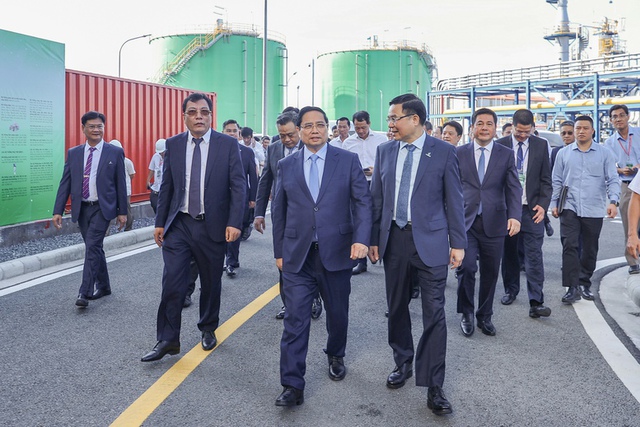
Prime Minister Pham Minh Chinh (1st from L) attends the inauguration ceremony of Nhon Trach 3 Power Plant and Nhon Trach 4 Power Plant, Dong Nai province, December 14, 2025 - Photo: VGP/Nhat Bac
The first Vietnamese LNG projects are the twin Nhon Trach 3 and Nhon Trach 4 power plants in the southern province of Dong Nai, developed by state-owned industry and energy group Petrovietnam with a total investment of US$1.4 billion.
With a combined capacity of 1,624 megawatts, the two plants are expected to generate more than nine billion kilowatt-hours of electricity annually, helping stabilize the power system in southern Viet Nam as the share of wind and solar energy grows.
Primarily serving the southern region—Viet Nam's economic engine and a major hub for high-tech foreign investment—the facilities are seen as laying the foundation for a domestic gas-fired power market. They are also expected to serve as a model for 13 additional LNG power projects identified in the national power development plan.
The projects come as Viet Nam faces rapidly rising electricity demand, requiring annual capacity additions of 6,500–8,200 MW, while peak consumption has reached around 54,500 MW. Demand growth is being driven by the expansion of high-tech manufacturing, semiconductor production, data centres and major infrastructure projects, including high-speed rail.
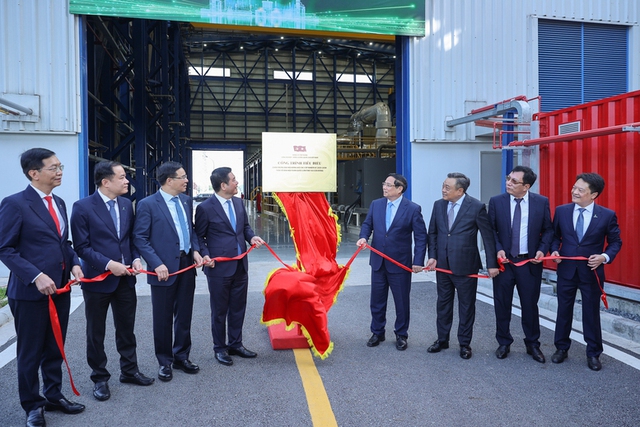
Nhon Trach 3 Power Plant and Nhon Trach 4 Power Plant are outstanding projects celebrating the 14th Party Congress
Speaking at the inauguration ceremony, Prime Minister Pham Minh Pham praised the projects as exemplary, highlighting their ability to overcome numerous obstacles while ensuring construction quality, safety and environmental standards.
These projects are equipped with GE 9HA.02 gas turbines, among the world's most advanced in terms of capacity and efficiency. The technology delivers efficiency levels of 62–64 per cent and is capable of blending up to 50 per cent hydrogen, with the potential to transition to 100 per cent hydrogen in the future.
Compared with conventional fuels, LNG-fired power generation cuts carbon emissions by around 40 per cent compared with coal and 30 per cent compared with oil, contributing to Viet Nam's commitment to achieve net-zero emissions by 2050.
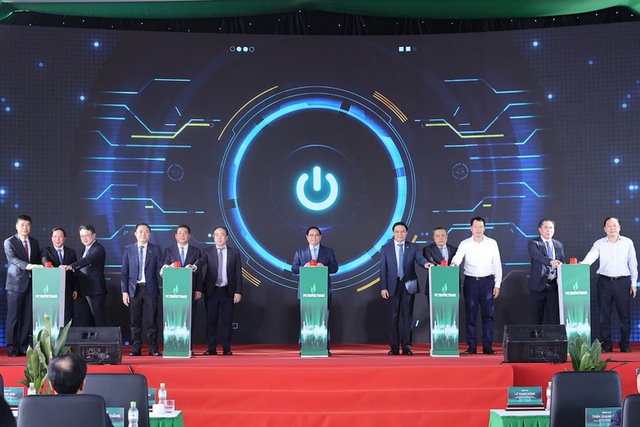
Prime Minister Pham Minh Chinh (center) and delegates at the inaurugration ceremony of Viet Nam's first LNG power plants, Dong Nai province, December 14, 2025 - Photo: VGP/Nhat Bac
Construction of the projects began in May 2022, at the height of the COVID-19 pandemic, and proceeded without government guarantees. Developers faced challenges ranging from incomplete regulatory frameworks for LNG pricing and long-term power purchase agreements to land acquisition and complex equipment logistics, while financing had to meet stringent international standards.
Despite these hurdles, PetroVietnam and main contractors Lilama and Samsung C&T worked intensively to keep the projects on schedule. The selection of the EPC contractor took just 11 months, among the fastest timelines for a project of this scale. Notably, domestic contractor Lilama accounted for about 40 per cent of the EPC workload, the highest local participation rate recorded for a thermal power project in Viet Nam.
The Politburo issued Resolution 70 in August on national energy security through 2030, with a vision to 2045, prioritising energy development to support more than 10 percent annual growth with state-owned enterprises in lead roles and the private sector as a key driver.
Earlier, Nhon Trach 3 power plant, Viet Nam's first liquefied natural gas (LNG) power plant was connected to the national grid on February and put into commercial operation in July, 2025./.