Viet Nam emerges from inflation crisis to US$510-billion economy
VGP - From an economy plagued by severe shortages and inflation of 774 percent at the end of 1986, Viet Nam has, after 40 years of Doi Moi (Renovation), become an upper-middle-income developing country with a GDP exceeding US$510 billion.
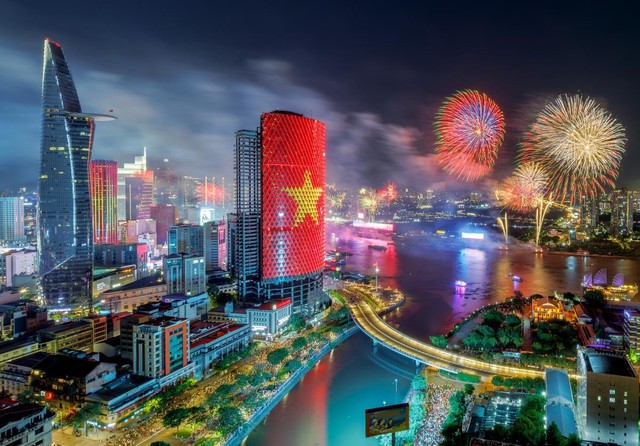
After 40 years of Doi Moi (Renovation), under the Party leadership, Viet Nam has become an upper-middle-income developing country with a GDP exceeding US$510 billion in 2025
This is part of a report reviewing theoretical and practical issues arising from 40 years of Renovation, released by the 13th-term Central Committee of the Communist Party of Viet Nam.
Looking back at the pre-1986 period, when the country was heavily devastated by war and mired in a prolonged socio-economic crisis. In the late 1970s and early 1980s, the economy suffered from severe goods shortages and difficult living conditions. During the first decade after national reunification, Viet Nam's per capita income was only US$125–200 per year, placing the country among the world's 20 poorest. Inflation rate surged to 774 percent by the end of 1986.
The 6th National Party Congress identified one of the main causes of this situation as serious mistakes in major policy orientations, strategic direction, and implementation. As a result, Viet Nam launched the Doi moi process in 1986. In the first decade, despite the impact of embargoes and sanctions, the economy gradually emerged from crisis and overcame difficulties. Economic stagnation and recession were progressively addressed, while relatively high growth was maintained over a sustained period.
During the 1996–2005 period, the country remained stable, with its position and strength increasing. From a situation of goods shortages, production capacity gradually met the essential needs of the population and the economy; exports expanded, reserves were formed, and foundations for long-term growth were steadily consolidated.
In the 2006–2015 period, Viet Nam became a lower-middle-income developing country; political and social stability was maintained, and social security ensured. Average economic growth during the first 30 years of Đổi mới reached nearly 7 percent per year. From 1991 to 2016, exports grew 60-fold and imports 80-fold, reflecting the scale of economic expansion and deepening integration.
From 2016 to the present, despite fluctuations in the international environment, average GDP growth has been maintained at 6.2 percent per year. The size of the economy and per capita income have nearly doubled, reaching over US$510 billion and around US$5,000 per person; people's living standards have improved markedly.
Alongside economic growth, the country has implemented a sweeping reform to streamline the political system, build a three-tier government structure, and reorganize development space. Many strategic decisions have been issued to create breakthroughs in the new development phase. Independence, sovereignty, unity, and territorial integrity have been firmly safeguarded; political security and social order maintained; and an independent, self-reliant foreign policy of diversification and multilateralization consistently pursued.
Overall, after 40 years of Doi moi, the report affirms that the country has achieved major accomplishments of historic significance.
Standing Vice Chairman of the Central Theoretical Council Tan Tan Sang noted that the determination of the Party and State, together with the people's trust, has been the foundation enabling Viet Nam to overcome numerous challenges and achieve historic results.
However, the report also points out a range of persisting difficulties, including the risk of falling behind and of being trapped in the middle-income bracket. Development remains insufficiently sustainable, while labor productivity and competitiveness are still low. The Fourth Industrial Revolution continues to pose new demands for production, trade, and social welfare.
Breakthroughs in socialist-oriented market economy
A prominent highlight of the 40-year review is the evolution in theoretical awareness regarding the socialist-oriented market economy.
From the 6th Party Congress, the Party raised the issue of reforming the economic mechanism, restoring and developing a multi-sector economy, and fully utilizing commodity–money relations. The 7th Congress further identified the development of a multi-sector commodity economy as a long-term strategic orientation during the transition to socialism. By the 10th Congress, consensus had emerged recognizing the market economy as a product of human civilization.
The 13th Party Congress defined the socialist-oriented market economy as Viet Nam's overarching economic model during the transition to socialism, associated with the goal of a "prosperous people, strong country, democracy, equity, and civilization." The economy comprises multiple forms of ownership and sectors, with the state economy playing a leading role; the collective economy being strengthened; the private sector serving as an important driver; and the foreign-invested sector being encouraged.
Resolution No. 68 of the Politburo issued in May 2025 emphasizes the private sector as the most important driving force of the national economy, while calling for accelerated industrialization and modernization based on science, technology, and innovation.
The report reviews the shift in perception—from viewing the market economy as a distinct feature of capitalism opposed to socialism, to recognizing it as a common achievement of human civilization. The socialist-oriented market economy model is regarded as a key pillar of an institutional framework for rapid and sustainable development, and "a new type in the history of development."
From a backward nation to a developing country
After 40 years of Doi Moi, Viet Nam has transformed from poverty and backwardness into an upper-middle-income developing country, with significantly enhanced potential and international standing.
Capital markets and corporate bond markets have gradually become important channels for corporate financing. Securities, insurance, and real estate markets have continued to expand in scale and product diversity. The labor market has grown in size and quality, while science and technology have advanced and become more deeply connected with the region and the world.
Viet Nam has established trade relations with more than 230 countries and territories; signed 17 free trade agreements with over 60 partners; and attracted foreign direct investment (FDI) and official development assistance (ODA) from many major partners worldwide.
At the same time, the goal of a "prosperous people, strong country, democracy, equity, and civilization" has gradually been realized through adjustments to base salaries and regional minimum wages, poverty reduction, and the expansion of the middle class. The Human Development Index (HDI) and happiness index have improved.
Nevertheless, the economic development framework still contains overlapping regulations that hinder production and business. Economic sectors have not developed as expected; the leading role of the state economy has not been fully realized; the private sector remains fragile; and the foreign-invested sector has yet to generate the anticipated spillover effects. The growth model is not yet firmly anchored in science, technology, and innovation.
Beyond the economy, the report also notes positive changes in culture, education, science, national defense and security, and foreign affairs. Viet Nam achieved universal primary education in 2000, lower secondary education in 2010, and preschool education for children under five in 2017. In national defense and security, the strategy of protecting the Fatherland "early and from afar" has been implemented; foreign relations have continued to expand, with diplomatic ties established with 194 UN member states and partnership relations at various levels with major partners.
Striving for double-digit growth in 2026–2030
In the coming period, the international environment is forecast to remain complex, with intensifying strategic competition among major powers, while the Fourth Industrial Revolution profoundly reshapes economic structures and modes of production.
Domestically, the goal by 2030 is to become an upper-middle-income country with a GDP of US$ 900 billion and per capita income of US$8,500; by 2045, GDP is targeted at US$ 2.5 trillion, with education ranked among the top 10 in Asia. However, challenges such as income inequality persist.
The overarching orientation is to remain steadfast in comprehensive reform; restructure the economy; and establish a new growth model based on science, technology, innovation, and digital transformation. Viet Nam aims for double-digit growth during 2026–2030; to become a developing country with modern industry and upper-middle income by 2030; and a high-income developed country by 2045.
To achieve these goals, the development and enforcement of laws will continue to be strongly reformed; macroeconomic stability maintained; inflation controlled; and major balances ensured. The State will effectively implement mechanisms to attract and utilize talent, while promoting new growth drivers such as digital transformation, green transition, and the circular economy.
The state economy is oriented to "truly play a leading role," while creating conditions for the private sector to truly become the most important driving force of the national economy, with a focus on developing large private conglomerates. Foreign investment will be selectively attracted, prioritizing high technology; the defense and security industries will develop in a modern, dual-use direction.
The two centenary milestones continue to be pursued on the foundation of patriotism, self-reliance, solidarity, and the aspiration for a prosperous and happy nation.
By 2030, the country aims to implement a basic policy of universal free healthcare. "The review of 40 years of Doi Moi provides a scientific and practical foundation for drafting the documents of the 14th National Party Congress," Professor Ta Ngoc Tan said./.