Top Jordanian legislator suggests establishing a free trade zone for Vietnamese goods in Jordan
VGP - Speaker of the Jordanian House of Representatives Mazen Turki El Qadi proposed establishing a free trade zone for Vietnamese goods in Jordan to facilitate exports to the Middle East during his meeting with Prime Minister Pham Minh Chinh in Ha Noi on Tuesday.
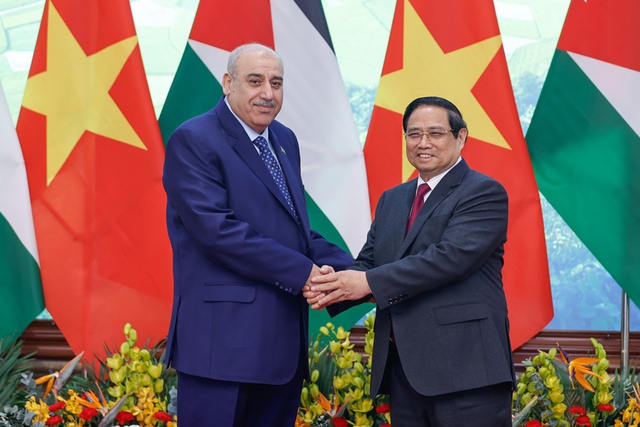
Prime Minister Pham Minh Chinh (R) hosts a reception for Speaker of the Jordanian House of Representatives Mazen Turki El Qadi, Ha Noi, February 3, 2026 - Photo: VGP
El Qadi said Jordan considers Viet Nam as an important partner in Asia, expressing his hope to strengthen bilateral ties, particularly in the fields of agricultural production, healthcare, pharmaceuticals, defense industry, cybersecurity, halal industries, and science and technology.
He expressed appreciation for Viet Nam's stance and support for the Palestinian people and the two-State solution, welcoming Viet Nam's participation in the Gaza Peace Board.
The guest affirmed readiness to serve as a bridge and work closely with Viet Nam in promoting peace and implementing reconstruction and humanitarian programs in the region.
Pham, for his side, emphasized that Viet Nam is willing to ensure a stable and high-quality supply of agricultural and aquatic products for Jordan and welcomes Jordanian enterprises to the country to explore opportunities for investment and business cooperation.
He proposes studying the application of Jordan's coral reef–based technology for preventing saltwater intrusion in Viet Nam.
The two leaders vowed to increase all-level delegation exchanges, soon establish permanent representative offices in each other's capitals, organize political consultations, establish a Viet Nam–Jordan business cooperation working group, and promote the signing of key cooperation agreements on visa exemption, investment protection, and the avoidance of double taxation.
The pair underscored the need to raise bilateral trade turnover to US$500 million by 2030 and US$1 billion by 2035, accelerate market access for each side's competitive goods, support one another in ensuring food security, and develop the Halal industry.
The two sides discussed specific measures to strengthen cooperation in the fields of healthcare, tourism, education and training, and science and technology, as well as mutual support and coordination at multilateral forums, particularly within major organizations such as the United Nations and UNESCO.
Both sides pledged to join hands in addressing shared regional and global issues on the basis of respect for international law and each side's principled stances./.