
To Lam's full remarks at conference to disseminate Politburo's Resolution No. 10 on development of foreign-invested economic sector
VGP – Below are the full remarks delivered by General Secretary and President To Lam on June 30 at national conference to disseminate key contents of Politburo's Resolution No. 10 on development of foreign-invested economic sector.
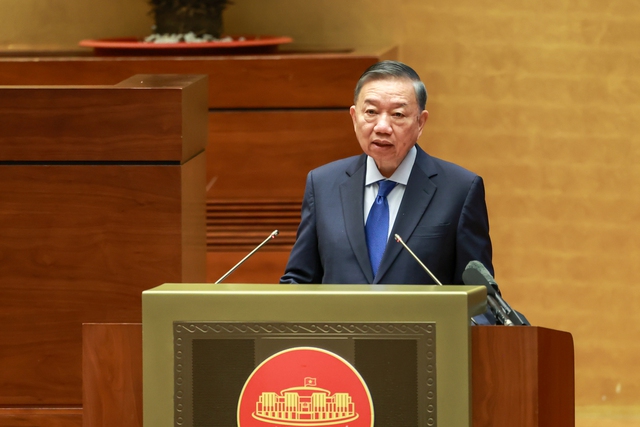
General Secretary and President To Lam delivers remarks at the national conference to disseminate key contents of Politburo's Resolution No. 10 on development of foreign-invested economic sector in Ha Noi, June 30, 2026. Photo: VGP
Distinguished leaders and former leaders of the Party, State, National Assembly, Government, and the Viet Nam Fatherland Front; leaders of Party committees at all levels; and leaders of central departments, ministries, sectors, and localities,
Fellow Party members, veteran cadres, citizens nationwide, and members of the business community attending the Conference,
The Resolution No. 10-NQ/TW, dated June 8, 2026, on the development of the foreign-invested economy, was issued by the Politburo based on a comprehensive review of nearly 40 years of implementing the Party's guidelines on opening up the economy and attracting foreign investment. This Resolution signifies a fundamental shift in our development mindset: moving away from merely opening doors to welcome capital inflows to proactively selecting and utilizing international resources to build national competitiveness.
Listening to the feedbacks from various localities, sectors, and international partners, it becomes increasingly clear that while capital is crucial, it is not the sole requirement; foreign technology is equally indispensable. This reality is clearly reflected within the core tenets of the Resolution.
Beginning with the 1987 Law on Foreign Investment, through numerous amendments, consolidations, and refinements of the Law on Investment, Viet Nam has progressively perfected its market economy institutions, broadened integration, and cultivated an increasingly open, transparent, and stable investment environment.
This process has transformed Viet Nam from a closed economy that was short of capital and heavily dependent on foreign aid, into a highly open economy that is deeply integrated into both regional and global spheres. From a baseline in the late 1980s where international trade accounted for an insignificant share, Viet Nam has today become a vital link in global production and trade networks, with total import-export turnover exceeding 180 percent of GDP, of which Foreign Direct Investment (FDI) accounts for approximately 75%. The foreign-invested sector has made positive contributions to growth, exports, industrialization, job creation, and the absorption of modern technology and management practices.
Today, Viet Nam stands in a completely different position. We no longer ask how to attract more foreign capital; instead, we must answer a far more challenging question: how to effectively utilize foreign resources to enhance our domestic strength, technological capacity, competitiveness, and economic autonomy.
We must look squarely at the current limitations in attracting FDI:
The localization rate remains low, while linkages with domestic enterprises, technology transfer, research and development (R&D), and high-quality human resource training have not yet met expectations. Many foreign investment projects remain predominantly focused on processing and assembly, heavily relying on land, low-skilled labor, cheap energy, and low environmental standards, or depending excessively on incentives without generating new capacity for the economy. Certain localities continue to compete for investment based on the sheer quantity of projects, relying on land, tax, and fee incentives rather than prioritizing land-use efficiency, energy conservation, state budget contributions, technology transfer, domestic enterprise development, environmental protection, and economic security. Furthermore, several regions remain "lowlands" in attracting foreign investment, such as the Mekong Delta, the Central Highlands, and the Northern Mountainous Region. We must proactively approach, select, guide, and effectively utilize international capital flows to reinforce national capacity. We must measure the efficiency of foreign investment attraction by capital productivity and quality, the level of technology utilized, the number of high-quality jobs created, the training of Vietnamese engineers and managers, the integration of domestic enterprises into global supply chains, the creation of greater added value, and active participation in innovation activities within Viet Nam. We must not merely attract investment based on administrative boundaries but must organize it through cluster linkages, value chains, industrial and innovation ecosystems, and inter-regional spaces. We must not compete by lowering standards or trading off our environment, natural resources, social welfare, and economic security for short-term growth. Instead, we must compete through institutional quality, modern infrastructure, high-quality human resources, low compliance costs, professional public services, and a stable, predictable business environment. It is critical to note that the implementation of Resolution No. 10 must be tightly aligned with the Resolution of the 14th National Party Congress and other strategic resolutions of the Politburo, particularly Resolution No. 68 on private economic development and Resolution No. 79 on state-owned economic development.
To overcome these shortcomings, Resolution No. 10 sets significantly higher objectives and requirements: the development of the foreign-invested economy must be closely linked with enhancing strategic autonomy, manufacturing capacity, technological capability, and the overall competitiveness of the economy.
By 2030: Viet Nam aims to be among the leading group in ASEAN regarding its business and investment environment, competitiveness, innovation, public service quality, and the capacity to absorb high-quality foreign investment projects. Concurrently, a wide range of other specific targets have been set.
Achieving these ambitious goals demands that we deeply internalize the entire content of this Resolution to act more decisively, more rapidly, and more substantially in our mindset regarding foreign investment. Specifically:
The current objective of attracting foreign investment is to convert these external resources into the internal capacity of the Vietnamese economy. To this end, domestic private enterprises must be enabled to participate, learn, and progressively move up the value chain. The state-owned economic sector must invest and lead in foundational, strategic sectors, thereby creating the infrastructure and development space for other sectors. These three economic sectors must not develop in isolation but must cooperate and resonate collectively within a unified national strategy.
The Global Minimum Tax (GMT) policy no longer allows countries to be overly generous with tax incentives, especially when we aim to attract global multinational corporations. Several neighboring countries in the ASEAN region are aggressively and successfully accelerating their attraction of projects in semiconductors, data centers, artificial intelligence, electronics, clean energy, and international finance—most notably Singapore, Indonesia, Malaysia, and Thailand.
Viet Nam needs to invest heavily in top-tier infrastructure, clean energy, institutional quality upgrades, policy reliability creation, labor skills training, intellectual property rights protection, capital market development, and supplier ecosystem quality improvements, among others.
In that spirit, I request all levels, sectors, and localities to focus on thoroughly understanding and effectively implementing the following 8 core tasks:
First, we must unify our awareness and radically transform our mindset regarding foreign investment. The foreign-invested economic sector is an integral component of the national economy, operating in cooperation, healthy competition, and mutual development alongside the state-owned, private, and cooperative economic sectors. We create all favorable conditions for capable, technologically advanced, responsible, and long-term committed investors to succeed in Viet Nam. Concurrently, we must strictly screen projects, firmly rejecting those utilizing outdated technology, consuming excessive energy, using land inefficiently, posing environmental pollution risks, or practicing transfer pricing, tax evasion, origin circumvention, or posing risks to national defense, security, data, and critical infrastructure.
Second, we must perfect our institutions to ensure stability, transparency, predictability, and alignment with international practices. Ministries and sectors must review and synchronize regulations concerning investment, business, and markets. We must resolutely address overlaps, contradictions, cumbersome procedures, and inconsistent interpretations among different agencies and localities. Investors must not be forced to navigate too many administrative layers or spend excessive time and costs to execute a lawful project. State agencies must decisively transition from a management mindset to one of development facilitation, modern governance, and public service for enterprises. Beyond accelerating procedures, we must assist investors in predicting policy directions, clearly visualizing long-term prospects, and feeling secure in their long-term investments.
Third, we must phase out input-based incentive mindsets, replacing them with output-based support tied to the level of commitment fulfillment. Projects featuring advanced technology, investment in research and development (R&D), contributions to green and digital transformations, training for Vietnamese workers, utilization of domestic suppliers, technology transfer, land and energy conservation, and emission reductions must receive commensurate support. Conversely, projects that face prolonged delays, waste land, pollute the environment, practice transfer pricing, violate laws, or fail to deliver on their commitments must be strictly penalized. Depending on the severity of the violation, we will claw back incentives, reclaim land, or terminate the project entirely if necessary.
Fourth, we must vigorously develop the domestic industrial ecosystem and foster substantive linkages between FDI enterprises and Vietnamese firms. This is the central task of the Resolution. Ministries, sectors, and localities must not only invite foreign corporations but also simultaneously elevate the capacity of Vietnamese enterprises to become their suppliers. It is necessary to build a comprehensive supplier database, strengthen connections between FDI and domestic firms, and support Vietnamese enterprises in upgrading their governance, technical standards, financial capacity, product traceability, intellectual property, and digital transformation. FDI enterprises need to publish their procurement needs, technical standards, localization roadmaps, and cooperation opportunities. Major corporations investing in Viet Nam must accompany the development of supporting industries, train local suppliers, share standards, transfer knowledge, and create conditions for domestic enterprises to integrate deeper into global value chains.
Fifth, developing high-quality human resources is the decisive factor. Without a pool of excellent engineers, experts, technicians, and managers, we cannot attract or retain high-tech projects, nor can we transition from processing and assembly to design, research, and the production of high-value-added products and services. Localities hosting industrial parks, economic zones, and high-tech zones must proactively link up with educational institutions, research institutes, and enterprises to provide tailored training matching the needs of specific industries, clusters, and strategic projects. We must create conditions that enable Vietnamese personnel to progressively assume technical, managerial, research, design, and supply chain operational positions within FDI enterprises.
Sixth, we must invest more heavily in strategic infrastructure and the foundational infrastructure required for the new economy. If we wish to attract major high-tech projects, data centers, research facilities, financial hubs, free trade zones, or modern manufacturing plants, we must guarantee stable electricity, clean energy, seaports, airports, expressways, railways, digital infrastructure, eco-industrial parks, and an optimal living environment for experts and workers. Infrastructure must be recognized as the bedrock of national competitiveness. Localities can no longer tolerate the fragmented, scattered, and disconnected development of industrial parks that lack worker housing, social services, vocational training, or integration with domestic enterprises.
Seventh, we must fundamentally innovate our investment promotion work. We must pivot away from broad, generic outreach toward highly targeted engagements. This requires thorough preparation to work directly with specific corporations, corporate groups, investment funds, and strategic partners. We must clearly define the target partners, the specific industries to be attracted, project locations, and the necessary preparatory conditions concerning land, electricity, infrastructure, human resources, policies, and local suppliers. We must accompany investors from the initial exploration stage through execution, operation, and expansion. Post-licensing support must be enhanced to resolve bottlenecks for existing projects, creating favorable conditions and incentives for investors to expand their footprints and retain profits for reinvestment rather than repatriating them. Furthermore, we must restructure and elevate the capacity of investment promotion agencies at both central and local levels.
Eighth, we must develop a modern capital market to attract long-term, stable, and responsible indirect investment flows. Resolution No. 10 does not solely address FDI; it explicitly mandates capital market development, the upgrading of our stock market status, and the growth of investment funds, international financial centers, and free trade zones. Viet Nam must transition from being merely a manufacturing destination into a hub for capital mobilization and allocation, as well as a provider of financial, technological, and innovation services for the region. This process must be inextricably linked to financial security, systemic safety, information transparency, investor protection, and the stringent control of risks associated with capital flows, money laundering, speculation, and market manipulation.
Distinguished comrades and friends,
Resolution No. 10 will only translate into reality through decisive, substantive execution that is measured strictly by outcomes. Every ministry and sector must formulate a concrete action program with clearly assigned tasks, explicit deadlines, and defined responsibilities. Each locality must devise an investment attraction strategy aligned with national planning, localized advantages, developmental conditions, and regional connectivity capabilities. We cannot allow a scenario where every single locality chases after identical project types—where every jurisdiction seeks its own seaport, airport, data center, or high-tech zone without a rational basis in planning, resources, infrastructure, and comparative advantages.
We must implement a holistic master plan alongside clear assignment and decentralization of authority, supported by effective coordination. The central level will steer the strategic direction, perfect institutions, coordinate inter-regional activities, screen major projects, and oversee implementation. Localities must be proactive and creative, but they are strictly prohibited from competing by disrupting master plans, lowering standards, or trading off long-term interests. We need to construct a comprehensive set of evaluation criteria to measure the performance of the foreign-invested economic sector across individual industries and localities. Particular emphasis must be placed on generating precise statistics regarding foreign investment projects concerning their technological level, added value, linkages with domestic enterprises, land utilization status, state budget contributions, human resource training, and environmental impacts. The evaluation of cadres, government bodies, and localities in investment attraction must also be benchmarked against these identical criteria.
To our foreign investors in Viet Nam,
Thank you for choosing Viet Nam as your second home, for living and working here, and for investing in our nation. You have responded exceptionally positively to our Resolution No. 10, despite it being issued on June 8, 2026—just 22 days ago—and officially implemented today. Having listened to your remarks, and knowing that many other investors present here have not yet spoken, I can genuinely feel that this Resolution addresses your current needs and resolves several grievances faced by foreign investors in Viet Nam today. Thank you for your highly practical proposals toward its implementation.
I request the Government, the Ministry of Finance, the Ministry of Industry and Trade, the Ministry of Agriculture and Environment, the Ministry of Science and Technology, and local authorities to establish coordinated programs to thoroughly study and act upon the proposals and recommendations raised by foreign investors. We wholeheartedly welcome your continued investment in Viet Nam, under a framework of mutual cooperation for development and the harmonious sharing of benefits. We guarantee the most favorable, secure, and successful business and living environment for foreign investors in Viet Nam.
Distinguished comrades and friends,
We are entering a new era of development with a completely renewed posture. Viet Nam does not attract investment at all costs; rather, we stand as a nation with a clear strategy, specific choices, screening capacities, and a commitment to accompany high-caliber investors to collectively generate new values. We welcome foreign investors who come to Viet Nam for long-term business, who abide by the law, respect the legitimate interests of workers, communities, and the nation, and who are willing to share technology, train local talent, develop domestic enterprises, and elevate Viet Nam's standing within global value chains.
The spirit of Resolution No. 10 is clear: attracting foreign investment is not intended to replace domestic strength, but to reinforce internal capacity and enhance economic autonomy; it is aimed not merely at rapid growth, but at sustainable, inclusive, and high-quality development.
I call upon the entire political system, the business community, and both domestic and foreign investors to uphold the highest sense of responsibility, innovation, and creativity. Let us act with absolute determination to bring this Resolution to life, converting sound policies into excellent projects, robust enterprises, new value chains, high-quality jobs, and newfound capacities for our country.
This is the most practical way to continue writing a new chapter of reform, integration, and development, propelling Viet Nam forward rapidly and steadfastly on its path toward becoming a developed, high-income nation by 2045.
Thank you very much!