To Lam meets with Russian Prime Minister Mikhail Mishustin
VGP - General Secretary and President To Lam and Russian Prime Minister Mikhail Mishustin agreed to further elevate science and technology cooperation, considering the field a potential driving force for Viet Nam-Russia comprehensive strategic partnership.
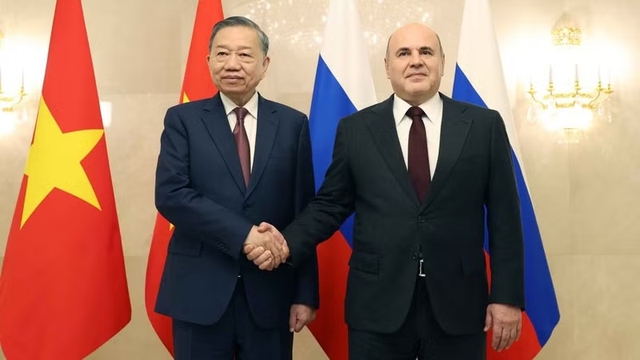
General Secretary and President To Lam (L) and Russian Prime Minister Mikhail Mishustin, Moscow, September 8, 2026 - Photo: VNA
The two leaders reached the consensus during their meeting in Moscow on September 8 (local time).
General Secretary and President To Lam appreciated the important role played by the two Governments in concretising and implementing agreements and orientations reached by the countries’ senior leaders. He called on the two Governments to continue close coordination and effectively utilize the existing cooperation mechanisms, particularly the Viet Nam-Russia Intergovernmental Committee on Economic-Trade and Scientific-Technological Cooperation.
Both sides expressed satisfaction with positive growth momentum of the bilateral ties across a wide range of areas, including trade, investment, science and technology, education and training, people-to-people exchanges and tourism.
They noted that a number of difficulties and obstacles previously identified by the two countries’ leaders have been addressed, contributing to improvements in bilateral cooperation in recent times.
The two sides agreed to mull over new cooperation mechanisms and specialised working groups in potential areas, while encouraging businesses of both countries to expand operations in each other’s markets and strengthen business connectivity.
To Lam called for promoting two-way investment in a more balanced manner. Citing the successful operations of TH Group in Russia, he encouraged Vietnamese enterprises to expand investment in agriculture in Russia, while calling on Russian businesses to step up investment in industry in Viet Nam.
Underscoring the importance of transport and logistics connectivity in boosting bilateral trade, Mishustin proposed that the two sides explore solutions to improve the efficiency of maritime, railway and multimodal transport, contributing to the establishment of stable supply chains and facilitating the movement of goods between the two countries.
To Lam also highlighted the need to establish new strategic connectivity through cooperation in transport, particularly railways, maritime transport and aviation.
To enhance economic and trade cooperation, he called on the Russian Government to direct relevant ministries and agencies to continue reviewing and resolving difficulties and obstacles in economic, trade and investment ties; adopt appropriate measures concerning tariffs, quotas, transport, logistics and market access; and increase Viet Nam’s commercial presence in the Russian market.
As Viet Nam was the first country to sign a free trade agreement with the Eurasian Economic Union (EAEU), To Lam asked Russia to help encourage other EAEU member states to further open their markets, remove trade barriers and eliminate the threshold-based trade remedy mechanism applied to Vietnamese goods.
The two leaders spoke highly of the effectiveness of bilateral cooperation in the oil and gas sector, describing joint projects in the field as vivid examples of successful bilateral cooperation.
The Russian side expressed its desire to continue expanding energy cooperation with Viet Nam, not only in traditional areas but also in new fields in line with the development needs and orientations of both countries.
Science and technology as a new driving force
Both To Lam and Mishustin shared the view that science and technology holds significant potential to become a new driving force for bilateral relations and agreed on the need to further elevate cooperation in this area.
The two sides agreed to explore expanded cooperation in new energy, biomedical technology and other emerging fields.
To Lam proposed that the two sides make greater use of Russia’s strengths in basic science, engineering and technology in combination with Viet Nam’s needs for rapid and sustainable development.
He also asked Russia to support Viet Nam in training high-quality human resources in areas where Russia has strengths and Viet Nam has growing demand.
The two sides agreed to promote cooperation in culture, tourism and people-to-people exchanges, helping younger generations gain a deeper understanding of the history, traditions and longstanding friendship between the two countries.
Mishustin expressed his belief that General Secretary and President To Lam’s State visit to Russia, together with his talks with President Vladimir Putin, would provide fresh momentum and help identify important strategic orientations for Viet Nam-Russia relations in the new period.
He affirmed that the Russian Government would closely coordinate with its Vietnamese counterpart to concretise and effectively implement agreements reached by the two countries’ top leaders, translating political orientations into specific programs and projects and tangible cooperation outcomes./.