
Standing Deputy PM calls for expanding FTA network
VGP - Standing Deputy Prime Minister Pham Gia Tuc on August 18 attended the announcement ceremony of the 2025 FTA Index, a set of indicators assessing the implementation of free trade agreements (FTAs) by localities.
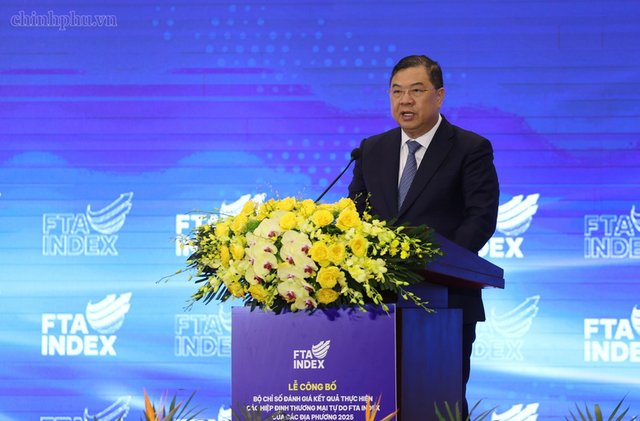
Standing Deputy Prime Minister Pham Gia Tuc addresses the announcement ceremony of the 2025 FTA Index, Ha Noi, August 18, 2026 - Photo: VGP
After nearly four decades of Doi Moi and more than two decades of international economic integration, Viet Nam has established an extensive FTA network, with 17 FTAs currently in force, covering more than 80 percent of global GDP, which provides an important foundation for expanding markets, attracting investment, promoting institutional reforms and enhancing the country's position.
The FTA Index, first launched in 2024 by the Ministry of Industry and Trade, has not only become a tool for assessing FTA implementation but has also introduced a new approach to the implementation of the agreements.
Many localities have proactively reviewed their action programs, strengthened dialogue with businesses, improved the quality of information provision, and supported businesses in taking advantage of FTA commitments.
The 2025 FTA Index has been improved in terms of its assessment methodology, survey scope and data quality. By December 30, 2025, the survey had collected responses from 4,266 import-export enterprises in 34 provinces and centrally run cities.
The survey results showed that information about FTAs has become increasingly accessible and clear. The proportion of businesses unaware of new-generation FTAs has fallen to below 10 percent.
The proportion of businesses receiving regular guidance on rules of origin increased by 15.9 percent, while the proportion receiving guidance on preferential tariff schedules rose by 16 percent compared with 2024.
Addressing the event, Pham said, FTA implementation should be regarded as an integral part of the socio-economic development strategy and an important indicator of local administrative capacity and ability to integrate internationally, rather than merely a task for the industry and trade or diplomatic sectors.
FTA implementation should be linked to investment attraction, digital transformation, green transformation, high-quality human resource training, and improving the capacity of small and medium-sized enterprises, stressed the Deputy Prime Minister.
He called for the development of a synchronized and accessible FTA information system, AI gradually applied to help businesses look up commitments, rules of origin and market standards, as well as receive risk alerts.
The Standing Deputy Prime Minister asked the Ministry of Industry and Trade to continue negotiating and signing new-generation FTAs with countries and territories, including the Southern Common Market (MERCOSUR)./.