
Quantifying human demand for next decade
VGP – The Government urged ministries, sectors, and localities to quantify their own human resource demand in order to outline proper training plans for themselves.
The
above request was made by Deputy PM Nguyễn Thiện Nhân during his online working
session with ministries and 63 localities to discuss and map out human resource
demand for the period of 2011-2015, with visions to 2020.
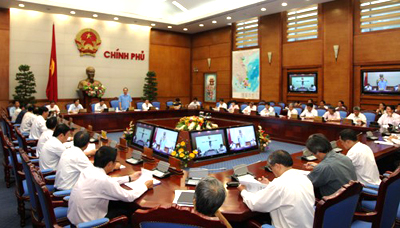
The
online working session between the central government and representatives of
ministries and localities to map out human resource development plans for the period
2011-2015 and visions to 2020, Hà Nội, August 10, 2010 – Photo: VGP/Từ Lương
Output should not
be fully born by MOET and GDVT
The
country’s development requirements in the next decade need specific and
feasible strategies and plans. However, most of ministries and localities have
not claimed shortage of highly-qualified human resource, except for capital
when they prepared annual plans.
If
people cannot transform capital into products and services, the national
economy will not post strong growth, DPM Nhân stressed the importance human
factor.
Human
resource preparation has not received adequate attention, or even constituted a
“knot” for socio-economic development, said participants to the working
session.
The
lack of workforce forecast caused difficulties for mega projects and headache
to foreign investors. A typical example is the US $3 billion Vũng Áng Economic
Zone in the central province of Hà Tĩnh, which needs some 30,000 trained
laborers and 100,000 in next three and five years respectively. However, how to
attain such a labor force is still a big question.
Thus,
the Ministry of Education and Training (MOET) and the General Department of
Vocational Training (GDVT) cannot cover the human demand of every ministry or
locality.
It
is necessary for ministries and localities to issue their future human resource
development orientations in accordance with the State’s overall strategy.
A human resource forecast unit to be established
DPM
Nhân urged ministries and localities to set up workforce forecast units headed
by a deputy minister or vice chairman.
Central
agencies will establish standing entities to sum up, classify, evaluate and
assess data collected from localities.
The
MOET and the Ministry of Labor, War Invalids and Social Affairs (MOLISA) were assigned
to organize a national conference on human resource forecast on August 25-26
this year.
The
DPM tasked ministries and localities, within September, October, and November,
must send their overview of human resource demand to the Ministry of Planning
and Investment, MOET, and MOLISA.
A
national human resource scheme for 2011-2015 and visions to 2020 will be
finalized and submitted to the Government for consideration in December.
Seven
localities namely Bắc Ninh, Thanh Hóa, Đà Nẵng, Đồng Nai, Lào Cai, Đắk Lắk and
Hậu Giang were ordered to pilot workforce planning and then share experience
with other localities for reference.
