THE SOCIALIST REPUBLIC OF VIET NAM
Government News
Viet Nam, Thailand set new trade goal of US$50 billion
VGP – Prime Minister Le Minh Hung and Thai counterpart Anutin Charnvirakul have agreed to set a new trade goal of US$50 billion during their summit meeting in Ha Noi on June 8.
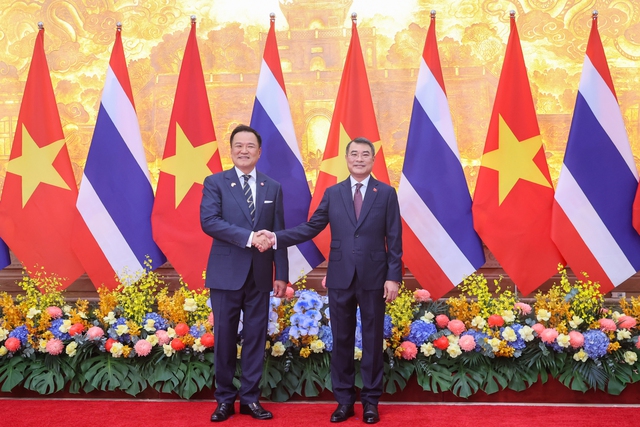
Prime Minister Le Minh Hung (right) shakes hands with Thai Prime Minister Anutin Charnvirakul in Ha Noi, June 8, 2026. Photo: VGP
The two Prime Ministers expressed their pleasure at the robust growth of Viet Nam-Thailand relations over the past five decades since the two countries established diplomatic relations in 1976.
Both sides agreed to continue consolidating political trust through regular exchange of delegations and contacts at all levels and across all channels, promoting the effectiveness of the existing bilateral cooperation mechanisms, including the Joint Cabinet meeting.
The two sides agreed to foster defense and security cooperation, maintain joint maritime patrol; coordinate in combatting transnational crime, especially drug, human trafficking, and high-tech crime.
The two Prime Ministers reaffirmed their commitment not to allowing any individual or organization to use one's territory against the other.
On economic front, the two leaders agreed to effectively implement the "three connectivity" strategy; promote transport, logistics, tourism and aviation connectivity; reduce trade barriers to boost movement of goods in a bid to soon reach the new trade goal of US$50 billion.
Both sides concurred to promote agriculture cooperation to ensure food security, as well as cooperation in the fields of science, technology, artificial intelligence, digital transformation, green economy, just energy transition, and innovation.
On multilateral cooperation, the two leaders agreed to continue close coordination within ASEAN and other multilateral forums; underscored the importance of maintaining ASEAN's solidarity, unity and central role.
Both sides agreed to promote ASEAN's common positions on the East Sea issue on the basis of international law, particularly the 1982 United Nations Convention on the Law of the Sea.
The two leaders reiterated their determination to fruitfully realize the signed agreements in an effort to further deepen the Comprehensive Strategic Partnership between the two countries, thus contributing to peace, stability, cooperation and development in the region.