THE SOCIALIST REPUBLIC OF VIET NAM
Government News
Viet Nam fosters ties with UNDP, WHO to improve air quality
VGP - Deputy Prime Minister Tran Hong Ha suggests that the UNDP and WHO support Viet Nam in building a pilot model for air pollution control in Ha Noi and expanding it to other localities across the country.
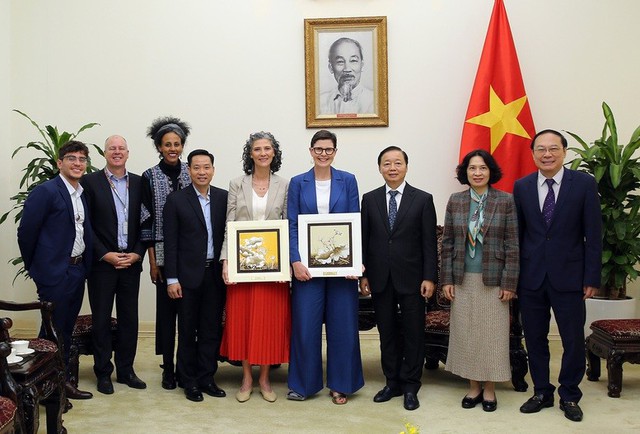
Deputy Prime Minister Tran Hong Ha (3rd from right) and Resident Representative of the United Nations Development Program (UNDP) in Viet Nam Ramla Khalidi (5th from left) and Representative of the World Health Organization (WHO) in Viet Nam Angela Pratt (6th from left), Ha Noi, March 11, 2026 - Photo: VGP/Minh Khoi
Tran made the suggestion during a reception for Resident Representative of the United Nations Development Program (UNDP) in Viet Nam Ramla Khalidi and Representative of the World Health Organization (WHO) in Viet Nam Angela Pratt in Ha Noi on March 11.
He said Viet Nam has initially assessed sources of air pollution nationwide, particularly in major urban centers such as Ha Noi and Ho Chi Minh City.
The structure of emission sources is quite similar to that of many developing countries. Industry accounts for about 27 percent of air pollution, transport around 25 percent, construction about 20 percent, and roughly 6 percent comes from other sources such as straw burning and open waste burning. The main pollutant at present is fine particulate matter (PM2.5).
Reducing air pollution requires addressing emission sources at their root, including transport, industry, construction, agricultural waste, and urban waste, said the Deputy Prime Minister.
Solutions must be implemented in a synchronized manner, ranging from urban planning, relocating industrial facilities out of urban areas, transitioning fossil fuel-powered vehicles to electric vehicles or developing underground transport systems, to applying construction standards and making better use of agricultural by-products such as straw instead of burning them, he added.
Currently, Viet Nam is seeking a comprehensive policy solution that is cross-sectoral and inter-regional. However, alongside policy development, resources for implementation remain a major challenge. This requires the Government to take into account people's livelihoods and travel needs, as well as a transition in technology and management approaches.
Given the context, the Deputy Prime Minister stressed the need for more comprehensive assessments of the damage caused by air pollution, particularly healthcare costs and socio-economic impacts. If the costs people spend on treating air pollution-related diseases can be compared with the investment required for solutions such as technological transformation, changes in transportation systems, or waste treatment, it would provide stronger grounds to promote necessary policies and actions.
Tran said Viet Nam could prioritize selecting Ha Noi as a pilot location, mobilizing the support and participation of international organizations to develop a model for air pollution control, which could later be reviewed and replicated in other localities nationwide.
Welcoming the proposal by the UNDP and WHO to organize a thematic forum on air pollution, Tran expressed his desire to connect with international experts, including those from China, to exchange experiences in designing monitoring systems and managing traffic.
In reply, Ramla Khalidi said that air pollution has been one of the areas where the UNDP and WHO have coordinated with Vietnamese ministries and agencies, particularly the Ministry of Health and the Ministry of Agriculture and Environment.
The UNDP and WHO are currently focusing their support for Viet Nam on five key areas related to air pollution: improving policies and legal frameworks; developing monitoring and early warning systems; conducting research and emission inventories; communication and raising public awareness; and linking air pollution control solutions with sustainable development goals, including the implementation of nationally determined contributions (NDCs) and the roadmap for low-carbon economic development.
Ramla Khalidi affirmed that although resources remain limited due to global uncertainties, the UNDP will continue efforts to mobilize and effectively utilize available resources to make practical contributions to improving air quality in Viet Nam./.