THE SOCIALIST REPUBLIC OF VIET NAM
Government News
Viet Nam, Denmark elevate ties to Comprehensive Strategic Partnership
VGP - Viet Nam and Denmark have decided to elevate their bilateral ties to a Comprehensive Strategic Partnership on the occasion of General Secretary and President To Lam's State visit to Denmark from October 19-21.
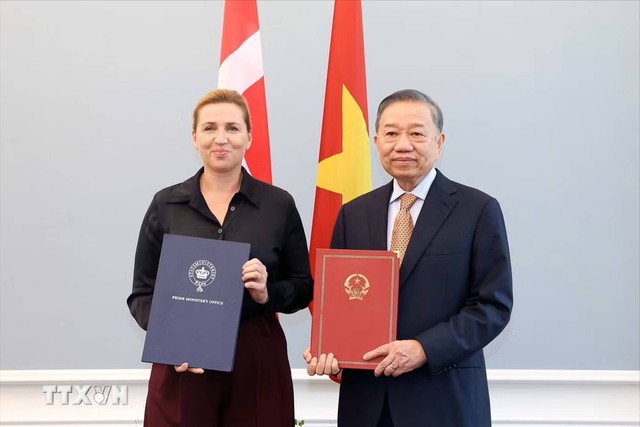
General Secretary and President of Viet Nam To Lam (right) and Danish Prime Minister Mette Frederiksen in Copenhagen, October 20, 2026. Photo: VGP
The decision was made during the summit meeting between General Secretary and President of Viet Nam To Lam and Danish Prime Minister Mette Frederiksen in Copenhagen on October 20.
With this latest move, Denmark becomes the 16th country to have established Comprehensive Strategic Partnership with Viet Nam, after China, India, Russia, the U.S., South Korea, Japan, Australia, France, Malaysia, New Zealand, Indonesia, Singapore, Thailand, the UK, and the European Union.
"With General Secretary and President To Lam's visit, we are opening a new chapter in our partnership," Ambassador of Denmark to Viet Nam and Laos Lina Gandløse Hansen told VGP ahead of the visit.
At a time of major change in the world, it is particularly important that small and medium-sized countries such as Denmark and Viet Nam strengthen their relations and further advance their cooperation, noted Ambassador Lina Gandløse Hansen.
In a bid to concretize the new partnership framework, General Secretary and President To Lam and Prime Minister Mette Frederiksen agreed to further strengthen political trust through maintaining the exchange of delegations and contacts at all levels and accross Party and State channels as well as people-to-people links; improving the effectiveness of bilateral cooperation mechanisms; promoting cooperation between the two sides' ministries, agencies, localities, and businesses.
The two leaders agreed that economic, trade and investment cooperation is an important pillar of the Comprehensive Strategic Partnership. They also agreed to continue to effectively implement of the Viet Nam-EU Free Trade Agreement (EVFTA), further open market for their goods.
Both sides concurred to continue building on the effectiveness of the Green Strategic Partnership established in 2023, making cooperation on energy transition, climate action, and sustainable development long-term strategic priorities.
Both sides also agreed to expand cooperation on strategic infrastructure, seaports, logistics, maritime transport, and supply chain connectivity; promote science, technology, innovation, and digital transformation as new drivers of bilateral cooperation.
The pair agreed to step up cooperation in research, application, and technology transfer in the fields of artificial intelligence, quantum technology, biotechnology, biomedical technology, digital technology, and emerging industries.
On multilateral aspect, the two leaders agreed to foster coordination and mutual support at the United Nations and multilateral forums; uphold multilateralism and respect for international law; promote ASEAN-EU relations in a substantive and effective fashion./.