THE SOCIALIST REPUBLIC OF VIET NAM
Government News
Viet Nam, China sign agreement on customs cooperation
VGP - Vietnamese Minister of Finance Ngo Van Tuan and Minister of the General Administration of Customs of China (GACC) Sun Meijun signed an agreement on cooperation and mutual administrative assistance in customs matters.
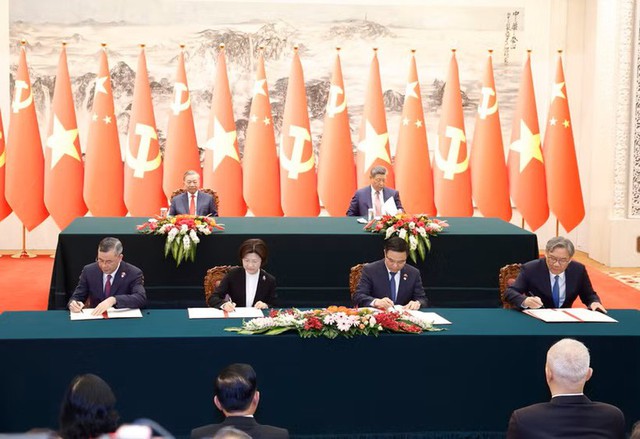
Viet Nam's Minister of Finance Ngo Van Tuan (first from left) and China's Minister and Secretary of the General Administration of Customs (GACC) Sun Meijun sign the agreement on cooperation and mutual administrative assistance in customs matters, Beijing, China, April 15, 2026 - Photo: VNA
The signing ceremony was held in Beijing, China, on April 15, under the witness of General Secretary, State President To Lam and his Chinese counterpart Xi Jinping.
The new agreement replaces the document signed in 1993, creating a legal framework for customs cooperation amid growing bilateral trade. Trade turnover between the two countries exceeded US$250 billion in 2025.
According to the Customs Department, both sides will exchange and share information on policies, laws, import-export data, and risk indicators, helping facilitate customs clearance while improving the ability to detect and prevent violations.
In addition, the agreement expands cooperation in digital transformation. Both sides will implement electronic data exchange, a single-window mechanism, and smart border gate connectivity. The authorized economic operator (AEO) program will also be expanded.
Furthermore, both sides vowed to maintain coordination via director-general-level conferences, while establishing direct contact points to handle arising issues. The implementation of smart border gates will be prioritized along road and railway routes, alongside the simplification of specialized inspections.
Third phase of Mekong Dragon Operation launched
The same day, the third phase of the Mekong Dragon Operation (OMD VIII) was launched via videoconference, with the participation of 24 customs agencies and law enforcement forces.
This initiative was jointly launched by the customs authorities of Viet Nam and China in 2018 to strengthen cooperation in customs control across the Asia–Pacific region.
This year's operation includes the participation of the United Nations Office on Drugs and Crime (UNODC), the Regional Intelligence Liaison Offices (RILO), Hong Kong Customs and Excise Department (China), and the Australian Border Force.
The OMD VIII is expected to serve as a key tool to maintain cooperation, strengthen intelligence sharing, and improve coordination efficiency among enforcement forces.
The operation is being implemented to combat transnational crime, while also contributing to regional security, environmental protection, and biodiversity conservation./.