THE SOCIALIST REPUBLIC OF VIET NAM
Government News
Viet Nam calls for stronger connectivity and resilience among ASEAN+3
VGP - Foreign Minister Le Hoai Trung called on ASEAN+3 countries to continue prioritizing deeper economic integration and stronger regional connectivity via effective implementation of existing trade agreements.
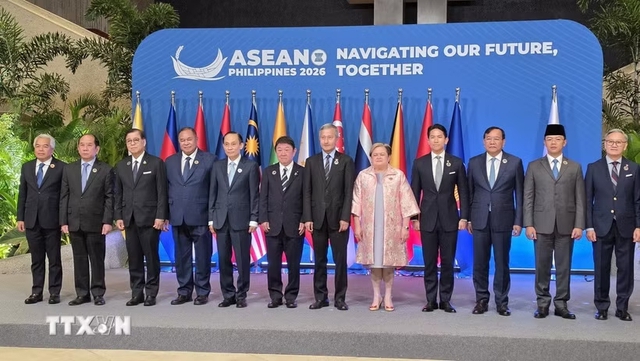
Foreign Minister Le Hoai Trung (fifth to left) attends ASEAN+3 Foreign Ministers' Meeting, Manila, the Philippines, July 23, 2026 - Photo: VNA
The Vietnamese diplomat made the call while addressing the ASEAN+3 Foreign Ministers' Meeting in Manila, the Philippines, on July 23.
Le reaffirmed the role of ASEAN+3 in providing a strategic framework for regional countries to deepen economic integration, strengthen self-reliance, and contribute to a peaceful and prosperous future for the region.
He also called for strengthening ties in energy and food security, including exploring the possibility of establishing a joint energy cooperation agreement to enhance the region's resilience and preparedness against external challenges and shocks.
The Vietnamese foreign minister urged China, Japan, and South Korea to step up collaboration and increase support for ASEAN in technology, innovation, and digital transformation, while effectively implementing agreements on cooperation in electric vehicles, clean energy, and low-carbon development.
Le reiterated Viet Nam's commitment to making every effort to further advance ASEAN+3 cooperation, contributing to peace, stability, and development in the region while delivering tangible benefits to its people.
China, Japan, and the Republic of Korea reaffirmed their commitment to supporting ASEAN Centrality, continuing assistance for the implementation of the ASEAN Community Vision 2045, and enhancing ASEAN's resilience against adverse external impacts.
Against the backdrop of growing global and regional uncertainties, the ministers agreed that ASEAN+3 - a cooperation between ASEAN Member States and three Northeast Asian nations, should further strengthen its role as the primary driver of East Asian cooperation by prioritizing economic cooperation and integration, enhancing resilience, and building capacity to respond effectively to crises and external shocks.
They underscored the importance of accelerating the implementation of the ASEAN Plus Three (APT) Cooperation Work Plan 2023-2027; deepening economic and trade relations; strengthening linkages among regional free trade agreements; and making more effective use of existing cooperation and financial support mechanisms.
The diplomats explored the possibility of expanding the regional rice reserve to help safeguard food security, as well as exploring the establishment of a shared petroleum reserve alongside bolstering cooperation on green transition and renewable energy to strengthen regional energy security.
They pledged to intensify cooperation in digital transformation, technology, and innovation by leveraging the leading position of Northeast Asian countries in these fields.
Greater investment in human capital through cooperation in education, workforce development, cultural exchanges, and tourism will also remain a priority, underlined the ministers.
The event, taking place within the framework of the 59th ASEAN Foreign Ministers' Meeting (AMM-59) and related meetings, brought together the foreign ministers of ASEAN member states, China, Japan, and South Korea./.