Viet Nam boasts four distinctive advantages in global drone race
VGP - Viet Nam has the potential to become a global hub for drone development and production, said Minister of Science and Technology Nguyen Manh Hung.
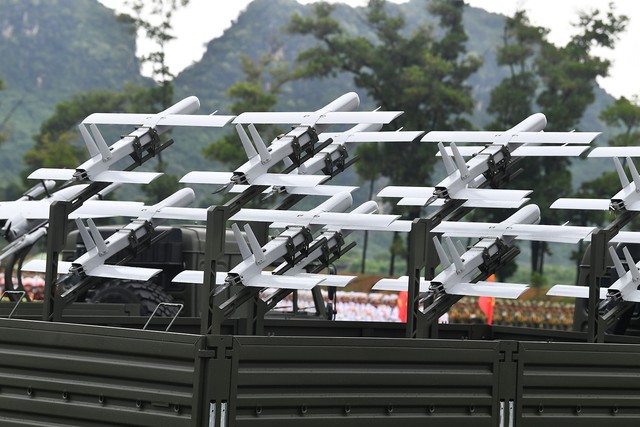
Viettel (Military Industry and Telecoms Group) plays a central role in Vietnam’s military UAV sector.
Minister Nguyen made the assessment during a recent working session with Real-time Robotics, a Vietnamese company specializing in robotics and unmanned aerial vehicles (UAVs).
He explained that the dream would become true if Viet Nam can leverage its strengths in software and AI engineering, integration with the East Asian electronics supply chain, cost-competitive manufacturing, and a large domestic application market
The drone industry is unlike many traditional manufacturing sectors because it does not depend heavily on heavy industry. Instead, it is largely driven by artificial intelligence, software development and system integration—the areas where Viet Nam enjoys several comparative advantages.
First, software and AI capabilities. Today's drones are far more than "small airplanes." Their core value lies in advanced technologies such as navigation systems, computer vision, autonomous operation and AI-based control. In essence, software determines much of a drone's value. Viet Nam has a large and growing pool of software engineers, a rapidly expanding AI ecosystem and relatively low research and development (R&D) costs, all of which strengthen its competitiveness in this field.
Second, Viet Nam's position within the regional electronics supply chain. The production of drones requires a range of components, including chips, cameras, sensors, motors and batteries. These are widely manufactured across the East Asian supply network, placing Viet Nam in a strategically advantageous location for efficient sourcing and production.
Third, competitive manufacturing costs. Drones are categorized as light electronic and mechanical products that can be assembled through modular production processes. Such products align well with Viet Nam's manufacturing capabilities and skilled technical workforce, allowing the country to remain globally competitive in terms of production costs.
Fourth, strong domestic demand. Viet Nam offers numerous practical applications for drones, including agriculture, power grid inspection, forest and maritime surveillance and logistics. A large and diverse domestic market enables businesses to test, refine and scale their technologies quickly. In contrast, many countries have struggled to develop strong robotics industries due to the absence of a sufficiently robust home market.
Minister Nguyen stressed that Viet Nam is entering a new stage of development. In this phase, technology enterprises will play an increasingly important role. Companies that are willing to invest in research and development (R&D), develop new technologies, and venture into challenging fields will be the ones leading the economy.
The State has the responsibility to create a favourable environment for technology enterprises to grow: an open and enabling institutional framework, a strong innovation ecosystem, policies that encourage research and development, and acting as the first buyer of new technological products.
He added that the Ministry of Science and Technology will continue to accompany technology enterprises, promote R&D activities, facilitate the commercialisation of research results, and support the development of new technologies.
Earlier, experts forecast that Viet Nam's UAV market could hit US$10 billion and create 1 million jobs by 2035, offering major opportunities for local tech firms to invest in R&D, manufacturing, and services.
The UAV usage is expanding across Viet Nam. In agriculture, the Mekong Delta already operates over 3,000 drones across 1.5 million hectares. The agricultural UAV and robotics market is predicted to reach US$ 363.7 million by 2030, up 4.76 percent annually. A single drone can spray or monitor 60–70 hectares per day, far exceeding the manual labor capacity of 1 hectare. In the electricity sector, one hour of UAV inspection can replace three days of manual work.
With the issuance of Decree 288, dated November 5, 2025, regulating the management of unmanned aircraft and other flying vehicles, Viet Nam now has a clearer regulatory framework for unmanned aerial vehicles. Previously, UAVs were managed mainly under the Law on People’s Air Defence, where they were treated primarily as security-sensitive objects. This approach made access and deployment difficult, even for aviation professionals.
Although the Party and Government have identified the low-altitude economy as a potential growth driver, the regulatory system has not yet fully shifted from a control-oriented mindset to a development-oriented one. Procedures remain relatively complex, which slows down commercial expansion./.