THE SOCIALIST REPUBLIC OF VIET NAM
Government News
Viet Nam announces roadmap for search, collection, and identification of remains of martyrs
VGP - Viet Nam will implement a two-phase roadmap for search, collection, and identification of remains of martyrs for 2026-2030 period.
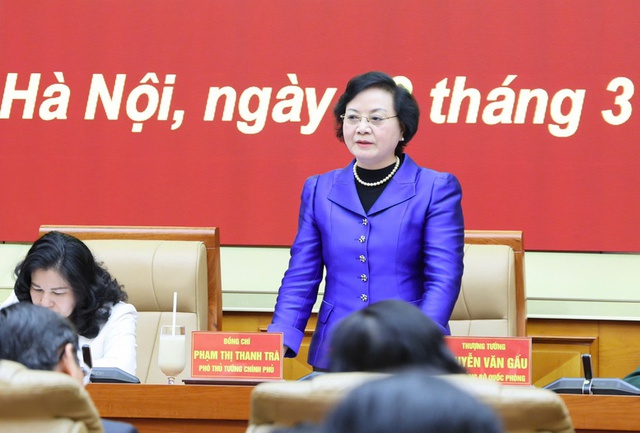
Deputy Prime Minister Pham Thi Thanh Tra
The roadmap was released on Tuesday by the National Steering Committee for Search, Collection and Identification of Remains of Marrtyrs, led by Deputy Prime Minister Pham Thi Thanh Tra.
Phase 1 (January 2026 – July 2027) aims to fundamentally address existing backlogs in the search and identification of martyrs' remains.
Key targets include: (i) searching for and repatriating approximately 7,000 sets of martyrs' remains; (ii) collecting samples from about 230,000 unidentified graves nationwide; (iii) conducting DNA testing on approximately 18,000 samples; (iv) building and putting into operation a genetic database of relatives of unidentified martyrs.
Phase 2 (August 2027 – December 2030) sets further goals of: (i) searching for and collecting about 3,000 additional sets of remains; (ii) conducting DNA testing on around 30,000 samples; (iii) promoting verification, supplementation, and correction of information for graves lacking adequate documentation through various verification measures.
Three major breakthroughs in 2026
Deputy Prime Minister Pham Thi Thanh Tra urged members of the Steering Committee to renew their thinking and implementation methods, emphasizing that the mission carries profound political, humanitarian, and moral significance.
In 2026, the Committee is tasked with focusing on three major breakthroughs:
First, completing the legal framework and related policies, particularly amendments to the Ordinance on Preferential Treatment of People with Meritorious Services to the Revolution and related decrees, as well as issuing resolutions and circulars on special mechanisms and technical-economic norms.
Second, intensifying the clearance of bombs, mines, and unexploded ordnance to facilitate search and repatriation efforts, especially in key localities such as Lao Cai, Lang Son, and Quang Tri. The Deputy Prime Minister stressed that clearance operations must be conducted promptly while ensuring absolute safety.
Third, accelerating biological sampling of unidentified remains in cemeteries nationwide to enable large-scale and synchronized DNA testing in line with the set targets.
Additional priorities include completing the national database on martyrs, martyrs' graves, and cemeteries; putting the Steering Committee system at all levels into effective operation; and strengthening inspection and supervision.
A call from the heart
Since the end of the war in 1975, the Government of Viet Nam has undertaken sustained efforts to locate, identify, and rebury fallen soldiers. Specialized teams under the Ministry of National Defense have been deployed across former battlefields, remote forests, and border areas.
Search missions have also extended to neighboring countries, particularly Laos and Cambodia, where many Vietnamese volunteer soldiers and experts laid down their lives. Through bilateral cooperation mechanisms, thousands of sets of remains have been repatriated over the years.
The work remains complex and painstaking. Many burial sites lack documentation, while difficult terrain and the passage of time pose significant challenges. In numerous cases, information provided by veterans and local residents has played a vital role in narrowing down search locations.
The upcoming 500-day campaign is expected to mark a new breakthrough in fulfilling the nation's enduring commitment to ensure that those who sacrificed for national independence and reunification are honored, identified, and returned to their families./.