THE SOCIALIST REPUBLIC OF VIET NAM
Government News
To Lam's upcoming visit to Thailand carries great significance for bilateral relations
VGP - The upcoming visit to Thailand by General Secretary and President To Lam carries great significance for the bilateral relations, emphasized Thai Ambassador to Viet Nam Urawadee Sriphiromya.
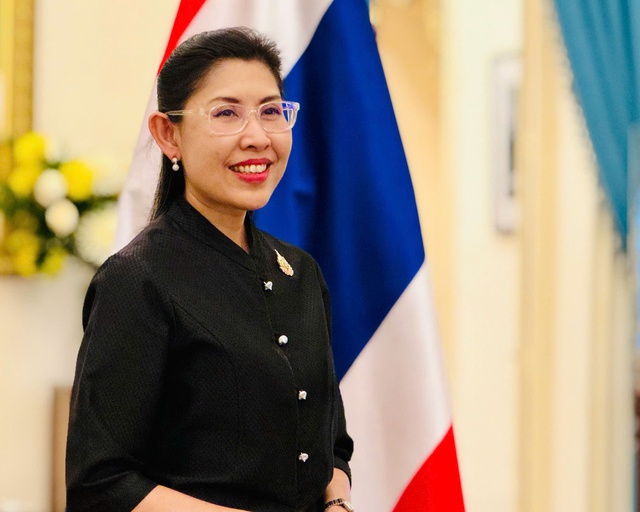
Thai Ambassador to Viet Nam Urawadee Sriphiromaya - Photo: VGP
The top Vietnamese leader and his spouse are set to pay an official visit to Thailand from May 27-29 at the invitation of Thai Prime Minister Anutin Charnvirakul and his spouse.
In a recent interview with VGP ahead of the visit, the Ambassador noted that this would be the first official visit to Thailand by the Vietnamese leader following the 14th National Party Congress and the introduction of new Vietnamese administration. The visit is also particularly meaningful as it coincides with the 50th founding anniversary of diplomatic relations.
According to the Ambassador, the visit reflects the strong mutual trust, respect, and close cooperation between the two countries.
She highlighted that Thailand was chosen as the first ASEAN destination for the Vietnamese leader's regional tour, underscoring the importance of bilateral ties. Thai authorities, as well as Thai citizens of Vietnamese origin, are looking forward to welcoming the high-level Vietnamese delegation.
The diplomat stressed that Thailand and Viet Nam are now Comprehensive Strategic Partners, the highest level of cooperation between Viet Nam and foreign countries.
Both sides are expected to discuss in detail the implementation of the Comprehensive Strategic Partnership, particularly through a new Plan of Action for the 2026–2031 period. The plan will cover cooperation across multiple sectors and aims to deliver concrete outcomes that support peace, security, and prosperity for both countries.
The visit takes place amid a rapidly changing and challenging international environment. In this context, consultations between leaders are important for coordinating responses to regional and global challenges, including maintaining peace and stability in Southeast Asia, promoting the ASEAN agenda, and strengthening cooperation on energy security, food security, and combating transnational crimes such as cybercrime, she unveiled.
The Ambassador cited Viet Nam's hosting of the signing conference for the United Nations Convention against Cybercrime, also known as the Ha Noi Convention, as an example of the country's growing role in international cooperation.
Sriphiromya praised Viet Nam's active engagement in multilateral forums, including the United Nations, UNESCO, and the Treaty on the Non-Proliferation of Nuclear Weapons process, describing the country as an increasingly influential actor in global affairs.
Viet Nam-Thailand relations reach unprecedented levels of closeness
Reflecting on bilateral achievements in recent years, Ambassador Sriphiromya said Viet Nam-Thailand relations have reached unprecedented levels of closeness.
Thailand was previously the first country to establish a Strengthened Strategic Partnership with Viet Nam, and the recent elevation to a Comprehensive Strategic Partnership marked another major milestone, she added.
Economic cooperation has also expanded significantly. Thailand has consistently remained among the top ten foreign investors in Viet Nam and recently moved from ninth to eighth position.
The Ambassador said this demonstrated strong confidence among Thai businesses in Viet Nam's economic policies and investment climate. Thai investments, she added, contribute not only to bilateral trade but also to local economic development and the well-being of Vietnamese communities.
People-to-people exchanges have likewise grown rapidly. Tourism flows between the two countries have increased substantially despite global economic uncertainties. Thai visitors regard Viet Nam as a friendly and welcoming destination with many cultural similarities, while Vietnamese tourists continue to travel to Thailand in large numbers. She described these exchanges as a solid foundation for expanding economic and investment ties.
The Ambassador also highlighted cultural cooperation as an increasingly important pillar of bilateral relations, adding that Ha Noi was selected as one of six capitals worldwide to host Thailand's flagship Thai Festival last year, and this year's edition was organized to celebrate the 50th anniversary of diplomatic relations.
In the area of political and security cooperation, she mentioned the recent port visit of a Thai royal naval ship to Ho Chi Minh City, the first such visit in 11 years, which was also organized to commemorate the anniversary year. Both countries continue to cooperate closely and support each other in regional and international forums such as ASEAN and APEC.
On trade and business cooperation, the Ambassador noted that bilateral trade has continued to grow steadily despite global economic challenges. Trade turnover has already exceeded US$23 billion, approaching the two countries' target of US$25 billion. Thailand remains Viet Nam's largest trading partner within ASEAN, while Viet Nam is Thailand's second-largest ASEAN trading partner.
Much of Thailand's exports to Viet Nam consist of intermediate goods that support Viet Nam's export-oriented economy, illustrating the complementary nature of bilateral trade. Thailand also views Viet Nam as an important gateway to other markets, particularly China, thanks to Viet Nam's improving logistics systems and border infrastructure.
The Ambassador identified several promising areas for future cooperation, including high technology, semiconductors, renewable energy, digital banking, fintech, and green investment. Thai companies are already investing in environmentally friendly industrial parks, renewable energy projects, and retail networks in Viet Nam. These investments help Vietnamese products reach international markets, including Europe, through Thai distribution systems.
She also pointed to opportunities in aviation, infrastructure connectivity, healthcare, and smart agriculture. Thailand and Viet Nam, she said, can work together to improve regional transport links, develop aircraft maintenance and repair services, and promote health-related industries and research cooperation.
Addressing common challenges, the Ambassador highlighted energy security and climate change as two urgent issues requiring closer collaboration. Both countries aim to achieve net-zero emissions and transition toward greener economies.
She stressed the need for sustainable resource management, particularly in water resources, as climate change increases the risks of droughts, floods, and natural disasters.
Viet Nam, Thailand are important contributors to regional peace, stability, and development
Regarding the role of Viet Nam and Thailand in Southeast Asia, the ambassador stressed that both countries are important contributors to regional peace, stability, and development.
Viet Nam's economic achievements and long-standing stability have enhanced its role within ASEAN, and Thailand sees strong potential for the two countries to jointly advance ASEAN's agenda, she underlined.
ASEAN is currently facing numerous challenges, including geopolitical competition among major powers and instability in other parts of the world. In this context, Thailand and Viet Nam share similar positions on preserving regional peace, maintaining ASEAN centrality, and promoting a rules-based regional order. Both countries also support balanced relations with major powers in order to prevent conflicts and sustain socio-economic development.
The diplomat further emphasized cooperation in sustainable development, green growth, and digital transformation. Thailand and Viet Nam, she said, are both promoting policies that support greener economies and enhanced regional connectivity through infrastructure development and supply chain integration.
She also highlighted maritime cooperation as another important area, particularly in promoting maritime security, freedom of navigation, and adherence to international law, including the United Nations Convention on the Law of the Sea 1982 (UNCLOS 1982).
The Ambassador also emphasized the importance of regional mechanisms such as the Mekong-Lancang Cooperation and the Mekong River Commission in addressing environmental and water management issues. In addition, she stressed the need for cooperation in tackling transboundary haze pollution and promoting sustainable agricultural practices through technology and smart farming.
Sriphiromya expressed confidence that both countries would continue to strengthen their partnership across all sectors and contribute jointly to regional peace, prosperity, and sustainable development./.