
THE SOCIALIST REPUBLIC OF VIET NAM
Government News
Review of State-owned economic sector after 40 years of Doi Moi
VGP - After four decades of Doi Moi, Viet Nam’s state-owned economy has seen its share of GDP halved, yet its revenue scale has expanded dramatically, increasing sevenfold compared to two decades ago.
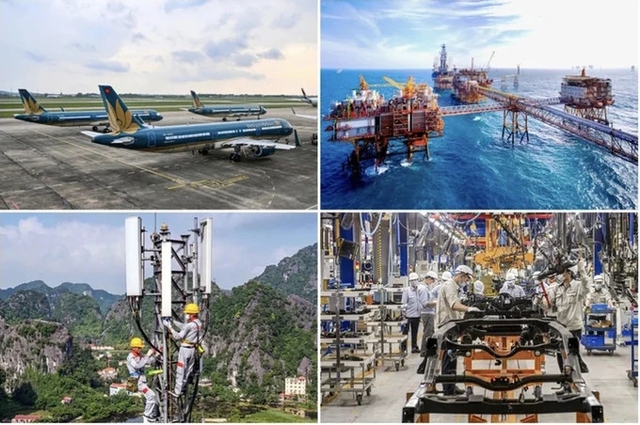
The Politburo’s Resolution 79 defines that the state-owned economy plays a leading role in the national economy, serving as a key resource for the State to stabilize macroeconomy, guide development course and compete on an equal and healthy basis with other economic sectors.
In practice, since the launch of the Doi Moi policy in 1986, the state-owned sector has consistently performed a guiding and regulating function in the economy.
Declining share, expanding scale
In the early years of Doi Moi, the public sector accounted for more than 40 per cent of GDP, driven largely by the rapid expansion of state-owned enterprises (SOEs). This share gradually declined following the equitisation “turning point” in the mid-1990s, alongside the strong rise of the private sector and growing inflows of foreign direct investment.
At present, the state-owned economy—encompassing land, national reserves, SOEs and state capital invested in enterprises—accounts for around 20 per cent of GDP and approximately 10 per cent of total State budget revenue.
Despite the reduced share in major macroeconomic indicators, absolute values have continued to rise. Total annual net revenue, mainly generated by SOEs, is now more than seven times higher than two decades ago, increasing from about VND 610 trillion to over VND 4.3 quadrillion. Over the same period, budget revenue from SOEs rose nearly fivefold to more than VND 180 trillion.
The state-owned economy continues to play a leading role in strategic and essential sectors, including energy, mining, telecommunication, transport infrastructure and logistics. State capital remains dominant in major enterprises such as Petrovietnam, Petrolimex, EVN and TKV in energy; Viettel, MobiFone and VNPT in technology; and Viet Nam Airlines in services.
Banking is another sector where state-owned players hold a strong position. Outstanding loans at the four State-owned commercial banks—BIDV, VietinBank, Agribank and Vietcombank—were estimated at more than VND 7.4 quadrillion by mid-2025, accounting for roughly 43 per cent of total credit in the economy.
However, the Politburo has acknowledged that policies governing the state-owned sector have been slow to innovate, while the management and use of many State resources and assets remain inefficient. In several cases, enterprise performance has not matched the scale of resources under management, and long-standing issues have not been addressed in a timely manner, leading to waste and losses.
SOEs also face structural pressure as they operate under the Enterprise Law like other businesses, while simultaneously complying with regulations on State capital management and public investment.
By the end of 2024, 164 SOEs—around 20 per cent of the total—still recorded accumulated losses exceeding VND 106 trillion. As of late September 2025, overall performance continued to lag behind the scale of resources controlled by the sector.
According to the Government, limited proactiveness and competitiveness remain major weaknesses, as SOEs often must wait for approval from State ownership representatives and relevant authorities. This slows investment project implementation and business operations.
In addition, SOE investments remain fragmented and weakly linked, failing to fully leverage sectoral strengths. Capital flows have increasingly concentrated in infrastructure and transport, with their share rising from 29 per cent in 2020 to nearly 44 per cent at present. Energy, national defence and security, education, agriculture and healthcare follow, each accounting for 5–10 per cent.
Restructuring to unlock growth
To address these bottlenecks, Resolution 79 identifies further restructuring and accelerated reform of SOEs as a key solution. The Government encourages consolidation, mergers and enterprise transfers, while allowing large SOEs with growth potential to increase charter capital using proceeds from equitisation, divestment and retained post-tax profits.
A major constraint for listed SOEs—particularly banks—has been the conflict between the need to retain earnings to strengthen capital and pressure to remit cash dividends to the State budget. Resolution 79 has removed this obstacle.
As of September 2025, Viet Nam had 843 enterprises with State capital, including 687 in which the State holds a controlling stake of over 50 per cent. The number of SOEs has continued to decline in recent years and now accounts for less than 1 per cent of operating enterprises, in line with equitisation policy.
Looking ahead, the Politburo has set ambitious targets. By 2030, 50 SOEs are expected to rank among Southeast Asia’s 500 largest enterprises, with one to three companies entering the global Fortune 500. Viet Nam also aims to have at least three State-owned commercial banks among Asia’s top 100 largest banks.
According to Fortune magazine’s ranking of Southeast Asia’s 500 largest enterprises published last year, Viet Nam had 76 representatives, including 20 with State controlling stakes. Petrovietnam and Petrolimex ranked 11th and 26th in the region, respectively, underscoring the continued economic weight of the State sector amid ongoing reform./.