THE SOCIALIST REPUBLIC OF VIET NAM
Government News
Politburo maps out long-term vision for Dong Nai City as Asia-Pacific aviation hub
VGP - The Politburo has unveiled a long-term development strategy to transform Dong Nai into a modern aviation hub in the Asia-Pacific region, with Long Thanh International Airport at the heart of a high-tech and innovation-driven airport city.
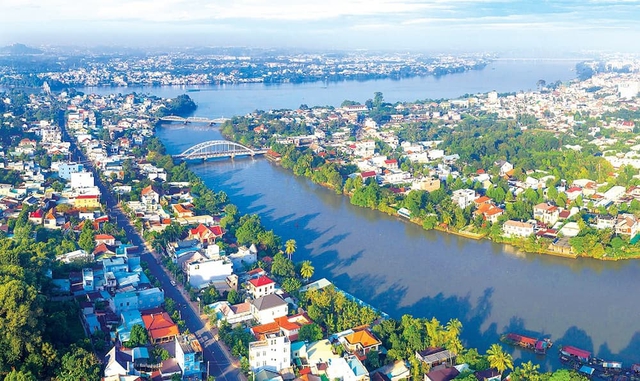
Outlined in Politburo Resolution No. 16 on the construction and development of Dong Nai City through 2035, with a vision to 2065, the strategy positions the southern locality as one of Viet Nam's key growth engines.
Signed by General Secretary and President To Lam, the Resolution envisions Dong Nai to become a green, smart and multi-center airport city driven by high-tech industries, aerospace manufacturing, aviation services and a modern aviation economy that meets international standards by 2035.
By 2045, Dong Nai is expected to emerge as a leading aviation hub in the Asia-Pacific region and a knowledge-based economy with a high quality of life. Looking further ahead to 2065, the city aims to become a globally connected airport metropolis ranked among the world's leading multifunctional aviation-oriented urban centers.
Long Thanh airport to power aviation ecosystem
The Resolution identifies Long Thanh International Airport as the core of an integrated aviation ecosystem.
It calls for expanding aerospace manufacturing, aviation services and other high-value industries around the airport while strengthening connections between air transport, seaports, logistics networks and global supply chains.
Urban development will follow a multi-center model with integrated planning across land, waterways, airspace, underground infrastructure and digital networks.
Priority development corridors include the Ho Chi Minh City–Bien Hoa–Long Thanh–Phuoc An Port axis, focusing on aviation, logistics and modern services, and the Bien Hoa–Dau Giay–Tan Phu–Central Highlands corridor, which will promote industrial development, agriculture, renewable energy, tourism and regional connectivity.
Digital economy to underpin growth
The Resolution targets annual GRDP growth of at least 10 percent during 2026–2030.
By 2030, Dong Nai's GRDP is projected to reach US$44 billion, with per capita income rising to US$9,200. The digital economy is expected to contribute at least 30 percent of total GRDP.
Growth is projected to remain above 10 percent annually during 2031–2035, lifting GRDP to US$70 billion and per capita income to around US$13,000 by 2035.
The long-term vision sets GRDP targets of US$150 billion by 2045 and US$600 billion by 2065, with per capita income reaching approximately US$67,500.
To realize these ambitions, the Politburo called for stronger institutional reforms, greater decentralization, increased mobilization of private investment, and faster progress in science, technology, innovation and digital transformation.
Building a globally connected airport city
The strategy prioritizes investment in transport, digital infrastructure, logistics and energy systems to improve Dong Nai's connectivity with Long Thanh International Airport, major seaports, key economic centers and international supply chains.
It also highlights the importance of enhancing urban governance and building a clean, efficient political system to support sustainable, long-term development.
Located at the eastern gateway to Viet Nam's Southern Key Economic Region, Dong Nai has long been a major industrial and logistics center. Supported by an extensive industrial park network, strong transport links with Ho Chi Minh City and neighboring provinces, and significant land reserves, the city is well positioned to transition from traditional manufacturing to high-tech industries, modern services and a knowledge-based economy.
The development of Long Thanh International Airport is expected to accelerate this transformation by creating a new growth pole centered on aviation, logistics and global supply chains.
Following its elevation to a centrally governed city on April 30, 2026, Dong Nai is expected to capitalize on its strategic location, transport infrastructure and industrial strengths to become a green, smart and globally connected airport city././.