THE SOCIALIST REPUBLIC OF VIET NAM
Government News
General Secretary, President To Lam wraps up State visit to China
VGP - General Secretary and State President To Lam departed Nanning on April 17, successfully concluding his four-day State visit to China at the invitation of General Secretary and President Xi Jinping.
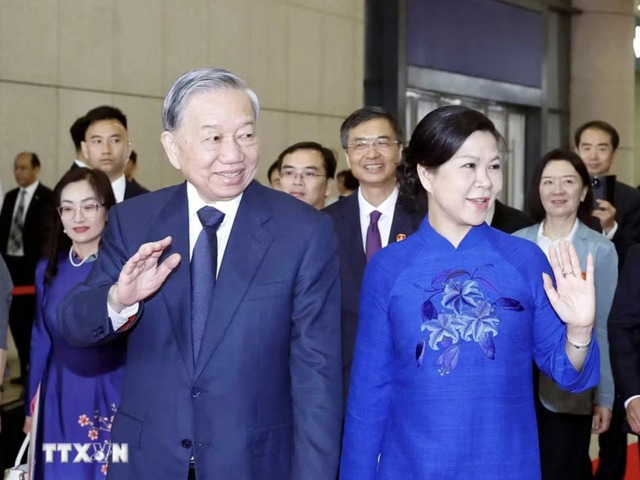
General Secretary and State President To Lam and his spouse successfully wrap up the State visit to China - Photo: VNA
Senior Chinese officials, including Liu Jianchao, Secretary of the CPC Central Committee and Chairman of the International Liaison Department, and Chen Gang, member of the CPC Central Committee and Party Secretary of the Guangxi Zhuang Autonomous Region, were present to see off the Vietnamese leader and his entourage.
During the visit, To Lam held talks with Xi Jinping and witnessed the signing of key cooperation agreements between the two countries. He also met with Chinese Premier Li Qiang, Chairman of the National People's Congress Standing Committee Zhao Leji, and Chairman of the Chinese People's Political Consultative Conference Wang Huning.
The Vietnamese leader delivered a policy speech at Tsinghua University, visited the Xiong'an New Area in Hebei province, and toured the China–ASEAN AI Application Cooperation Center.
The trip also featured meetings with Vietnamese diplomatic staff and the Vietnamese community in China, as well as exchanges with Chinese individuals who had supported Viet Nam–China friendship. To also attended a Viet Nam–China friendship art program, visited the historic Nanning Yucai School, and took part in activities launching the Viet Nam–China Border People's Festival 2026.
High-level meetings included in-depth discussions on domestic developments in each country, bilateral ties, and regional and international issues of mutual concern.
The two sides expressed satisfaction with the strong progress in relations between the two Parties and countries, marked by frequent high-level exchanges, increasingly comprehensive cooperation mechanisms, and more substantive defense and security collaboration.
Both sides highlighted breakthroughs in economic, trade, and investment cooperation, along with enhanced transport connectivity, dynamic local-level collaboration, expanding people-to-people exchanges, and closer coordination at multilateral forums.
Amid the current complex global landscape, the two sides underscored the importance of strengthening unity, enhancing strategic trust, and boosting connectivity in policies, trade, infrastructure, and energy. They reaffirmed their commitment to deepening and elevating Viet Nam–China relations in the new era, contributing to peace, cooperation, and development in the region and beyond.
Looking ahead, both sides agreed to advance the "six major orientations," including stronger political trust, more effective defence and security cooperation, deeper practical collaboration, firmer social foundations, closer multilateral coordination, and better management and resolution of differences.
The two countries also officially launched the "Viet Nam–China Tourism Cooperation Years 2026–2027," pledging to intensify joint promotion efforts, improve tourism infrastructure and services, and maintain their positions as each other's largest source of tourists.
During the visit, numerous cooperation documents were signed across a wide range of areas, including Party channels, public security, justice, economy, supply chains, customs, science and technology, social affairs, human resources, media, and local-level cooperation.
At the conclusion of the visit, both sides issued a joint statement on further deepening the Comprehensive Strategic Cooperative Partnership and advancing the building of a Viet Nam–China community with a shared future that carries strategic significance at a higher level in the new era.
The visit was widely regarded as a success, helping to strengthen the traditional friendship between the two countries, accelerate the building of a shared future community, and promote peace, stability, and prosperity in the region and beyond./.