Prime Minister proposes ACMECS expand development space, strengthen economic connectivity
VGP - The 11th Ayeyawady–Chao Phraya–Mekong Economic Cooperation Strategy (ACMECS) Summit took place in Ha Noi on Saturday.
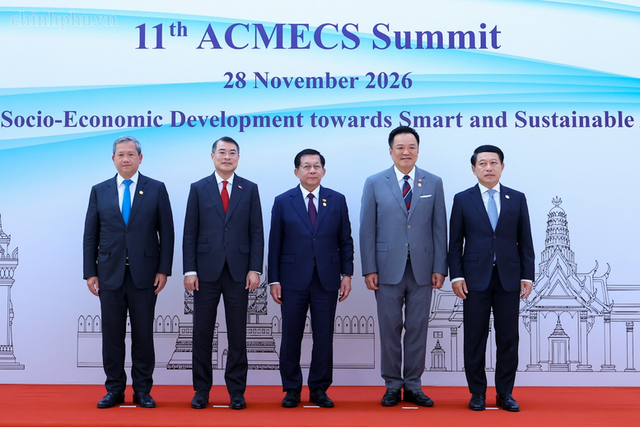
From left to right: Cambodian Prime Minister Hun Manet, Prime Minister Le Minh Hung, Myanmar President Min Aung Hlaing, Thai Prime Minister Anutin Charnvirakul and Lao Prime Minister Saleumxay Kommasith attend the 11th Ayeyawady–Chao Phraya–Mekong Economic Cooperation Strategy (ACMECS) Summit, Ha Noi, November 28, 2026 - Photo: VGP
The event, co-hosted by Viet Nam and Myanmar, brought together Vietnamese Prime Minister Le Minh Hung, Myanmar President Min Aung Hlaing, Lao Prime Minister Saleumxay Kommasith, Cambodian Prime Minister Hun Manet, and Thai Prime Minister Anutin Charnvirakul.
In his remarks, Vietnamese Prime Minister Le Minh Hung affirmed that Viet Nam has treasured and actively contributed to Mekong subregional cooperation in general, and the ACMECS in particular.
He noted with pleasure that ACMECS cooperation mechanism, initiated by all five Mekong countries, has contributed to strengthening solidarity and strategic trust among the member countries.
With a vision of transforming the Mekong into a high-quality, innovative, self-reliant and sustainable manufacturing hub, Le suggested that ACMECS focus on expanding development space, strengthening economic connectivity and enhancing the subregion's competitiveness.
He called on ACMECS countries to give priority to promoting connectivity of production centers, urban areas, seaports, border gates and markets; effectively develop the North–South, East–West and Southern Economic Corridors; and gradually establish highly competitive regional supply chains.
ACMECS countries should mobilize financial resources for strategic infrastructure connectivity, particularly road and railway links between the subregion and neighboring areas, especially routes along the corridor connecting China through the five Mekong countries and onward to Malaysia and Singapore, as well as an expressway linking the five Mekong countries with India.
Le called for harmonizing procedures, facilitating trade, accelerating digital transformation, promoting innovation and developing human resources as well as considering the initiative to establish a common "Mekong Agricultural Products" brand to enhance the value, market access and competitiveness of the subregion's products in regional and global markets.
The Vietnamese Prime Minister also called for making environmental protection, sustainable management of transboundary water resources and climate change adaptation as long-term strategic priorities.
ACMECS countries should further improve the effectiveness of natural resource management and sustainable utilization, particularly water resources; conserve biodiversity; strengthen responses to natural disasters and environmental pollution; and promote green growth, he noted.
Regular consultation and information-sharing arrangements should be set up, including information on development projects involving water resources, while enhancing connectivity among natural disaster early warning systems, Le said.
Le emphasized the need to renew cooperation modalities and promote ACMECS's operational effectiveness and role within the subregional and regional architecture.
The Vietnamese Prime Minister called on the ACMECS Interim Secretariat, in coordination with the Mekong Institute, to promptly finalize the draft ACMECS Master Plan for the new cooperation period. The plan should identify priorities and select a portfolio of practical projects capable of mobilizing resources from development partners and the private sector.
The Leaders adopted the Nay Pyi Taw Joint Declaration of the 11th ACMECS Summit, setting out directions for cooperation among the five countries in the period ahead.
Following the Summit, a ceremony was held to formally transfer the ACMECS Chairmanship from Myanmar to Thailand./.