
Prime Minister Le Minh Hung receives JBIC Governor
VGP - Prime Minister Le Minh Hung on Friday received Maeda Tadashi, Governor of the Japan Bank for International Cooperation (JBIC), calling for the bank's continued financial support for Japanese-invested projects and Viet Nam's strategic development priorities.
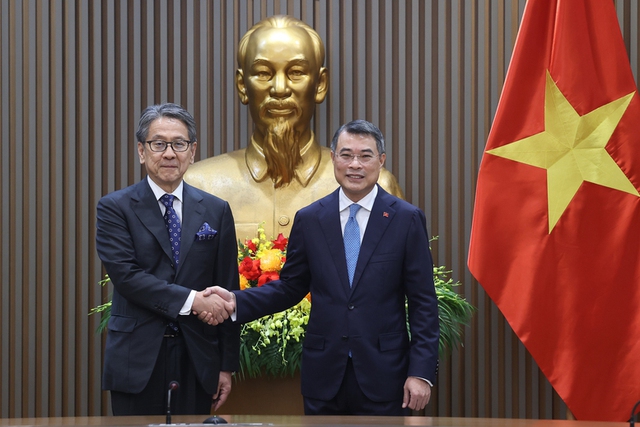
Prime Minister Le Minh Hung (R) shakes hands with JBIC Governor Maeda Tadashi, Ha Noi, July 2, 2026 - Photo: VGP/Nhat Bac
The Prime Minister welcomed the increasingly substantive and effective development of the Viet Nam–Japan Comprehensive Strategic Partnership, noting that bilateral cooperation has advanced significantly since the relationship was elevated nearly three years ago.
He underscored that Japan remains one of Viet Nam's leading economic partners, with cooperation expanding beyond traditional areas into science and technology, semiconductors, artificial intelligence (AI), digital transformation, green transition, renewable energy and space technology.
Le highlighted the recent official visit to Viet Nam by Japanese Prime Minister Takaichi Sanae, during which the two sides agreed to further deepen bilateral cooperation to promote sustainable development in a new era.
He said considerable potential remains to expand cooperation, stressing JBIC's key role in mobilizing financial resources for strategic infrastructure and supporting Viet Nam's long-term development, particularly its green transition.
To implement agreements reached during Prime Minister Takaichi's Viet Nam visit, Le urged JBIC to continue serving as a bridge for cooperation by developing financing and investment guarantee mechanisms to facilitate the establishment of industrial clusters, innovation centers and high-tech manufacturing facilities in Viet Nam.
Such initiatives, he said, would help accelerate the Southeast Asian country's industrialization and modernization while supporting national priorities, including attracting high-quality foreign investment, promoting private-sector development, building an international financial center, and fostering growth driven by science, technology, innovation and digital transformation.
Le also expressed his hope that JBIC would encourage greater Japanese investment in strategic sectors such as semiconductors, AI, batteries, new materials, critical minerals and other high-tech industries, helping strengthen Viet Nam's economic resilience.
He called on the bank to expand financial assistance, investment guarantees and co-financing for new investment projects, public-private partnerships (PPPs), and mergers and acquisitions (M&A), thereby facilitating technology transfer, improving corporate governance and strengthening supply chain connectivity between the two countries.
The Prime Minister also sought JBIC's continued support for the stable and efficient operation of the Nghi Son Refinery and Petrochemical project on the basis of mutual benefit and shared interests.
Welcoming progress on five of the 15 projects under the Asia Zero Emission Community (AZEC) initiative, he urged the bank to adopt more flexible lending procedures to accelerate implementation of the remaining projects. He also encouraged JBIC to explore opportunities for Vietnamese businesses under the Partnership for Energy Resilience and Resource Asia (POWERR Asia) initiative.
The Prime Minister noted that Viet Nam is actively implementing new strategic policies and revising key legislation, while welcoming recommendations from foreign investors, including JBIC, to further improve the country's legal and policy framework.
For his part, Maeda shared his assessment of opportunities to further strengthen Viet Nam–Japan cooperation, attract greater financing from international financial institutions and the private sector, and respond to evolving global developments affecting Viet Nam.
Expressing support for the Prime Minister's proposals, he reaffirmed JBIC's commitment to promoting practical cooperation projects based on the strong bilateral relationship, while implementing the outcomes of PM Takaichi's recent visit and supporting Viet Nam's long-term development priorities.
Maeda noted that although Japan remains Viet Nam's largest provider of official development assistance (ODA), sustaining stronger economic growth will require greater private-sector participation through PPPs, an area in which JBIC has extensive experience and is ready to provide support.
He said the bank would continue working with Viet Nam to advance the 15 AZEC projects, with a combined investment of around US$20 billion, as well as power, oil and gas projects aimed at strengthening the country's energy resilience under the POWERR Asia initiative.
Maeda added that JBIC is promoting cooperation with third countries to develop Viet Nam's semiconductor and AI industries, including semiconductor supply chains and data centers. The bank is also supporting Vietnamese start-ups and innovative enterprises through venture capital funds, while exploring cooperation in developing Viet Nam's International Financial Centre and expanding cultural exchanges between the two countries./.
